
SINGAPORE PROPERTY

EL Development, Sim Lian team up to develop strata food factory project in Mandai

The freehold project, with nearly 198,000 sq ft strata area, will be built on 2 adjacent sites owned by Sim Lian and Evan Lim & Co

Kalpana Rashiwala
Published Thu, Jul 28, 2022 · 04:51 PM
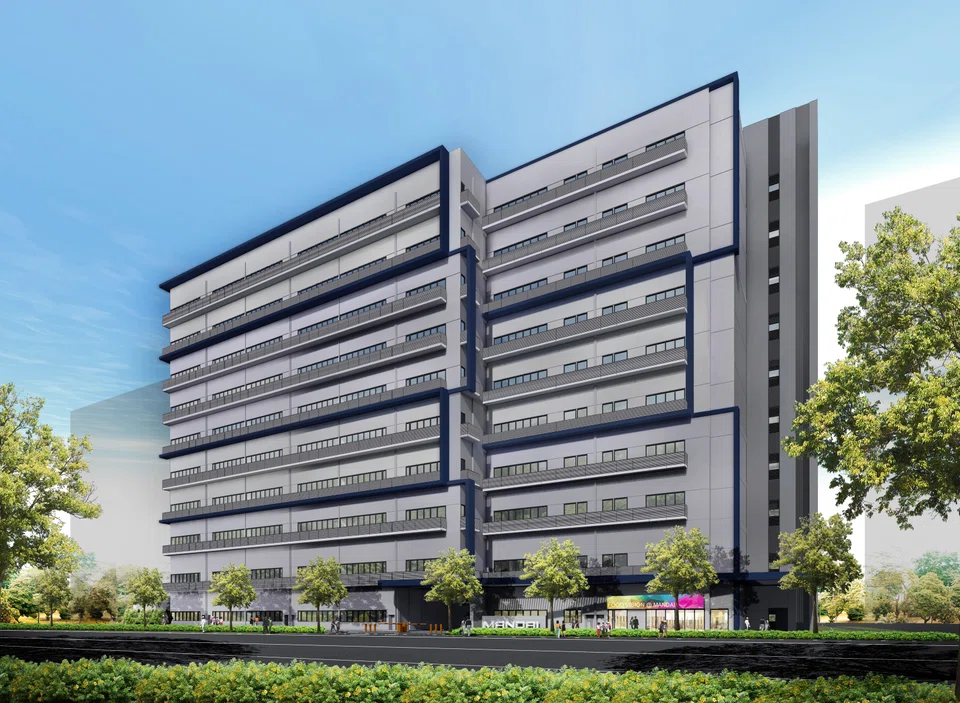
    • An artist's impression of Food Vision @ Mandai., which will have 114 strata food factory units and a canteen unit.
    • An artist's impression of Food Vision @ Mandai., which will have 114 strata food factory units and a canteen unit. PHOTO: MANDAI ESTATE DEVELOPMENT

    THE Kuik family’s Sim Lian Holdings and the Lim family behind Evan Lim & Co are teaming up to redevelop their neighbouring ageing freehold industrial buildings in Mandai Estate into a 10-storey strata ramp-up development for food factories.

    Their joint project, Food Vision @ Mandai, is slated to be launched for sale by year end, The Business Times understands.

    Its total gross floor area (GFA) will be about 32 per cent a third more than the combined existing GFA of the 2 buildings.


    Expected to be completed by end-2025, the project will have a total estimated strata area of 197,937 sq ft, comprising 114 food factory units (ranging from 1,561 sq ft to 1,668 sq ft) and a canteen unit of 1,668 sq ft.

    Food Vision @ Mandai will come up on the 79,175 sq ft freehold combined land area of the 2 properties, which will be sold to a joint-venture (JV) company.

    Construction group Evan Lim & Co is selling its building at 21 Mandai Estate for S$45 million; Chip Tiong Investment, an indirect wholly-owned subsidiary of Sim Lian Holdings, is selling the next-door Chip Tiong Industrial Building at 19 Mandai Estate, also at S$45 million.

    “Food factory space is relatively limited in supply because approval for such use is generally granted only on Business 2-zoned sites, and comes with stringent additional safety requirements. A food factory development is generally not allowed on light industrial/Business 1-zoned sites.”

    JLL’s Tan Boon Leong

    Both properties are being bought by Mandai Estate Development, the JV that will develop the new project.

    The Lim family’s EL Development and Sim Lian Holdings’ fully-owned unit Sim Lian Development each owns a 45 per cent stake in the JV company. The remaining 10 per cent is held by Lim Kim Kang Investment, controlled by the brother and nephew of Evan Lim.

    Evan Lim Building, which is more than 40 years old, is now being used by its owner as a warehouse. The property is grossly under-developed; its existing GFA is not even half the maximum allowed for the site under the Urban Redevelopment Authority’s current Master Plan. The S$45 million sale price for this property is inclusive of a nearly S$3 million development charge that Evan Lim & Co is understood to have paid to the state for the rights to develop the site’s untapped GFA.

    On the other hand, Chip Tiong Industrial Building’s existing GFA is already the maximum allowed for its site. The 7-storey block, built more than 20 years ago, is currently vacant, pending demolition.

    Breakeven cost

    Both properties are on sites zoned for Business 2 use, with a 2.5 plot ratio (ratio of maximum GFA to land area).

    A back-of-the-envelope calculation shows that the S$90 million total land price reflects about S$455 psf of potential GFA, resulting in a breakeven cost of nearly S$1,000 psf for the development.

    Tan Boon Leong, executive director of logistics and industrial at JLL Singapore, expects the strata units in the development to fetch about S$1,300 psf on average. “Similar units in the Paya Lebar location nearer town are selling at S$1,600 to S$1,800 psf on net strata area, excluding void space,” he said. (The units in Food Vision @ Mandai will not have strata void area.)

    Tan points to strong demand for freehold strata factory units from both investors and end-users, citing several factors.

    Firstly , there is more demand for cloud kitchens as home food delivery has gained momentum since the Covid-19 pandemic, especially during the periods when dining out was banned or restricted. While nearly all safe-distancing measures have been lifted, work from home still continues on a partial basis for most organisations, fuelling demand for home food delivery.

    “Food factory space is relatively limited in supply because approval for such use is generally granted only on Business 2-zoned sites, and comes with stringent additional safety requirements. A food factory development is generally not allowed on light industrial/Business 1-zoned sites,” Tan said.

    “Even rarer is food factory space with freehold tenure.”


