

En bloc sale market in 2026 set to be more active, but challenges remain
Pain points for developers include high costs and limited redevelopment potential, say market watchers

[SINGAPORE] After another subdued year for collective sales, the market could see more activity in 2026 as financing costs fall and rules governing the en bloc sale process come under review.
Ageing condominiums put up for sale have struggled to close deals in recent years, with developers reluctant to match owners’ asking prices, preferring to pick up land from the government land sale (GLS) market instead.
There were five successful collective sales concluded this year, although at least 16 attempts were made based on data compiled by Knight Frank for The Business Times.
Since the High Court approved the S$810 million Thomson View en bloc in July, residential deals inked this year have been on the smaller scale.
The 24-unit River Valley Apartments was sold for S$56 million to a family office in February. Chiku Mansions, which comprised nine units, was sold to Macly Group for over S$22 million in September. Starpoint, another nine-unit project, was sold for S$55.3 million to education service provider Stalford International Education in November.
Two industrial en bloc deals were sealed this year: Ching Shine Industrial Building was sold for S$113.2 million, and MacPherson Industrial Complex was sold for S$103.9 million.
The success rate for collective sales in 2025 was comparable to 2024, when four out of 16 deals went through. However, Knight Frank data showed it is significantly lower than the 63 per cent success rate during the 2017/2018 boom cycle.
Collective sale agreements for some developments, including Elias Green and United House, also expired as no buyers were found during the requisite 12-month period.
Challenges
“The bid-ask gap between developers and sellers remains sensitive, especially for residential properties due to the cooling measures that are in place and high construction costs,” said Galven Tan, chief executive officer of Knight Frank Singapore.
Michael Tay, CBRE Singapore advisory deputy managing director and head of capital markets, said that for sites in the Core Central Region in particular, the 60 per cent stamp duty charged on foreign buyers has been a significant hurdle.
“It’s a double whammy where developers struggle to get foreign owners to sign and find replacements, while also worrying about weaker buying interest from foreign purchasers because of that hefty additional buyer’s stamp duty (ABSD).”
Wong Xian Yang, Cushman & Wakefield’s head of research for Singapore and South-east Asia, said sellers face higher replacement costs as housing prices have risen significantly over the years.
He added that developers are cautious about meeting ABSD deadlines when they purchase en bloc sites, which are often more complex projects and slower to get off the ground.
“GLS sites have become the preferred route for land banking,” said Wong. “This is reflected in GLS tenders, where average bidders per site, including executive condominiums, climbed to 5.4 in 2025 year to date, up from three in 2024.”
With developers eager to replenish land bank as new projects sold down quickly this year, state tenders for choice sites saw heated competition – some drew nine to 10 bidders – and chased up bids.
Developers unable to secure sites through the GLS programme may increasingly turn to the en bloc market as an alternative, said Wong.
Easing financing costs may also bring more developers to the market, especially for scarce freehold sites, for which they may be willing to pay a premium.
Founder and executive director of AlpsEdge Real Estate Tan Hong Boon said the lower redevelopment potential of most projects attempting collective sales today is a “fundamental factor” for their limited success.
He noted that many of these residential developments were built after 1990 and have already maximised their allowable gross plot ratio under the Master Plan.
“Given that a developer redeveloping such projects now can only build up to the same amount of gross floor area… the collective sale sites provide limited upside,” he said.
“Many collective sale committees or marketing agents would then resort to proposing a higher reserve price to entice the majority owners to bite, just to find that the reserve price becomes too high for any developer to be interested in.”
Swee Shou Fern, head of investment advisory at ETC, noted how it is important to extensively engage and communicate with owners in a collective sale, to overcome en bloc fatigue or optimism bias.
“Like Thomson View, many developments have experienced multiple failed en bloc attempts. Owners in such developments are generally sceptical about the chances of success,” she said.
“On the other hand, there are also developments attempting (a) collective sale for the first time, and these subsidiary proprietors may (think) the success of a collective sale is a sure thing.”
Change on the horizon
In November, it emerged that the legal framework governing collective sales may be set for change.
In response to queries on talk about lowering the threshold for statutory majority consent required for an en bloc sale to proceed, the Ministry of Law said it continually reviews its policies and regulations to support the optimal use of land resources.
“This includes the collective sale regime under the Land Titles (Strata) Act, which aims to facilitate urban rejuvenation, while also ensuring appropriate safeguards are in place to protect the rights of property owners.”
Several developments are in the midst of preparing to open new tenders for sale.
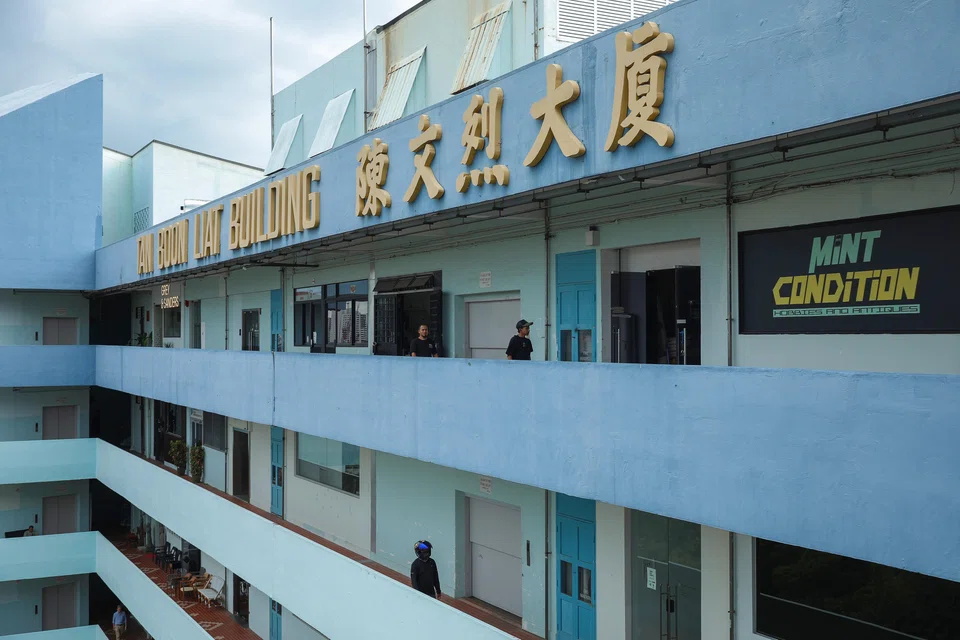
Loyang Valley, which closed with no bids in September, will be put back on the market in January 2026, at an unchanged reserve price of S$880 million. Tan Boon Liat Building, which was first marketed in February 2025 at S$1.15 billion, is also targeting a fresh tender early next year at a lower price of S$1 billion.
A few major developments such as The Centrepoint have crossed or are close to meeting the 80 per cent threshold needed to launch a tender for sale next year. Telok Blangah House is also preparing for collective sale.
However, market watchers expect potential reforms to the collective sale regime to have a limited impact.
A lowering of the threshold would spur a new wave of en bloc attempts with selective success, said Karamjit Singh, chief executive officer of real estate consultancy Delasa.
“Many failed attempts stemmed from inability to reach consensus at viable prices, while smaller developments often found themselves blocked by one or two owners holding 20 to 30 per cent of voting rights.”
Singh said any threshold reduction should be calibrated to building age – for instance, applying 70 per cent only to developments 30 to 40 years or older.
Terence Lian, Huttons Asia’s head of investment sales, pointed out that what developers value more is clarity and predictability, not just in zoning and plot ratio, but also infrastructure obligations.
AlpsEdge Real Estate’s Tan said many potential collective sales of commercial and mixed-use sites in the Central Area may require the exploration of alternative or highest and best uses for the sites.
“Engaging the planning authorities via pre-consultation and the submission of an outline application requires additional effort, expertise, time and money from the owners,” he said. “In this respect, certain improvements or streamlining may be required for the process.”
Currently, owners can apply for outline planning permission only after the 80 per cent collective sale threshold is met. However, the reserve price or redevelopment plans for the project may change depending on the outcome of the application, Tan said.
Looking ahead, ETC’s Swee expects smaller to mid-sized residential sites to draw the most interest, as they are more manageable for developers.
“With many GLS sites coming on stream, most of which tend to be larger and typically yield more than 200 units each, smaller collective sale sites are more palatable, which will also help bridge the gap in land supply.”
CBRE’s Tay noted that a lack of commercial site supply in the Central Business District could drive interest in collective sales for office assets.






