Executive condo sellers in suburbs among top profit gainers in Q2
Overall, sellers are reaping lower gains and average losses are rising as market moderates; biggest losers were prime properties

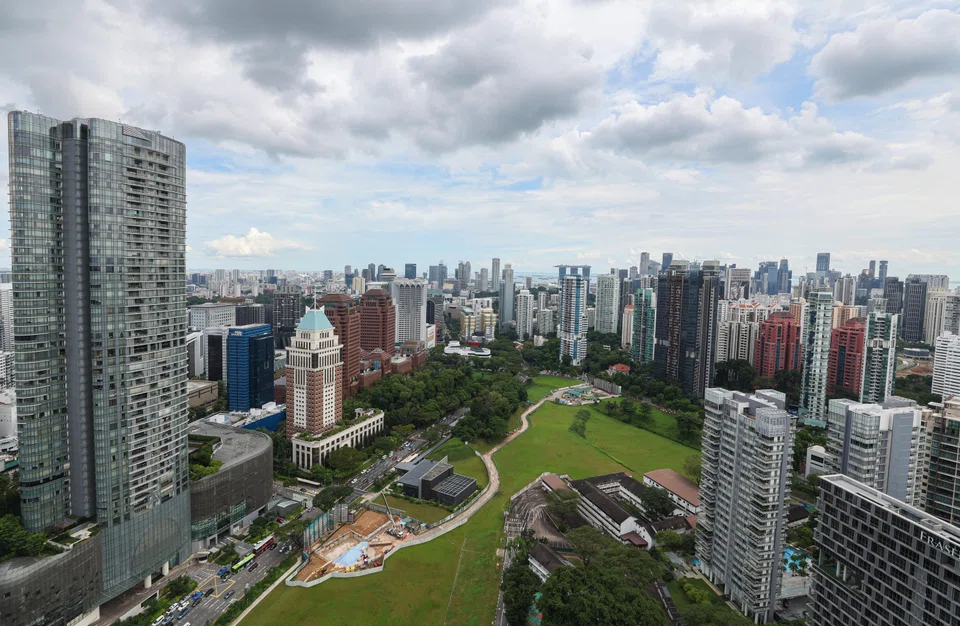
EXECUTIVE condominiums (EC) in the suburbs accounted for four of the five most profitable resale deals by percentage gain in the second quarter of 2023, with properties changing hands for almost double their original price.
And while prime properties chalked up the biggest absolute gains by virtue of their much higher prices, the five biggest losers in Q2 were all sales in prime areas, losing between S$300,000 and S$1.83 million and in value.
Data crunched for The Business Times by real estate consultancy Cushman & Wakefield showed that in Q2, four EC sellers pocketed profits of 86 per cent to 93 per cent after holding their units for an average of 6.5 years.
A 958 square foot (sq ft) unit at Wandervale in Choa Chu Kang transacted for S$1.28 million or S$1,331 per square foot (psf) in May. The seller reaped a tidy profit of 93 per cent over the unit’s original price of S$661,000 (S$690 psf) in April 2016. Based on the holding period of slightly over seven years, annualised profit was 9.7 per cent.
In another deal, a 570 sq ft EC unit at Sol Acres, also in Choa Chu Kang, was sold for S$850,000 or S$1,490 psf in May. From the initial purchase price of S$449,000 (S$787 psf) in April 2017 and the holding period of around six years, the annualised profit was 11 per cent.
The biggest profit-maker by percentage in Q2 was a 1,184 sq ft freehold unit at 303B Tanjong Katong Road in District 15. It was sold for S$1.95 million (S$1,647 psf) in June, for a 111 per cent gain or annual profit of 9.4 per cent from the S$925,000 (S$781 psf) the seller had paid in March 2015.
Cushman & Wakefield studied caveats for non-landed private homes with a prior purchase history between January 2012 and June 2023, and transacted in Q2 2023. It then ranked the top five profit-making and loss-making deals, both by percentage and quantum. The analysis excluded the transaction costs and taxes, such as buyer stamp duty and seller stamp duty.
Total profit from all profit-making deals was 5.6 per cent higher in Q2 at S$811.23 million compared to the previous quarter’s S$768.17 million, the data showed. But the average profit per transaction fell 10 per cent quarter on quarter to S$379,435 from S$421,145. Total losses remained largely unchanged from the previous quarter at S$13.54 million, while the average loss per loss-making transaction rose 29 per cent to S$221,958 from S$171,990.
“While market conditions have slowed, distress in the market remains limited with low levels of loss-making transactions,” said Wong Xian Yang, the consultancy’s head of research. “Nonetheless, with price growth moderating, sellers are reaping lower profits on average.”
In terms of absolute gains, the five biggest money-making transactions in the resale market were all freehold units in Singapore’s prime core central region (CCR). This was mainly due to the relatively higher prices and transacted unit sizes in the CCR, noted Wong.
A 2,799 sq ft unit on the 18th floor of the recently completed Boulevard 88 topped the list. It was sold for S$14 million or S$5,002 psf in April, for a gain of S$3.87 million or 38 per cent over the initial purchase price of S$10.13 million (S$3,619 psf). Based on a holding period of just over four years, the seller made an annualised profit of 8.2 per cent.
All the top loss-making deals – by both quantum and percentage – were in the CCR, bought during “varying periods of the market cycle”, Wong said.
The sale that spilled the most red ink in terms of quantum and percentage was a 1,281 sq ft unit at the freehold condo development Helios Residences in District 9. It changed hands for S$3.15 million or S$2,459 psf in April, losing 37 per cent or S$1.83 million in value from its initial price of S$4.98 million (S$3,890 psf) in November 2012. The seller suffered annual losses of 4.3 per cent, based on a holding period of 10-and-a-half years.
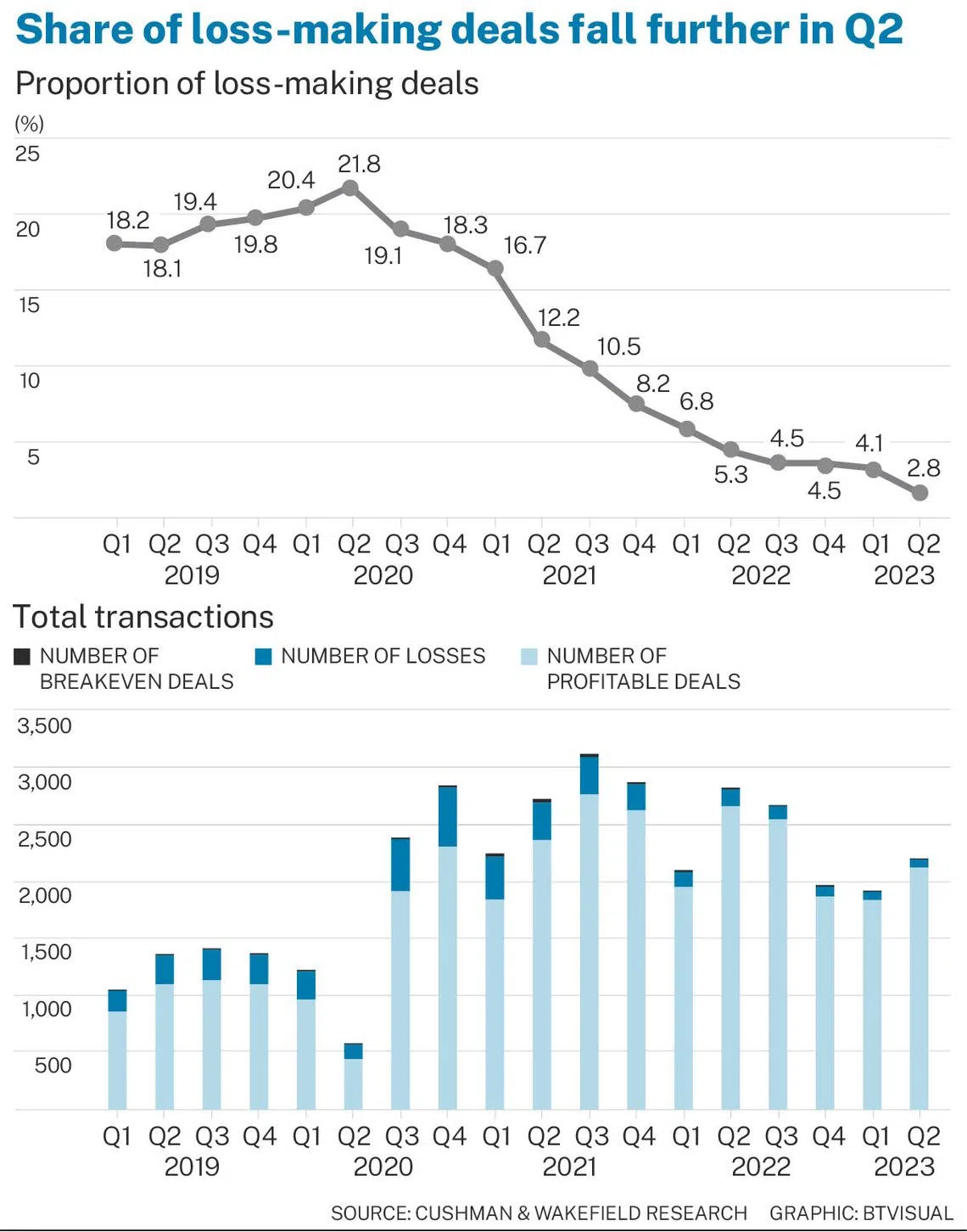
With home prices just starting to come off highs, the proportion of loss-making resale transactions in both landed and non-landed sectors fell for the second consecutive quarter to 2.8 per cent in Q2 – the lowest since Cushman & Wakefield started analysing the share of loss-making deals in Q1 2019.
Demand for residential properties has remained resilient and sellers have strong holding power, Wong said, so they can wait out for a price that is more beneficial to them – rather than exiting at a loss.
But with prime market segments bearing the brunt of recent cooling measures and overall demand tempered, the bulk of loss-making deals were in the CCR at 67 per cent, Wong pointed out. Transactions in the city fringe or the rest of central region (RCR) accounted for 19 per cent of loss-making deals, and the Outside Central Region (OCR) 14 per cent.
The Urban Redevelopment Authority’s flash data for the second quarter of this year indicated that prices of non-landed private homes in the CCR grew by just 4.3 per cent cumulatively in the past decade. That of the RCR and OCR grew by 33.9 per cent and 34.5 per cent, respectively.
Still, “there could be long-term repricing opportunities in the CCR for keen-eyed investors”, said Wong.
The share of loss-making deals may see “a slight uptick” in coming quarters in the current market, he added.
“However – barring an unexpected deterioration in economic conditions – it should remain relatively low this year, supported by a resilient labour market and healthy household balance sheets. This would support prices in the RCR and OCR markets.”