

Fewer residential completions, tight HDB resale supply seen propping up prices in 2025
The 6,974 resale flats expected to hit the market is the lowest in 11 years

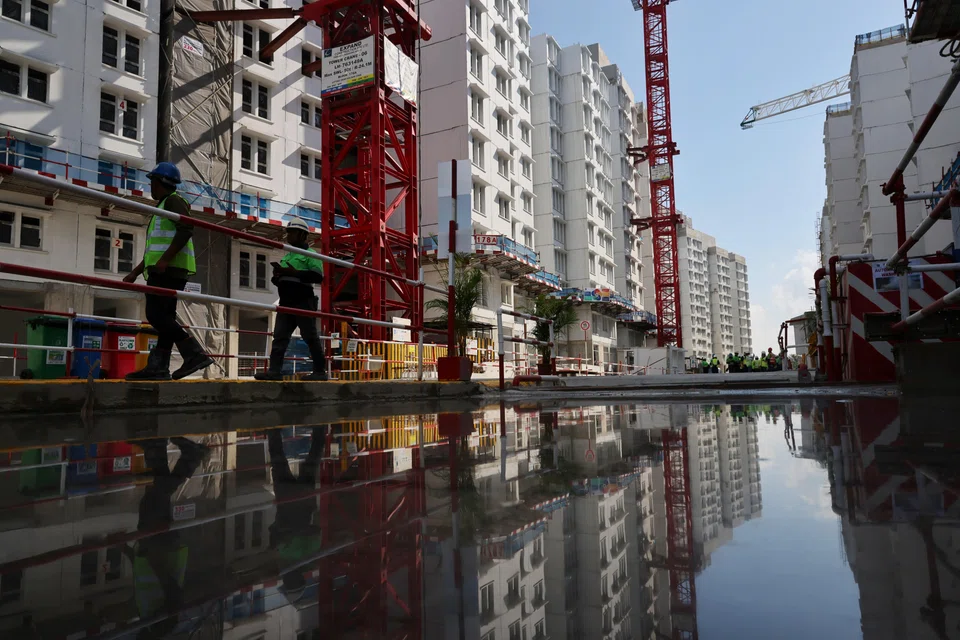
FEWER private residential completions, interest rate movements, and a tighter supply of HDB resale flats reaching their Minimum Occupation Period (MOP) will be some of the factors that may impact Singapore’s residential market in 2025.
These insights were shared at the Building and Construction Authority-Real Estate Developers’ Association of Singapore’s Real Estate Prospects Seminar on Thursday (Jan 23).
In a presentation on the changing trends and new growth areas in the residential market, Christine Sun, OrangeTee Group’s chief researcher and strategist, estimated that 6,974 resale flats are expected to hit the market in 2025 after owners fulfil the MOP. This is the lowest in 11 years since 5,301 units reached their MOP in 2014.
The drop in MOP flats may drive HDB resale prices higher in 2025, but Sun expects supply to recover and more than double to 13,480 flats in 2026.
A similar picture can be seen in the private residential market, where fewer condominium completions are expected to prop up resale and rental prices.
Sun estimates that 5,348 condominium units will be completed in 2025, down 41.3 per cent from the 9,103 units she estimates were completed in 2024.
Buyers will likely turn to the new launch market, as seven large projects with more than 500 units each are expected to launch in 2025, Sun said.
On Thursday, real estate market watchers and built environment leaders also shared their views on how the sectors can better collaborate and digitalise, as well as their outlook for the real estate market in Singapore.
Delivering the opening address, Minister for National Development Desmond Lee said: “Homebuyers should continue to exercise caution and be prudent when making property purchases because those who buy high in the property cycle – especially at prices above market valuation – may be hit hardest when the market cycle comes down.”
He noted that the economic outlook was not altogether certain, with domestic mortgage rates expected to remain elevated and the global economy potentially facing disruptions arising from geopolitical and trade frictions.
Should the United States impose tariffs on China, Singapore may be affected as it trades “quite a fair bit” with both countries, said Selena Ling, OCBC’s chief economist and head of global markets research and strategy.
“We don’t run a trade deficit against the US and we actually have a free trade agreement with the US so hopefully that means we are not the target of any initial tariffs,” Ling said.
She expects Fed rates to ease at a slower pace in 2025 compared to the 100 basis points of back-to-back rate cuts delivered in 2024. This is consistent with the Fed’s stance to bring interest rates nearer to neutral levels over time.
While there are still uncertainties and potential headwinds, the interest rate environment is starting to look like it will improve, said, Michael Tay, CBRE’s deputy managing director and head of capital markets in Singapore.
According to CBRE’s 2025 Asia Pacific Investors Intentions Survey published in January, net-buying intentions among real estate investment trusts in 2025 rose to 22 per cent, from negative 13 per cent last year. Developers, however, are expected to be net neutral investors due to significant increases in construction and labour costs, he said.
In Singapore, where market fundamentals are strong and supply is tight, investors who are looking at long-term investments may “start to come back and look at the office market again” especially for core assets, Tay said.
Alan Cheong, Savills Singapore’s executive director of research and consultancy, believes that in 2025, CBD Grade A office rents are likely to be flat.
While CBD Grade A offices are still in demand by companies which want a prestigious address and easy access by staff, this does not mean that net demand will be strong, he said.
“The pain this year will still be felt among technology companies as they are the first to restructure to improve productivity and left saddled with excess legacy space. Business and science parks will be the first to be impacted by this,” Cheong said.
The industrial and logistics sector will continue to be preferred, although Tay said investors may be cautious over pricing as there is a possibility that rents may not grow at the same pace as they did over the last few years.
Tay said: “As one of the few asset classes that delivered positive carry when all-in rates ranged between 4 and 5 per cent, the fact it could achieve a yield of between 6 and 7 per cent in this sector made it very attractive to investors.”
Investors are also very keen on living sector assets in Singapore given its status as a business hub, tourism recovery and plans for Changi Airport Terminal 5 which is expected to deliver more passenger traffic.
While a gap remains between pricing and what investors are willing to pay, Tay believes that gap will narrow and transactions will start to flow.
TRENDING NOW

Singapore identifies 7 firms responsible for haze fires, notices issued urging action: Grace Fu

Philippine power giant First Gen rebuffs foreign offers, plans up to US$2.6 billion in expansion
DBS remains analysts’ pick ahead of Q3 earnings after Singapore banks’ share slump
Indonesia imposes US$116 million in fines over manipulation of Sinar Mas, Prajogo-linked stocks

