

Flex office space market rebounds in Q3, further growth seen despite economic headwinds: CBRE

Ry-Anne Lim
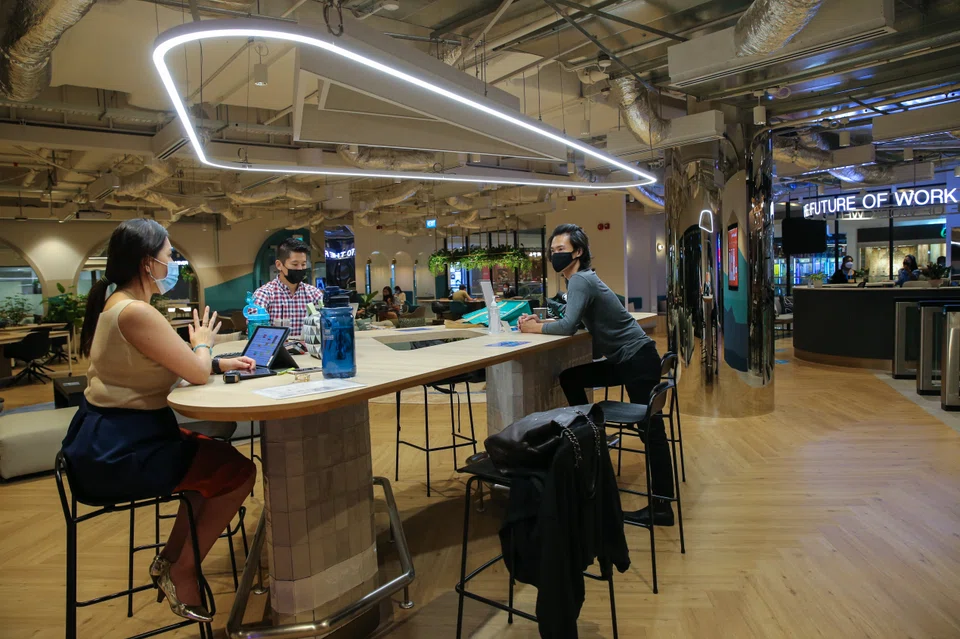
FLEXIBLE workspaces are back in business post-pandemic, with further growth “imminent” despite rising economic headwinds, according to real estate consultancy CBRE Research.
In a report on the flex space sector released on Friday (Nov 25), CBRE noted that occupancy at flex space centres recovered to a “healthy (average) level” of 80 to 90 per cent by the third quarter of 2022, from the average of 50 to 60 per cent during the pandemic. This has, in turn, encouraged operators of such office properties – including serviced offices as well as co-working space – to “source for new sites, leading to renewed growth in the flex space market”, said CBRE.
There is also a return of confidence in the flex space market, noted CBRE, with leasing volume of operators amounting to 150,000 square feet (sq ft) between January and September 2022, well beyond 2021’s entire volume of 120,000 sq ft.
Based on the consultancy’s latest occupier survey, 17 per cent of respondents said flex spaces will account for 26 to 50 per cent of their portfolio by 2024, from the current 3 per cent; and almost all companies said they will have “some sort of flexible work arrangement” by 2024.
The same survey discovered that companies might opt for flex spaces instead of traditional leases as a short-term space solution for a temporarily dispersed workforce, a solution for uncertain demand, or as part of employees’ flexible working arrangements.
Such solutions might be attractive for the tech industry amid global mass layoffs and hiring freeze, CBRE said. “Flexible workspace could become a pivotal solution for the industry as occupiers will require more flexibility and use this period of uncertainty to plant out their real estate growth,” it pointed out.
CBRE noted further that flex spaces are more competitively priced and require lower upfront costs –in terms of fit-out costs and security deposits – than traditional leases, reducing overall capital expenditure.
The typical price for a flexible hot desk membership within the central business district (CBD) is about S$350 to S$450 per desk per month, CBRE found. In the core CBD, the average price of a private suite goes up to about S$900 to S$1,000 per desk per month. This translates to about S$10 to S$11.10 per sq ft per month, assuming each desk takes up about 90 sq ft of office space.
In comparison, average CBD Grade A office rent is around S$11.60 per sq ft per month as at the third quarter of 2022, and could continue to rise in the next few years, according to CBRE.
The consultancy noted that banks, family offices and private wealth asset managers have now adapted to these “flex enterprise solutions”, with the banking and finance sector accounting for 50 per cent of corporate demand between the first quarter and Q3 this year.
While growth in the flex space market is “imminent”, CBRE cautioned that overall demand for office spaces could fall off in the short-term due to “rising global economic headwinds and more conservative corporate real estate demand”.
In the longer term, however, CBRE expects flex spaces to grow in prominence as one of the “core tenant sectors” in the local office market, with the potential availability of upcoming new and secondary spaces in the market providing room for growth – making now a good opportunity for operators to acquire new sites and expand.
Within the near future, Guocoland’s Network Hub building at City Hall will include 80,000 sq ft of flex space when it opens in the fourth quarter of 2022. JustCo’s International Plaza at Tanjong Pagar and The Work Project’s Six Battery Road at Raffles Place will each feature 50,000 sq ft of co-working space in Q4 too.
Sidharth Dhawan, senior director of agile real estate services at CBRE Asia Pacific, said: “These are interesting times for the sector.” He added: “Viewing it from a supply perspective, flex spaces will continue to play a vital role in landlords’ amenity strategies. When it comes to demand, flex spaces will complement a variety of occupier use cases, including headcount fluctuation, capital expenditure avoidance, and hybrid office strategies.”
TRENDING NOW

Singapore government slaps loan curbs on individual private-hire car buyers

If Europe goes to war, the fallout will be felt in East Asia
The grid is the transition: Why Asean’s next energy challenge is coordination

Indonesia stocks suffer worst plunge in nearly 30 years as MSCI proposes standalone status

