

Flexi-work leaves San Francisco trailing NYC in office comeback
Tech tenants' flexibility and spreading Delta variant stall momentum
Seattle
A FIFTH of all office space vacant. Tech companies looking to offload millions of square feet they had previously leased. Rents down 14 per cent.
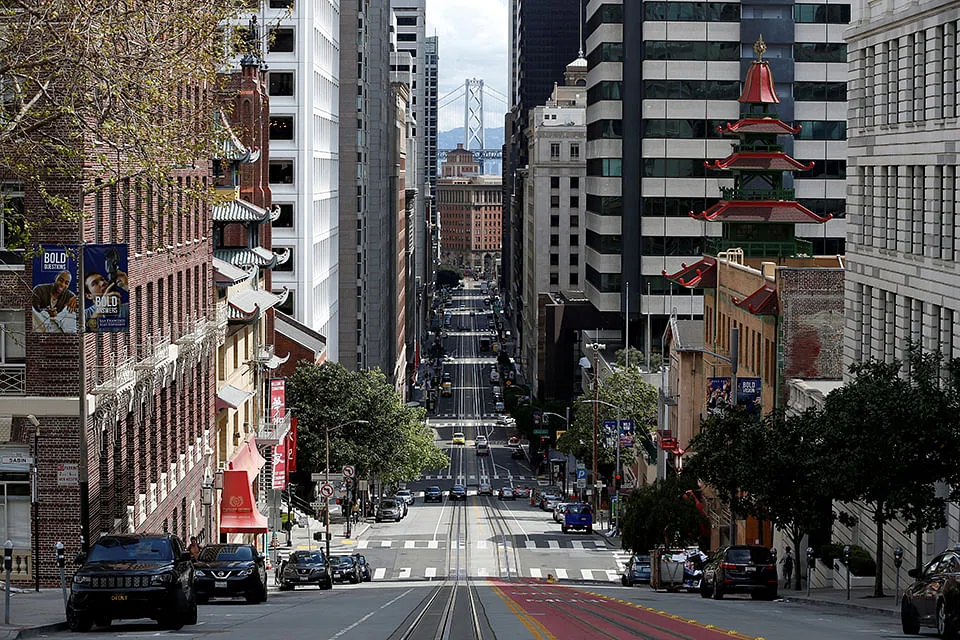
The San Francisco office market, once among the most expensive and sought-after in the US, fell harder than just about anywhere in the country during the pandemic. Now, it is getting left behind as other major cities see faster recoveries.
With a high proportion of employers allowing workers to do their jobs remotely, available office space in San Francisco keeps piling up - with potentially huge ramifications for downtown small businesses, apartments and the local tax base. And, as the Delta variant spreads, what momentum companies had in returning to the office is slowing.
"The tech tenants in San Francisco have been very flexible about working from home," said Ryan Masiello, the co-founder and chief strategy officer at property data firm VTS, which tracks office tours. "That's probably one of the biggest drivers impacting demand."
Already, Apple and Google - which employ thousands of people in the Bay Area - have pushed back their return-to-office dates, even as Wall Street banks such as Goldman Sachs and JPMorgan go ahead with getting workers into their Manhattan skyscrapers. San Francisco-based Lyft is not calling employees back until next February, while Twitter shut its offices soon after reopening.
Boston Properties, one of the largest owners of top-tier office space in the US, said on an earnings call on July 28 that card swipes to access its buildings in San Francisco still trailed other markets, including New York and Boston. The same day, landlord Equity Residential said apartment demand is hurting from companies' "ambiguous" return-to-office plans.
New York's office market is still in a tenuous recovery, with lots of availability and many companies looking to sublease space. But interest from prospective tenants suggests something has shifted, as more employers eye a return to workplaces. In June, the city had reached 98 per cent of pre-pandemic averages, according to VTS. Los Angeles climbed to 99 per cent.
In San Francisco, tenant interest is just 68 per cent of pre-Covid levels - up significantly from a year ago, but still the lowest among seven cities VTS tracks. That includes Seattle and Boston - which also have a high proportion of remote-friendly jobs.
The tepid demand is colliding with a glut of space, as companies including Twitter, Uber and Salesforce market offices they no longer need.
San Francisco's vacancy rate topped 20 per cent at the end of the second quarter, the highest level since 2003, according to JLL. Direct asking rents are down 14 per cent since their peak at the end of 2019, to US$79.93 a square foot.
The subleases hitting the market slowed in the second quarter and some firms have decided to reoccupy space they had previously marketed. VTS data also show that demand from tech tenants doubled from the first quarter to the second, and they were seeking slightly larger spaces on average.
Yet, the city's vast amount of available space is quite a comedown for a market where tech giants like Facebook and Google used to vie for huge leases, sometimes even before buildings were finished.
In a report recapping second-quarter activity, brokerage Newmark Group called out several noteworthy leases. Few were household names. Among them: a nearly 100,000 sq ft (9,290 sq m) deal by a company called Figma and another 54,000 sq ft agreement by Sigma Computing.
"The bulk of the demand is really coming from the unicorn, pre-IPO, set," said Elizabeth Hart, a vice-chairman at Newmark. "Many of them left the office markedly different companies than they are now."
Some early-stage tech companies have grown so much during the pandemic that they cannot return to their previous offices, she said.
Bigger tech companies are likely to come back - eventually.
Both Facebook and Google kept their space in San Francisco during the pandemic and have been rumoured to be touring properties recently, said Nick Slonek, a principal and managing director at broker Avison Young, who has worked in the city for three decades.
"No one is giving up on San Francisco," he said. "We've been slow to recover, but I know personally my book of business is as busy as ever."
A spokeswoman for Facebook, which has leased two office towers in the city in the past four years, said the company is "always evaluating our facilities and real estate needs" but does not comment on rumours. A Google spokesperson declined to comment.
The Bay Area still remains a key place for the tech industry to recruit employees. That should remain true, even as some of the largest companies expand in Texas, New York and elsewhere. And falling rents may even draw in more companies that had balked at paying the city's high prices.
"This is a good time to be opportunistic," said Alexander Quinn, director of research for Northern California at JLL. "This is one of those few moments in San Francisco where it's a tenant-favourable environment." BLOOMBERG
Decoding Asia newsletter: your guide to navigating Asia in a new global order. Sign up here to get Decoding Asia newsletter. Delivered to your inbox. Free.
Share with us your feedback on BT's products and services
TRENDING NOW

Grab executives buy back shares after stock hits 3-year low on Atome deal
Simba admits exceeding spectrum limits amid failed M1 deal; parent company Tuas’ full-year profit surges 277%

He built the Vingroup empire. Now South-east Asia’s richest man is handing some key roles to his sons
StarHub, Keppel confirm talks over potential M1 deal

