A fresh start for Jurong Lake District with Town Hall Link site released
Government to invest in key infrastructure to reduce uncertainties for developers; project will add at least 40,000 sq m of new office space

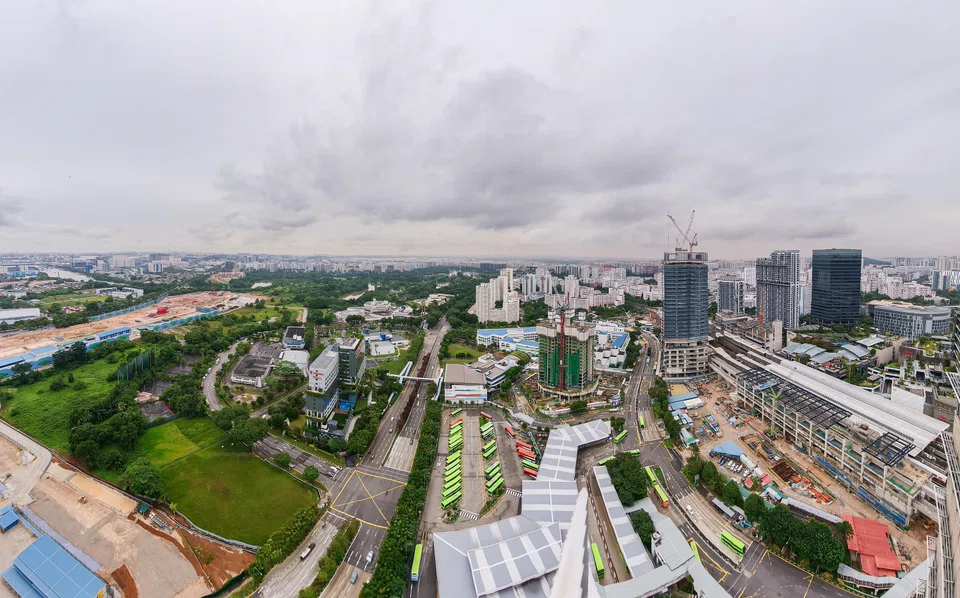
[SINGAPORE] The Urban Redevelopment Authority (URA) has released the first Jurong Lake District (JLD) plot, carved out of a massive area previously tendered for a master developer project, with a white site along Town Hall Link put up for sale from its reserve list.
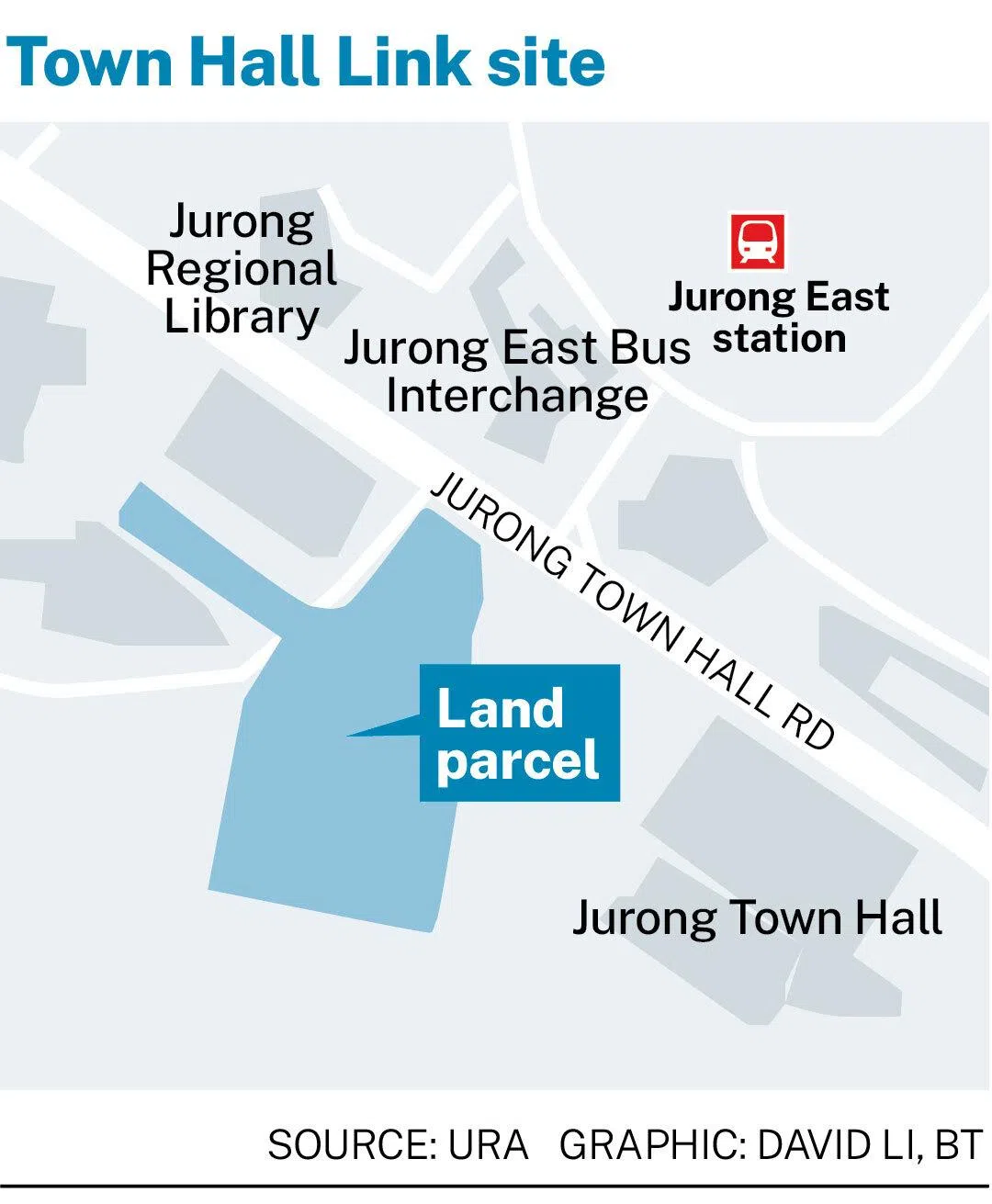
The 3.7 hectare (ha) site was parcelled out of a 6.5 ha site offered in 2023. The master developer tender was not awarded when it closed the following year because the sole bid of S$2.5 billion was deemed too low.
The release of the scaled-down site, along with the government now undertaking key infrastructure works, marks a restart of plans to build the largest mixed-use business district outside Singapore’s city centre.
In all, JLD will eventually supply 1.4 million square metres (sq m) of office space, in what will be “a key pillar of our decentralisation strategy to bring good-quality jobs and amenities closer to homes”, the URA said.
Interest in the site will hinge on demand for office space in the suburban market, where retail malls and condo projects have typically been successful.
The Town Hall Link project will add at least 40,000 sq m (about 430,000 square feet) to some 200,000 sq m of existing office space in the Jurong Lake area.
Private office space in the Jurong East planning area registered an occupancy rate of 87 per cent in Q4 2025, up from the pre-Covid average of 80 per cent in 2018 and 2019, said URA.
Singapore’s Central Business District (CBD) houses 5.2 million sq m of office space in the Downtown Core region. A push to move commercial activity – and jobs – outside the CBD brought 130,000 sq m of office space to Tampines, 70,000 sq m to Woodlands, and 200,000 sq m to Paya Lebar Central.
After considering feedback from developers since the master developer tender, URA has planned for the carved-out site to yield a gross floor area (GFA) of 186,139 sq m, with a gross plot ratio of five.
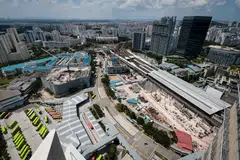
While it is about half the size of the originally planned master developer site, the Town Hall Link site is large enough to catalyse development of the precinct with critical mass maintained, and cater to medium-term growth in demand for housing and offices, URA said.
Some government agencies are looking into moving their offices to JLD, Singapore’s urban planner added in a statement on Monday (Mar 16).
A minimum of 40,000 sq m of office space is required on the Town Hall Link project, which is a volume of office space roughly equivalent to the upcoming Shaw Tower in Beach Road.
Another 20,000 to 44,000 sq m must be set aside for retail, and up to 102,000 sq m for a residential development for an estimated 1,200 homes; 24,000 sq m may be developed as serviced apartments.
The remaining GFA can be used to develop more offices or hotels, or facilities for complementary uses, such as sports and recreation or civic and community purposes.
Demand for new office space
Office demand in Jurong East is firm and the occupancy rate resilient, because of a lack of new supply over many years, said Tricia Song, CBRE head of research for Singapore and South-east Asia. The newest major completed office tower in the area is Westgate Tower.
“Injection of a significant office supply may take some time to absorb,” she added, pointing to a key motivating factor being the rent differential.
As at Q4 2025, CBRE data pegged the average CBD core Grade-A rent at S$12.30 per square foot (psf) a month; decentralised Grade-A rent averaged S$8.45 psf a month, putting the rent differential at about 31 per cent.
The 10-year historical average for the rental gap between CBD offices and those in decentralised office locations is about 50 per cent, narrowing with newer decentralised projects hitting the market, said Catherine He, Colliers Singapore head of research.
“Over the next four years, with sustained occupier demand and limited supply in the CBD, rents are expected to continue strengthening. This will likely widen the gap and support the outflow of demand to Singapore’s second CBD in JLD,” said Dr Chua Yang Liang, JLL head of research and consultancy in South-east Asia.
Still, rental savings alone will not sufficiently drive relocations, said He. Factors such as convenience and additional operational complexity play a part.
Desmond Sim, group chief executive of Realion (OrangeTee & ETC), described demand for decentralised offices as “still quite healthy”, as they allow occupiers who do not need a central location to save on costs.
Firms are increasingly adopting hybrid-office strategies by maintaining a city-centre presence for client-facing functions and moving back-office functions to lower-cost locations.
Office rents in the city centre are hovering at S$15 to S$16 psf a month, whereas rentals at JTC Summit, a 31-storey office tower on Jurong Town Hall Road, are at S$5 to S$5.50 psf a month, he noted.
How challenging the business case will be depends on whether the developer can position the end-product effectively to attract potential tenants and buyers, said He.
“The integrated nature of the project gives the developer the ability to capture value from residential and retail components to trade off against lower office yields.”
The government’s commitment to develop the area, such as getting government agencies to consider moving to JLD, can sustain the depth of future demand, said He.
Buildings that cost the same to construct and maintain, but command lower rents tend to have thinner operating margins and longer break-even timelines, increasing development risk, said Song.
However, with the government fronting some infrastructure costs, part of the development risk would be mitigated.
“The land cost is the balancing item to make the numbers work for the master developer,” she said.
Sim added: “The west has a very large base of public and private housing, and there’s demand not just for retail, but for medical-related uses as well – be it clinics, testing centres or elderly care facilities.”
The original master developer site encompassed three plots of land for at least 1.5 million sq ft (about 140,000 sq m) of office space, up to 1,700 homes and close to 800,000 sq ft of space for other uses such as retail, as well as food and beverage.
A consortium of five real estate heavyweights – CapitaLand Development, City Developments Ltd, Frasers Property, Mitsubishi Estate and Mitsui Fudosan (Asia) – had put in a bid of about S$2.5 billion, or S$640 psf ppr, which was deemed too low.
Following that tender, the government engaged with industry extensively to gain perspective, The Business Times understands.
Infrastructure works
The government will now carry out key infrastructure works to reduce uncertainty for developers, a major concern that surfaced.
These include removing decommissioned roads and diverting services, demolishing state properties, building an underground link to the upcoming Cross Island Line (CRL), a covered linkway to the Jurong East MRT station and new roads.
The developer will be required to build an elevated pedestrian link, a district cooling system plant, a central station for the district pneumatic waste conveyance system, and fit out an underground pedestrian link to the CRL station.
Works to prepare the land are already under way, including demolition by URA and construction related to the upcoming CRL station.
The Town Hall Link site sits south of the Jurong East MRT station and the Jurong Gateway commercial hub, where Westgate, Jem and IMM malls are located.
The former JCube mall is being redeveloped by CapitaLand Development into the 40-storey mixed-use project, J’den.
The Town Hall Link site being released via the reserve list gives potential tenderers time to study the revised planning and tender requirements, said URA. It will be put up for tender only if a developer submits an offer of a minimum price that is acceptable to the government, or if there is sufficient market interest.
Progress in the precinct
Several key development projects, such as Jurong Gateway Hub and the new Science Centre, will be completed in the coming years. The Jurong Region Line stations are expected to open in 2028 and the CRL stations, in 2032.
The Taman Jurong public housing project, with five 40-storey blocks totalling around 1,844 units, is slated for completion in 2029, adding to the 2,000 residential units around the Jurong East MRT station.
Decoding Asia newsletter: your guide to navigating Asia in a new global order. Sign up here to get Decoding Asia newsletter. Delivered to your inbox. Free.
Copyright SPH Media. All rights reserved.