

Green standards of office buildings a top priority for relocating companies
Other key factors include location and cost, as well as future-proofing workplaces

AS BUSINESS needs change, some companies relocate from one building to another, even though hefty costs are involved. For instance, a business may change addresses because it is expanding and has a larger headcount.
However, an increasingly important driver behind a relocation could be the pressing need to meet certain green standards.
After over four decades at Hong Leong Building in Raffles Place, professional services firm KPMG moved in 2022 to its current premises in Asia Square Tower 2 – a short walk away.
KPMG’s former managing partner in Singapore, Ong Pang Thye, said the company was able to reduce about half its office space’s carbon footprint after doing so. (*see amendment note)
This was possible due to measures such as a reduction in space, initiatives to cut electricity consumption by using motion sensors, and utilising energy-efficient equipment.
Alan Cheong, executive director for research and consultancy at Savills Singapore, said the trend of companies looking to move to newer and better ESG (environmental, social, and governance)-rated buildings began around the start of the Covid-19 pandemic in 2020.
However, “so far, there have not been any moves by large multinational companies (MNCs) to relocate because their leases are due for renewal mostly in 2025 and 2026”, he said.
More companies are embracing ESG because the transition to hybrid work during and after the pandemic gave them greater flexibility in their workplace strategy, which has enabled them to right-size to better-quality offices, including ESG-compliant ones within a similar budget, said Jeryl Teoh, co-head of commercial leasing at Cushman & Wakefield (C&W) Singapore.
Typically, the greater focus on ESG credentials of real estate among large global organisations leads them to newer buildings where ESG considerations have already been built into the design of the asset.
Amid the global push towards net-zero carbon emissions, companies are increasingly pressured to select office spaces that meet their ESG requirements, noted Chua Yang Liang, head of research and consultancy at JLL. “However, in this current cautionary cost environment, ESG compliance is often not the sole motivation (factor).”
While improved sustainability performance may have driven KPMG’s relocation, there are other factors that matter, including quality, cost, location and space requirements, said David Fogarty, head of ESG consulting and sustainability services, and David McKellar, head of office services, both from CBRE.
Market watchers whom The Business Times spoke to also highlighted reasons such as the health and well-being of employees, and the need to future-proof their workplaces as key considerations for companies when relocating.
These organisations tend to identify assets that support the enhancement of such social factors, and are typically drawn to better-quality buildings that happen to have higher levels of green certification.
Kamya Miglani, head of ESG research at JLL, said office occupiers have many choices when leasing green-certified buildings. The property consultancy firm said over 90 per cent of the current Grade-A office stock in Singapore has been green-certified.
“With such a high availability of BCA (Building and Construction Authority) Green Mark-certified stock, the occupiers may or may not be paying a premium in the Singapore market,” she said.
Referencing data from CBRE’s recent Singapore Office Occupier survey, Fogarty and Tricia Song, CBRE’s head of research for South-east Asia, said among those office occupiers willing to pay a green premium, 67 per cent said they were willing to pay a premium of under 5 per cent; a third said they were willing to pay a premium of 10 per cent or higher.
Occupiers expect to pay lower rents for buildings that do not meet the ESG requirements. CBRE estimates the “brown discount” to be up to 5 per cent for buildings of similar location, age and amenities.
The average occupancy rate for Green Mark-certified office buildings in the Central Business District remained 2 to 4 per cent higher than that of non-certified ones, noted Wong Xian Yang, head of research for Singapore and South-east Asia at C&W.
While Grade-A office properties predominantly have achieved higher Green Mark certifications, this is not the case for Grade-B stock. Average rents at Grade-B office buildings with green credentials are 8 to 10 per cent higher than those without the certification, and this rental gap has increased over time, said C&W’s Wong.
He noted that the rental growth of Grade-B properties without the green rating was slower –at an average annual growth of 0.2 per cent between 2016 and 2023, versus the 1 per cent growth for green-certified buildings in the CBD.
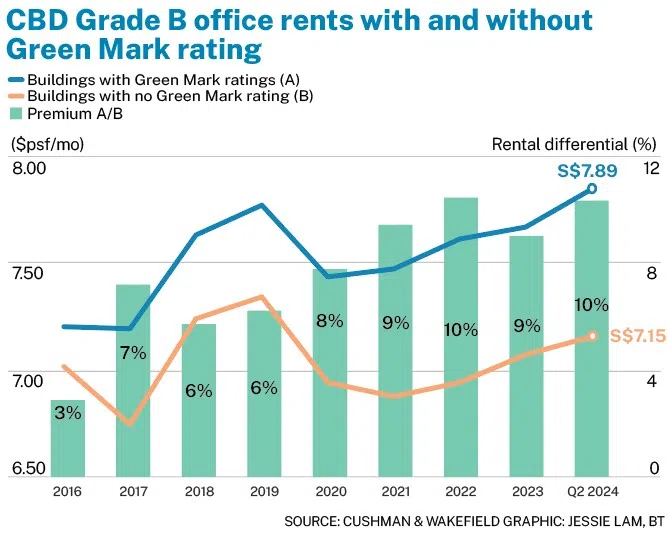
CBRE’s Fogarty pointed out that although the overall rental performance of Grade-B stock has lagged that of Grade-A stock, it is difficult to attribute the higher vacancy and lower rents to non-ESG compliance alone.
Some office buildings along Shenton Way, Tanjong Pagar and Robinson Road, which were built in the 1980s or 1990s, may be regarded as obsolete in today’s context. C&W’s Teoh said such buildings that do not meet tenants’ sustainability criteria face leasing challenges and higher vacancy risks, as well as even lower rents.
Nonetheless, JLL’s Chua noted that these buildings can still draw tenants due to their lower rental costs.
With the rising demand for ESG-compliant buildings, Chua said owners of older buildings could tap current government incentives such as the Green Mark Incentive Schemes or the CBD Incentive Scheme to refurbish or redevelop their older office stocks to stay competitive and relevant.
City Developments Limited (CDL) has upgraded all its existing office buildings to the latest Green Mark standard, said the company’s spokesperson. For example, Republic Plaza and King’s Centre, among their older assets, have been upgraded and retrofitted to improve their energy-efficiency.
CDL also has a City Green Tenant Bonus programme, which aims to encourage tenants to adopt sustainable practices and reduce energy consumption. The programme debuted in July 2024, said the spokesperson.
Over at Hong Leong Holdings, Hong Leong Building has received the BCA Green Mark Platinum certification and has been retrofitted for energy efficiency, water conservation, waste reduction and use of sustainable materials, said its spokesperson. The developer is now carrying out asset-enhancement works to the property, and planning to complete it at the end of 2025.
Developers in Singapore often pursue Green Mark certification not only for compliance, but also because it is a way to show their commitment to sustainability, access green-financing options, and meet the expectations of stakeholders and tenants who prioritise ESG criteria, said Nicholas Tan, head of commercial, property management at JLL.
Besides the BCA Green Mark, other voluntary certifications such as LEED, the WELL Building Standard, SmartScore and WiredScore are being pursued by some building owners to enhance their sustainability credentials, he added.
Amendment note: An earlier version of this story did not indicate Ong Pang Thye as the former managing partner of KPMG Singapore.
TRENDING NOW

Government to bring forward raising of retirement age, give employers more financial support to create flexi-load jobs

If Europe goes to war, the fallout will be felt in East Asia
Former minister Maliki Osman, Revolut chairman join Asia Gulf Holdings advisory board

Small nuclear reactors could boost the Asean Power Grid: GE Vernova executive

