

Havana property boom only for Cubans, for now
Havana
A FEW hours and a mojito or two after arriving in this 500-year-old city, with its ocean vistas and dazzling architecture, American visitors often ask: Can I buy a piece of this?
They cannot. The Cuban government doesn't allow it. The US government doesn't allow it. Not yet, at least.
But with the two countries moving to restore diplomatic relations and end decades of estrangement, it is not difficult to imagine a day when pent-up global market forces will wash over this city's sagging buildings and mansions in distress. Cubans are already angling to get ahead of the flood.
Three years after Raul Castro cast aside decades of communist housing dogma and allowed homeowners to buy and sell their properties for the first time since the 1960s, the island's real estate market is proving to be a powerful engine of economic and social change.
"It isn't only the ability to buy property," said Magda Mora, 39, who returned to Havana in 2012 after 14 years in Italy and Miami. "It's buying property that can be used for a business."
Ms Mora bought a 3,300-sq-ft duplex in the heart of the city's Vedado neighbourhood, renovated it and now lives upstairs with her family, converting the lower unit into a mini hostel. It has five rooms that rent for US$35 a night each, earning good reviews on TripAdvisor.
Anyone who has driven around Havana has seen that a tremendous amount of wealth was invested in stone, marble and mahogany in the years between Cuba's founding as a republic in 1902 and Fidel Castro's takeover in 1959. Few cities in the Americas can compare.
Wealthy and middle-class Cuban families who fled for the United States saw their homes expropriated by the government. Many went to poorer Cubans or the caretakers that the wealthier families had left behind. The city's exclusive neighbourhoods became racially mixed, and Havana became a much more "heterogeneous city", according to architect and city historian Miguel Coyula.
Today, many of those families are selling, finding themselves suddenly in possession of a valuable asset. But that trend appears to be re-gentrifying the city along racial lines and class divisions, particularly because lighter-skinned Cubans are more likely to have relatives abroad with money to invest.
Castro's 1960 housing reform led to a ban on property sales and a decree that no Cuban could possess more than one urban dwelling while converting hundreds of thousands of renters into owners - albeit owners who couldn't sell. Although Cubans were allowed to "swap" houses in deals that often involved under-the-table cash, the lack of a formal market and government restrictions on private home construction worsened the shortage.
The problem is exacerbated by a supply crunch, as the Cuban government consistently falls short of its housing-construction goals. More than 130,000 city residents are living in shelters or substandard housing, according to government data. Migrants from poorer eastern Cuba settle in shantytowns on the city's edge or crowd into crumbling urban tenements that the real estate boomlet has yet to reach.
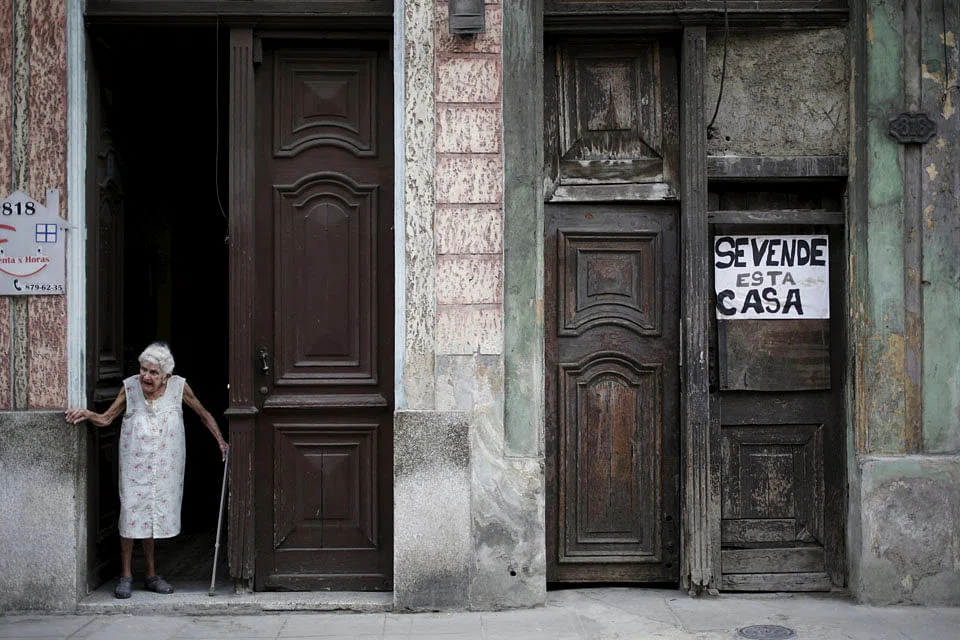
Meanwhile, elderly Cubans whose children left the island remained in large homes they couldn't afford to maintain.
Market forces are now fixing such absurdities, brokers say, allowing older Cubans to easily downsize and get the cash they need to live on, while new investors are transforming tattered properties into boutique hotels before an American tourist surge hits.
Significant restrictions remain. Cubans are limited to one property in the city and one vacation home. Titleholders must be Cuban citizens or permanent residents, not foreigners. The deals are almost always done in cash, and the transactions must pass through Cuban banks, though buyers and sellers often agree to exchange additional sums outside the country to minimise tax payments.
Communist authorities are in the game too, building high-end condominiums for sale to non-Cuban buyers, with plans to erect more alongside golf courses and yacht marinas in partnership with Chinese investors.
At a deeper level, Castro's limited real estate liberalisation has brought a sea change in Cubans' regard for their homes, transforming them from yet another domain of state control into a tangible asset whose value needs to be preserved, if not improved.
The reform is even altering the relationship between local government officials and Cuban property owners, who are no longer passive about broken sewer pipes, uncollected garbage and perpetually neglected city parks.
"People see that the value of their homes is related to their surroundings," said Nery Galindo, who obtained a licence as a private real estate broker as soon as the government legalised the trade in 2013. Her company, Espacio Cuba, has two offices in Havana and a website in Spanish and English with photo galleries and a database of properties listed for as much as US$650,000.
Similar sites have advertised 1940s- and '50s-era mansions for more than US$1 million. The phrase "capitalist construction", referring to properties built prior to Castro's revolution, is used as shorthand for "quality". Most of the listings are in Havana's most desirable districts, especially Vedado and Playa. A typical three-bedroom, two-bath apartment in those neighbourhoods sells for about US$60,000, while detached houses there are often listed for US$100,000 or more.
That's a fortune in a country where the average government salary is stuck at US$20 a month. But those Cuban workers aren't the target demographic, unless they're the ones selling. With salaries that low, many of them are - especially if they live in Havana's more coveted districts.
Brokers say many of the new buyers are Cubans who, like Ms Mora, left the island and want to regain a foothold or secure a cheap place to retire. This appears to have the indirect political consequence of making them stakeholders who prefer a gradual evolution in Cuba rather than an upheaval that would hurt their investment. WP






