Heritage black-and-whites: The cost versus value of their conservation

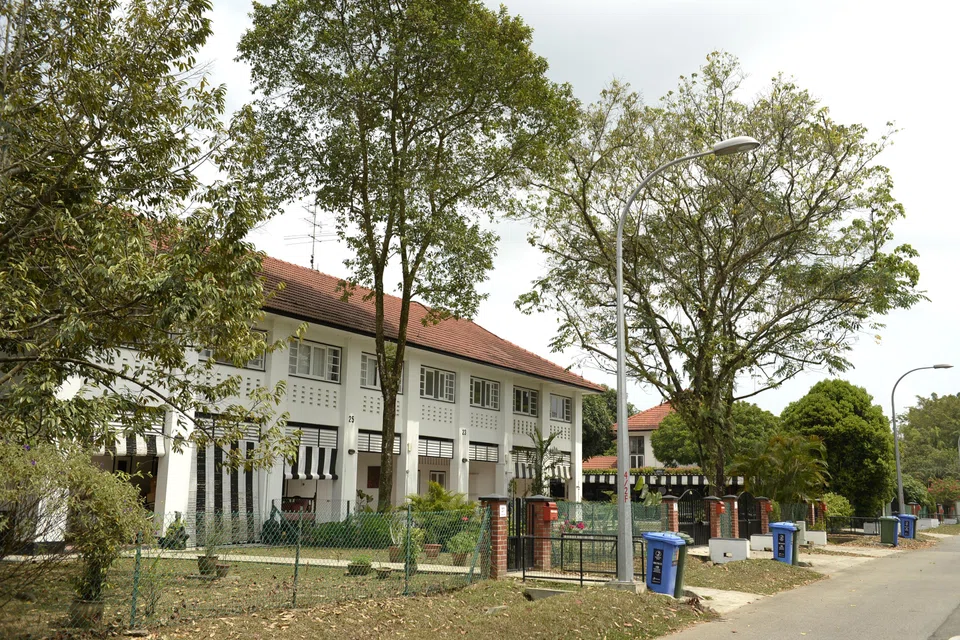
BUILT in the early 1900s, black-and-white bungalows were designed for residential use. Because of their age, however, most lack modern amenities and may not be a first choice of home for many.
The Singapore Land Authority (SLA) has tried to strike a balance between redeveloping the properties and conserving them. That means covering the cost of upgrading the units.
SLA spent S$515,400 and S$570,500 respectively, to restore 26 Ridout Road and 31 Ridout Road. The money went towards general building repairs, electrical rewiring, horticulture works, road and fencing repairs, and termite treatment.
Such expense is not uncommon. SLA said it had done work on other black-and-white bungalows costing between $408,800 and $1.13 million each time.
Why does it cost so much to maintain black-and-whites?
Karamjit Singh, chief executive of property consultancy Delasa, said that although black-and-white bungalows are “spacious and charming”, they “lack the luxurious or modern appeal”.
Some have also been left vacant, which adds to their “state of disrepair”.
“Spending $200,000 to S$500,000 is barely patching up the houses to basic habitable condition, not transforming them to luxurious or palatial standards. That would require easily several millions in investments per house,” Singh said.
These buildings would not be habitable if some works, especially those involving sewerage and sanitation systems, are not carried out, said Sing Tien Foo, Provost’s chair professor in the Department of Real Estate, National University of Singapore (NUS) Business School.
Would it be more cost-effective to actively maintain the properties, or refurbish them to be leased as furnished units or serviced apartments?
Dr Lee Nai Jia, head of real estate intelligence, data and software solutions at PropertyGuru Group, said: “It’s important to consider that these enhancements could result in higher costs, which may not be economically feasible for properties in exclusive private residential locations.”
What is the return on this investment of taxpayer dollars?
The rental rates of the black-and-white bungalows differ among estates.
All such properties have a guide rent – the minimum rent to be achieved – that is assessed by professional valuers.
In 2022, the average monthly rent paid for a black-and-white bungalow in the Ridout estate was S$12,972. Rents range from S$2,250 for a unit in Sembawang to S$41,500 for a unit in the Nassim estate.
According to the Ministry of Finance’s revised FY2022 estimates, rents collected from residential properties contributed S$887.2 million in revenue to the state. This was about 1 per cent of the estimated operating revenue of S$90.28 billion in FY 2022 and 6.8 per cent higher than the S$830.8 million collected in FY2021.
Is there room for resource optimisation?
Tan Keng Chiam, Colliers’ executive director and head of valuation and advisory services, said the rental rate of a black-and-white bungalow depends on factors such the size of the land and building, the condition of the building and the grounds, market conditions, functionality, design, layout, amenities, terms of use, location and orientation.
SLA cannot arbitrarily lower rents for the 600 or so black-and-white bungalows it oversees.
The agency does rent some of these bungalows out for commercial, rather than residential use as well.
Prof Sing of NUS Business School noted, however, that such a change of use could involve modifications to the internal layout and structure of the houses.
Savills Singapore’s executive director of research and consultancy Alan Cheong said more advertising could be done for black-and-whites – to allow price discovery and open up a larger pool of potential tenants to bid for them.
“For properties to be rented at fair market rate, they must be exposed to the market for sufficiently long periods of time – to determine whether rents should be lowered or raised,” he said.
In January 2023, the occupancy rate for all black-and-white houses was 89 per cent. Tenancies are granted on two-year or three-year terms, up to a maximum allowable tenancy of three + three + three years at any one time.
Besides the lack of awareness, Dr Lee cited other factors that make it challenging to rent out black-and-white bungalows.
One is location. Properties in central areas typically attract more interest than those in areas such as Seletar or Sembawang. Second, tenants often face substantial costs when attempting to renovate these properties for comfortable living. And they likely won’t be able to recoup such expenses.
Why SLA is exploring the master lease option
SLA is studying the feasibility of a longer leasehold period – such as 30 or 60 years – for an entire black-and-white bungalow estate, with a private developer as master-leaseholder.
This master-leaseholder would be responsible for rejuvenating the entire estate, and would in turn reap the benefits over the longer lease period.
CapitaLand Development is now the master-lessee of 12 black-and-white bungalows at Rochester Park, which are part of a new campus-style integrated development called Rochester Commons.
Seven of these bungalows are used as offices, and the other five, as food and beverage establishments.
Another 23 black-and-white bungalows in The Oval@ Seletar Aerospace Park are managed by JTC. Some of them have been transformed into eateries such as Wheeler’s Estate and The Summerhouse.
Alternative uses of black-and-white bungalows
Black-and-white bungalows have been repurposed for social and educational uses as well.
At the Gallop Extension to the Singapore Botanic Gardens, a black-and-white bungalow has been repurposed as the Forest Discovery Centre.
Bungalows, such as those at 715 and 717 Mountbatten Road, are used as childcare facilities.
Dr Lee of PropertyGuru said there is potential for broader usage of black-and-white bungalows by the wider community: “While luxury housing options cater to high-income groups, there should also be opportunities for start-ups; social enterprises; the meetings, incentives, conferences and exhibitions industry, and even thematic local-produce markets.”
Chia Siew Chuin, head of residential research at JLL Singapore, suggested that these buildings could also be transformed into “off-site training, meeting, or retreat campuses, tailored to cater to the needs of companies”.
Balancing heritage and revenue
The original intent of these black-and-white bungalows for residential use will need to be compromised should the economic motives of maximising land value prevail, said Prof Sing.
To ensure preservation of some cultural heritage, however, Dr Lee suggested that some of these bungalows could be converted into tourist attractions.
“Conserved homes in Penang and Malacca, such as the Green Mansion (Peranakan House) and the Blue Mansion, have seen widespread popularity,” he said. “These heritage sites have not only added cultural value, but also boosted local industries, particularly food and beverage and hospitality.”
JLL’s Chia added: “These buildings also have the potential for adaptive reuse as art and cultural galleries and studios, serving the dual purpose of preserving their architectural heritage and fostering vibrant spaces for artistic and cultural expression.”
Colliers’ Tan suggested private developers could build around colonial bungalows to preserve their heritage value.
He cited the example of Sim Lian Group’s conservation of Matilda House in Punggol. The developer converted the building – one of Singapore’s oldest houses – into a clubhouse within its condominium project, A Treasure Trove.