High stakes on the table for Singapore's integrated resorts
The two IRs must navigate a tourism, leisure and entertainment landscape transformed by Covid-19

Singapore
THE two Singapore integrated resorts (IRs) reported better financial numbers for the first half of this year compared to a year ago, but the IRs are performing far below what they were doing prior to the onset of the Covid-19 pandemic in early 2020.
Based on results posted by Las Vegas Sands, which owns Marina Bay Sands (MBS), net revenues of MBS rose 19 per cent year-on-year (yoy) to US$753 million in the first half of 2021. But net revenues for H1 2021 is around half that of US$1.46 billion and US$1.58 billion for H1 2019 and H1 2018 respectively.
The fall in earnings versus pre-pandemic days is even sharper - adjusted property earnings before interest tax depreciation and amortisation of US$256 million in H1 2021 is about one-third that of US$769 million in H1 2019 and 28 per cent that of US$909 million in H1 2018.
For the first six months of 2021, Genting Singapore, which owns Resorts World Sentosa (RWS), posted a 24 per cent yoy rise in revenue of S$555 million and net profit of S$88 million, reversing a loss in H1 2020.
But the group's revenue in H1 2021 is less than half that of over S$1.2 billion in each of H1 2018 and H1 2019. Net profit in H1 2021 is less than a quarter of that in each of H1 2018 and H1 2019.
Adding to the challenge facing the IRs is that they are incurring major capital expenditure.
In exchange for extending the exclusivity period of their casino licences to end-2030, the two IRs will invest a combined S$9 billion to expand and refresh their non-gaming components.
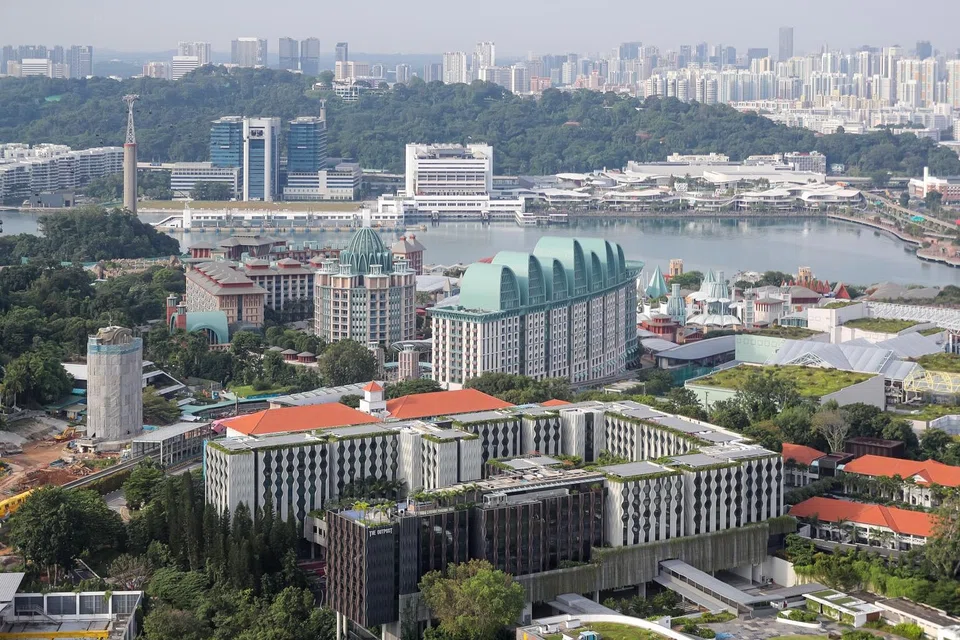
MBS will build a fourth tower with an entertainment arena. There will be a new 15,000 seat arena and a luxury all-suite hotel with around 1,000 rooms.
RWS will expand Universal Studios Singapore and the SEA Aquarium, and add up to 1,100 more hotel rooms, among other enhancements.
MBS and RWS will each have an option to deploy some additional gaming area and add to their number of gambling machines.
The IRs make the bulk of their revenue from gaming. Key contributors to non-gaming revenue include rooms, events, retail and attractions.
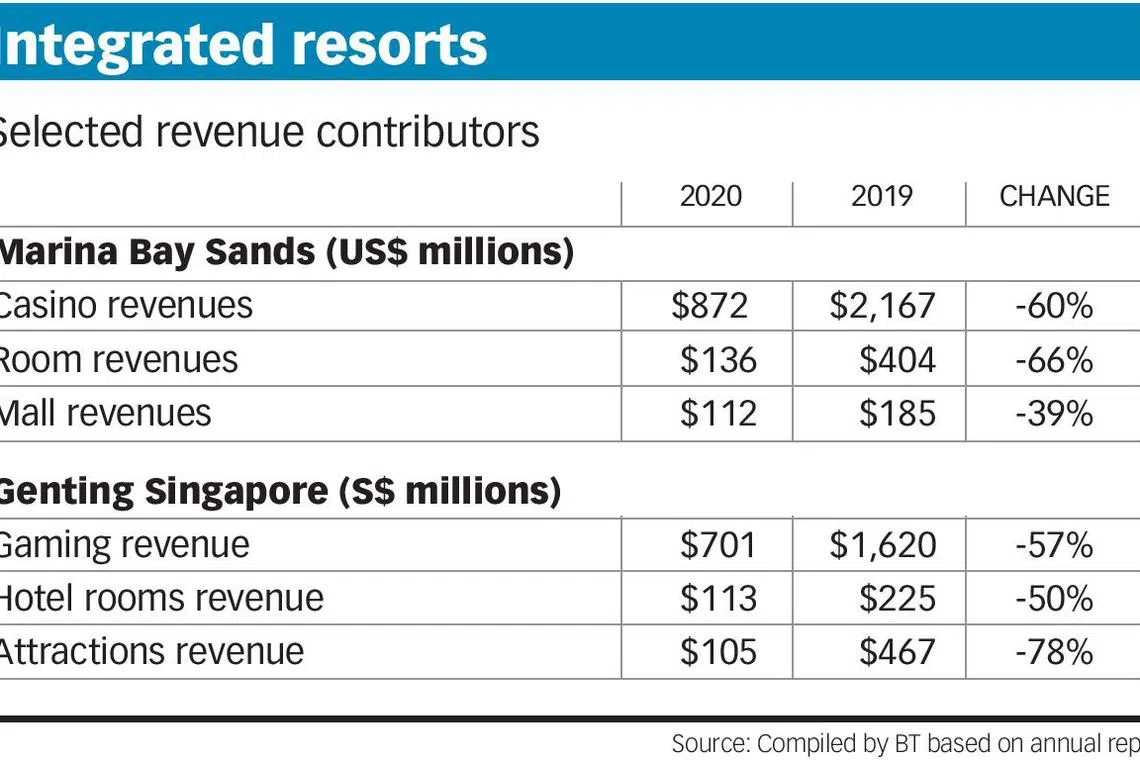
For Genting Singapore, about 80 per cent of revenue in H1 2021 came from gaming. The casino segment contributed close to 70 per cent of net revenues of MBS for the three months ended June 30, 2021.
For the quarter ended June 30, 2021, MBS' hotel occupancy was 68 per cent, versus 97 per cent for the comparable period in 2019. Average daily rate in Q2 2021 was 53 per cent of that in Q2 2019.
Should Singapore's borders reopen more, can revenues and profits of the IRs rebound strongly, and will their multi-billion dollar expansions pay off?
If travel measures ease, pent-up demand from travellers, who are looking to splurge, might help revive fortunes of the IRs.
Genting Singapore though sounded cautious in its latest results announcement, saying "a sustained and broad-based recovery in travel and tourism will be protracted and subject to a high degree of uncertainty".
Even if borders reopen freely, some leisure travellers may be cautious in resuming international travel as concerns over public health and being stranded in a distant place linger.
Visitors from China may not return in large numbers. China may be cautious in deciding whether to allow its people to travel abroad freely and more Chinese could opt to support domestic tourism.
The upcoming Golden Week in China in early October is likely to see luxury Chinese travellers flock to domestic destinations such as Sanya and Yunnan.
The economies of neighbours such as Indonesia, Malaysia and Thailand have been hit by the recent resurgence in Covid-19 cases. Can these economies recover strongly? Growing wealth and confidence of the middle class in neighbouring countries will be needed to drive visitor numbers to Singapore and its IRs.
With their large number of hotel rooms, big ballrooms and ample supply of meeting spaces, the IRs contribute to Singapore's success in the meetings, incentives, conventions and exhibitions (MICE) business.
The MICE business could increasingly adopt a hybrid model of virtual and physical, with an ensuing decline in demand for physical venues. Driven by cost considerations and efforts to reduce carbon footprint, companies may reduce physical in-person gatherings of their global talent.
As for the casino gaming business, competition in Asia is intensifying. Operators have been adding to gaming fare, rooms, and attractions in Macau.
Casinos look set to take off in Japan even though Yokohama City published its decision to cancel its integrated resort bid process last week. Genting Singapore, which was working with various Japanese corporations on this bid, has thus discontinued its participation in this bid.
The threat of casino gaming losing popularity in future cannot be discounted entirely.
Betting on horse racing in Singapore has been on the decline possibly due to the opening of casinos here in 2010. Younger Singaporeans have not been enticed by horse racing, being drawn to bet on football matches instead.
Might casinos lose the younger set to online gaming, sports betting and online gambling?
There are questions over the type of hotels and resorts will appeal to luxury travellers going forward. Large hotels with many rooms may lose their allure.
The new concept of luxury may involve many eco elements. Think of the new Mandai eco-resort featuring guest rooms in tree houses shaped like seed pods, elevated walkways snaking through a forest canopy and interactive guided nature walks. Banyan Tree will operate this luxury resort which promises guests "unprecedented access" to nature.
Subject to the pandemic situation being under control, luxury travellers may opt for sanctuaries offering exclusivity and tranquility in places such as Bhutan, Maldives, Mauritius and Tuscany. Singapore players such as Christina Ong and Bonvest Holdings operate luxury resorts in some of these locations under the Como and The Residence brands respectively.
The casino business is for those with steely nerves. Visionaries such as Steve Wynn, who founded Wynn Resorts, and the late Sheldon Adelson, who founded Las Vegas Sands, helped remake Las Vegas in the United States as a gaming, convention and entertainment venue, with big bets and bold plans. The late Stanley Ho, who founded SJM and Shun Tak, is associated with the success of gaming in Macau, while the late Lim Goh Tong, who founded Genting Group, succeeded at Genting Highlands in Malaysia.
Singapore's IRs are owned by well resourced and experienced groups. Expect these groups to understand and anticipate customer needs as they work to lure visitors back to their properties. The IR owners can also take on board what visitors expect post-pandemic in working on their new additions.
Tourism has been a key contributor to Singapore's economy and the government is keen to help this sector build back strongly.
The IRs can count on the Singapore Tourism Board and Changi Airport Group among others, to roll out the red carpet to lure visitors to Singapore.
The ace in hand for the IRs is probably Singapore's ability to draw the rich to its shores and be a venue of choice for holding world class events.
The stakes are high for the two IRs as they navigate a tourism, leisure and entertainment landscape transformed by the pandemic. Not stuff for the faint of heart.
READ MORE:
- MBS seeks deadline extension to deliver details on expansion plan
- RWS, MBS must still invest S$9 billion or risk higher taxes: MTI
- Las Vegas Sands falls in late trading after missing second-quarter estimates
- Marina Bay Sands caught in net of whales and murky waters of third-party transfers
- Genting Singapore leads Japanese consortium in submitting Yokohama IR bid
- Genting Singapore posts S$88.2m H1 profit, expects travel recovery to be drawn out, uncertain
- Genting's new Vegas resort is a US$4.3b bet on city's comeback