

Hong Kong's tiny apartments increase pain of Covid isolation
 Add BT as a preferred source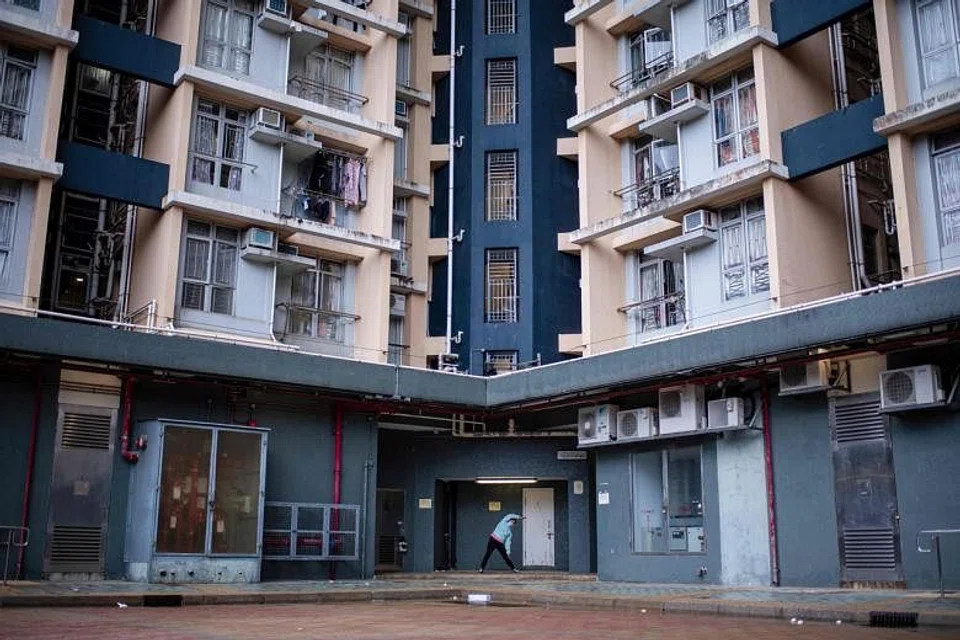
DeeperDive is a beta AI feature. Refer to full articles for the facts.
[HONG KONG] Hong Kong's biggest Covid-19 outbreak has left tens of thousands of patients struggling to isolate themselves from their families in one of the world's most crowded cities.
Growing numbers of infected people are recuperating at home because hospitals have been stretched to their limits. While it's become common for patients around the world to stay home during their recovery from the virus, the predicament for those in Hong Kong is more severe given the tight living space in the Asian city.
Lam, a teacher in her 20s, had to stay home for almost a week after testing positive before she was sent to the quarantine camp in Penny's Bay. Lam lives in a 2-bedroom apartment of about 28 sq m with her parents and a brother. To make her isolation at home possible, Lam's brother who shares a bedroom with her had to sleep in the living room.
Lam ate separately and only left the bedroom to use the bathroom, which she cleaned with bleach each time to avoid infecting her family.
"If I lived alone, it wouldn't be a problem to self-isolate," said Lam, who only gave her surname. "I was so stressed, always feeling sorry for causing them trouble" by quarantining at home, she said.
Small space
Navigate Asia in
a new global order
Get the insights delivered to your inbox.
She isn't alone. It's common for young people in Hong Kong to live with their parents because property prices and rents are often too expensive for them to afford their own apartment. The city had the world's least affordable housing market in 2020, with prices exceeding 20 times median household income.
Living space is notoriously small in the city of 7.4 million. The median area of accommodation for each resident was about 15 sq m as of 2016. That's less than half the 39.8 sq m average home area per person in urban China in 2019.
In Hong Kong's densest area Kowloon, there were on average 49,060 people per square km in 2020, compared to Singapore's 7,485 in 2021. That combined with the outbreak of the highly contagious Omicron variant has resulted in a greater risk of infection.
Sham Shui Po and Yau Tsim Mong, districts in Kowloon where cases are among the highest, have the most subdivided flats in the city - tiny partitioned units that are often stuffy and poorly designed.
30,000 waiting
Hong Kong's coronavirus cases have exploded in recent weeks after months of no community transmission, leaving isolation facilities full. There are an estimated 30,000 Covid patients waiting at home, Chief Executive Carrie Lam said at a briefing on Tuesday (Feb 22).
The local government has stuck to its "Dynamic Zero Infection" strategy so it can reopen borders with mainland China as soon as possible.
Residents' endurance for staying at home will be tested even further if authorities resort to lockdowns. Chinese officials have told Hong Kong counterparts that they think a lockdown will be needed to contain surging cases, according to people familiar with the discussions. The local government has conceded some kind of targeted stay-at-home restrictions may be necessary if the situation worsens.
Hong Kong is getting help from the mainland to increase quarantine capacity. The Chinese government commissioned a team to build 10,000 Covid isolation and treatment units at Penny's Bay and Kai Tak Cruise Terminal. Some 20,000 more units will be provided at hotels, sports centres and newly completed public housing estates, the government said Saturday.
Public hospitals will give priority to elderly and paediatric patients in serious condition, a spokesperson for the Hospital Authority said in an emailed statement. Young patients and those with stable or mild symptoms will be asked to wait and recover at home for now.
China's demand
The current pandemic situation underscores the local authority's struggles with 2 of Beijing's priorities for Hong Kong: Covid Zero and affordable, decent housing. The central government has already taken note.
Chinese President Xi Jinping recently called on the city to take "all necessary measures" to control the outbreak, marking an unusual direct intervention. Prior to the latest Covid wave, Beijing stressed the need for Hong Kong to improve housing.
Many are unconvinced that the local government can rein in Covid infections in the near future.
"It's been chaotic," said Lam, the teacher. "You want to have zero Covid, but you don't even have enough manpower or resources to do it." BLOOMBERG
Decoding Asia newsletter: your guide to navigating Asia in a new global order. Sign up here to get Decoding Asia newsletter. Delivered to your inbox. Free.
Share with us your feedback on BT's products and services






