

Hongkong Land leans on ‘hotelification’ to boost Singapore office portfolio performance
Hongkong Land seeks to provide a hotel-like experience for workers and visitors in its buildings in Marina Bay

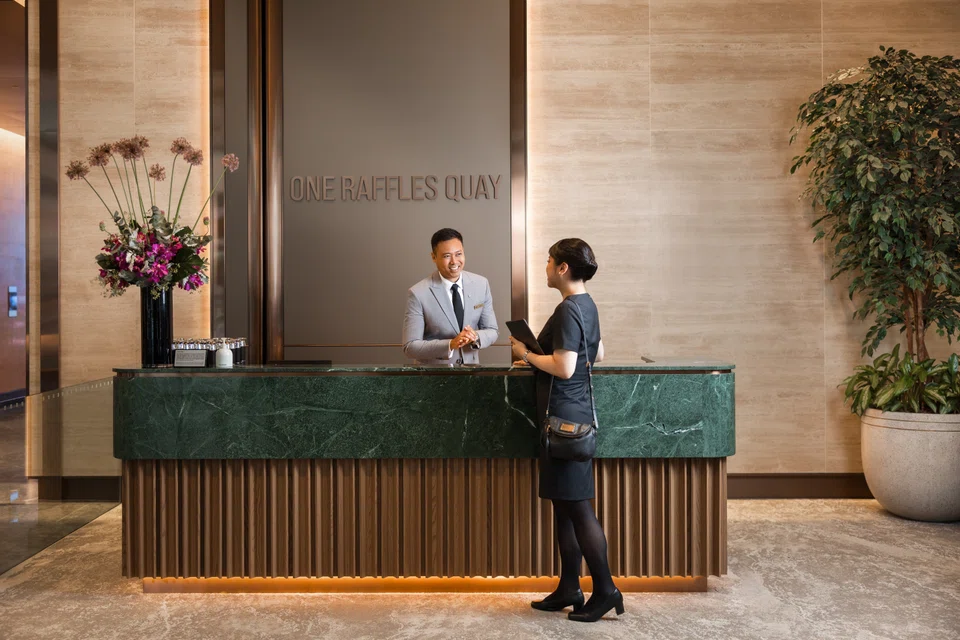
[SINGAPORE] At Marina Bay Financial Centre Tower 2, concierge staff weave through crowds in the lobby, greeting visitors and assisting them with their enquiries.
The set-up is more similar to what guests typically encounter in a luxury hotel than what they would usually find in an office building.
Since 2019, Raffles Quay Asset Management (RQAM), which looks after Marina Bay Financial Centre (MBFC) and One Raffles Quay (ORQ), has worked with asset owner Hongkong Land to redesign and reposition the office spaces in its portfolio to create a hotel-like experience for visitors.
A senior concierge staff was seconded from parent group Jardine’s Mandarin Oriental to RQAM in 2022, to familiarise its customer experience teams with luxury hotel standards of service.
Ben Robinson, Hongkong Land’s director and head of office for South Asia commercial property, said: “Today’s tenants are looking for more than just a great location and high-quality finishes when it comes to selecting office space. They’re increasingly focused on the experience that their staff and guests receive when they work in or visit their offices.”
As at Jun 30, MBFC was almost fully occupied, with an occupancy of 99.2 per cent.
Hongkong Land owns a one-third stake in the commercial space in MBFC and ORQ, both of which now compete with newer buildings for tenants in Singapore’s Central Business District. ORQ was completed in 2006, and MBFC in 2012.
Hongkong Land developed both assets together with Keppel Land and Cheung Kong Holdings.
After completion, Keppel Reit acquired Keppel Land’s interest in ORQ, and Cheung Kong sold its stakes in ORQ and MBFC Towers 1 and 2 to its Suntec Reit. MBFC Tower 3 anchor tenant DBS acquired Cheung Kong’s share of the building.
Since the first quarter of 2024, ORQ has undergone a S$17 million asset-enhancement initiative (AEI), acting on feedback from its key anchor tenants; three food and beverage (F&B) outlets were added, and the garden plaza was redesigned into a large event space.
Robinson said: “As a result of doing that successfully, we secured a number of key tenants on a longer-term basis.”
As at Jun 30, ORQ had a committed occupancy of 97.2 per cent. Major tenants include Deutsche Bank, EY and ByteDance.
Robinson declined to provide details on how rents moved after the AEI. According to Hongkong Land’s results for H1 2025, rental reversions across its Singapore portfolio were positive, with average rents increasing to S$11.40 per square foot (psf) from S$11.10 psf for the year-ago period. Vacancy stood at 2 per cent as at end-June.
According to Q2 data compiled by Savills, rents in Grade-A spaces in the Marina Bay area stood at S$13 psf, with vacancy for the submarket at 11.1 per cent.
Robinson believes the Singapore office market is in a healthy state, with the relatively low supply of prime office space and stable rental growth.
For the second quarter, the median monthly office rents for Category 1 offices, which refer to the better-quality buildings in core business areas, fell 3.2 per cent to S$11.68 psf, government data showed.
Robinson said: “There’s no significant supply in the Marina Bay area on the horizon. What we’ve really seen (is) the take-up of space in IOI Central Boulevard Tower and the very stable, high-level of retention that we’ve seen in our portfolio.”
Across Hongkong Land’s Singapore office portfolio, the weighted average lease expiry of its tenants as at December 2024 was 3.3 years. Among the top 30 tenants, which account for 43 per cent of total net lettable area, weighted average lease expiry was 4.2 years.
Hongkong Land is looking to differentiate its buildings with more “customer-led experiences”, said Robinson. In 2019, RQAM launched the By the Bay app, which shows tenants the dining and shopping deals available, as well as the fitness classes being organised in the buildings.
As at June 2025, the app had over 67,000 registered users.
He said: “If we’re able to better understand our community, if we’re able to better understand our corporate tenants and how they’re interacting with the portfolio, we’re able to deliver a far more premium level of experience and service.”
For instance, RQAM runs promotions through the platform to understand anonymously which staff are going to which F&B outlets, which helps them decide if they need to reconfigure the tenant mix.
Data collected from turnstile usage helps RQAM understand when tenants are arriving at and leaving the offices, which provides indicators to manage their plant equipment more efficiently.
Tracking indicators such as ambient temperature, airflow, CCTV footage and utilities consumption has enabled the landlord to reap 35 per cent savings in electricity across its portfolio, compared to 2019 levels.
The company is also rolling out an integrated facility management control tower platform across its Central portfolio in Hong Kong by 2026.
When asked whether Hongkong Land is considering placing any of its Singapore office assets into a Reit, a plan floated in earlier interviews, Robinson said capital recycling is a “key pillar” of Hongkong Land’s strategy moving forward, but that there were no updates at this stage.
TRENDING NOW

Inside Jensen Huang’s last hours as Nvidia CEO

Higher rates, weaker spending: Is the Philippines entering stagflation?

‘I’ll be buying more’: Singapore investors pour into Nvidia shares on Jensen Huang’s exit

Demand, tech capabilities position Apac and AI as Skyscanner’s next growth frontiers: CEO Bryan Batista

