

How the ferry is changing the Brooklyn-Queens waterfront
East River ferry is enjoying a revivaI and changing the perception of mass transit. While it isn't quite driving deals yet, it is the talk of the town
New York
IN THE 1850s, Walt Whitman took a ferry from Brooklyn to Manhattan and did a remarkable thing - he wrote something nice about his commute.
"Ah, what can ever be more stately and admirable to me than mast-hemm'd Manhattan? River and sunset and scallop-edg'd waves of flood-tide?" New Yorkers today are generally less enthused about mass transit. But the East River ferry is enjoying a revival, thanks to a recent expansion and is luring developers to a long-neglected stretch of the city's industrial waterfront, from western Queens to south Brooklyn.
About seven months after the city expanded and subsidised the privately run ferry service - reducing the fare from up to US$6 to US$2.75, the same as a subway ride - ridership is up and so are rents in neighbourhoods that were once harder to reach. Private vessels have been ferrying commuters since the 19th century, and a limited city-subsidised version of the ferry service has been running since 2011.
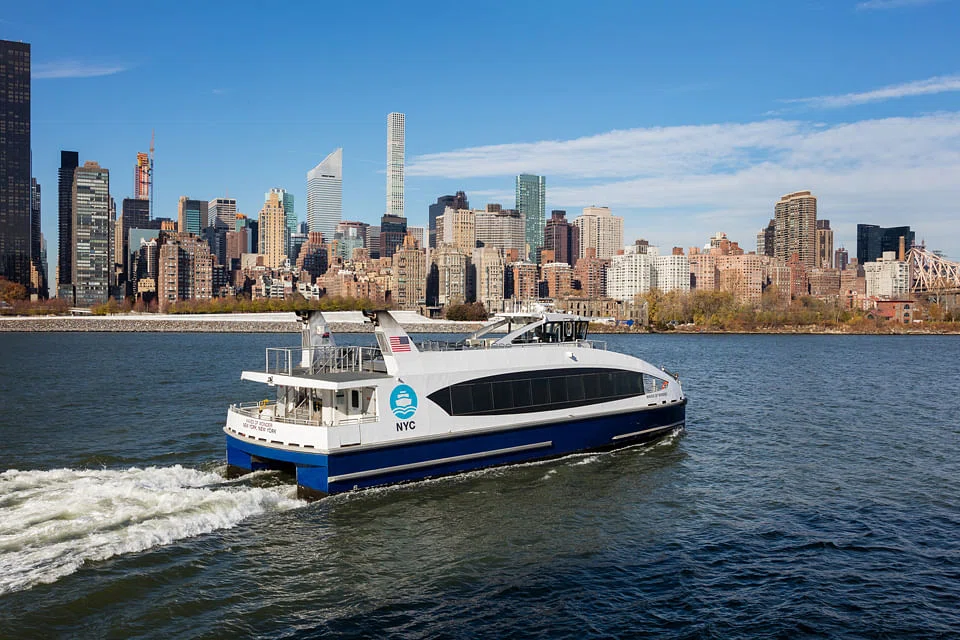
But in May, the city's Economic Development Corp introduced NYC Ferry, a now 16-vessel fleet of ferryboats that can each transport up to 149 passengers. The service connects Brooklyn, Queens and Manhattan on four lines, with plans next year for routes to the Lower East Side and Soundview in the Bronx.
The Economic Development Corp. said the ferry service is averaging about 12,000 passengers a day, and it expects ridership to climb, as about 500,000 New Yorkers live within a half-mile of a ferry stop.
As The Times reported recently, two of four new ferry lines are already carrying more passengers than had been projected for 2019, and the city is already considering adding new express routes to get commuters to and from their jobs more quickly.
For some longtime residents on the waterfront, the ferry's success brings a measure of vindication.
"When I first got here, everybody thought I was out of my mind," said Mayra Mercado, 49, a physician assistant who moved to the western edge of Astoria, Queens, in 2006. "It used to be a very lonely, long walk home," she said of her 20-minute hike to the N train.
She bought a one-bedroom condo on Vernon Boulevard, a half block from the river, for about US$305,000, because she loved the idea of waterfront living. Now, 11 years later, sales data suggest that she could sell her unit for nearly double that price. She isn't looking to sell, however - partly because she loves the area but also because nearby two-bedrooms can run close to US$1 million.
Ms Mercado, who lives with her partner, Peter Anderson, 50, a marine biologist, is just a five-minute walk from the new ferry landing, and she takes the ferry twice a week to get to her job in midtown. (When it is too cold or rainy, she drives.) Since the line opened this summer, some friends have completely sworn off subway rush hour, she said, and use the ferry exclusively.
On board the ferries, commuters cruise the East River with free Wi-Fi and views of the Manhattan skyline. A kiosk serves organic snacks, beer and wine, and matcha green-tea blends that cost US$5.25 (credit cards accepted). The 35-minute Astoria loop, which opened in August, connects to Roosevelt Island, Long Island City, 34th Street in midtown and Wall Street.
"You should see our sunsets, they're absolutely spectacular," Ms Mercado said of the vistas along a placid but gritty swath of former landfill, where swans glide near chain-link fences.
Nearby is the Socrates Sculpture Park, a dumpsite-turned-park-space with modernist art that embraces the area's industrial past.
Even before the ferry arrived, the neighbourhood was transforming. Within a 10-minute walk of the ferry landing, there were 38 condo or rental projects, a total of 2,102 units, in the works in November, said Patrick W Smith, an associate broker with Stribling & Associates. That exceeds the existing inventory of just 30 residential buildings and 1,667 units, he said. And it doesn't include Halletts Point, a massive rental project by the Durst Organization, which could add some 2,100 additional units, about a quarter of which will be reserved for lower-income renters, by 2022, said Jordan Barowitz, a Durst spokesman.
"The moment they announced the ferry, we bought as many things as we possibly could," said Brett Harris, a founding partner of AKI Development, which has six projects near the Astoria landing.
Local rezoning that made it possible to build more housing on the mostly commercial waterfront in 2010 brought AKI and others to the area, but the ferry kicked things into high gear, he said. Graffiti House, the seven-story rental AKI completed last year, is fully leased, with all 28 one-bedroom units, which have heated floors and high-end finishes, going for around US$3,000 a month. "We thought we were going to get US$2,000 to US$2,100," Mr Harris said.
Evidence of the ferry's effect can already be seen at other stops along the East River, said Grant Long, senior economist at the real estate site StreetEasy. In an analysis of rentals within a 10-minute walk of the ferry service, rents grew about 1.5 per cent faster in the last year than those up to a half-hour away in Astoria, Greenpoint and part of Brooklyn Heights and Cobble Hill. Markets farther south, in Sunset Park and Bay Ridge, showed signs of similar rent growth near the ferry, but there were too few transactions to analyse.
"The difference in rental growth is really striking because it's uniform," said Mr Long of the areas closest to ferry lines. Pricier neighbourhoods with more transit options, like Dumbo, Williamsburg and Long Island City, were less affected. Since rents across the city have been largely stagnant, with Brooklyn and Queens averaging just 0.3 per cent increases in the last year, the rent growth in these waterfront neighbourhoods is telling. "This is as close to causation as you can get," Mr Long said.
In Greenpoint, where rents near the India Street ferry landing were up 1.9 per cent, the pier is a work in progress. On a recent weekday morning, cranes and earthmovers sputtered and hummed over the churn of the East River, while construction workers filled the air with colourful language. Two blocks inland, a hip coffee shop served oat milk lattes, but the walk to the ferry landing was still lined with shuttered garage bays and heavy machinery.
The construction crew was working on the Greenpoint, a glassy 40-story rental and condo project opening next year with 603 units, 95 of them condos with prices ranging from US$835,000 for a studio to about US$3.5 million for a three-bedroom. Sales began in June and more than half the condos are under contract or reserved, said Jodi Stasse, who is managing sales with Corcoran Sunshine. The bulk of the project, rental apartments, will start leasing in the spring. In exchange for city tax benefits, about 20 per cent of the units will be reserved for lower-income tenants.
There are signs that parts of the riverfront market may be getting frothy. In October, almost half the new rental buildings in Brooklyn offered concessions, like a period of free rent or discounted broker fees, said Jonathan J Miller, the New York real estate appraiser. That is a significantly higher number than in Manhattan (where only 34 per cent of new towers were offering concessions), which is stoking concerns about oversupply.
Many remain bullish on the Williamsburg waterfront, including some boldface names. Eliot Spitzer, the former governor of New York, who resigned after a sex scandal, is now at the helm of his family's first ground-up rental project in many years, a few minutes away from the Domino site.
"In my view, that's all good," Mr Spitzer said of the nearby competition. "There will be sufficient demand." His three buildings at 416 and 420 Kent Ave, where prices range from about US$2,800 a month for a studio up to about US$10,000 a month for a penthouse, will have 857 units, said David Maundrell of Citi Habitats New Development, with about a quarter reserved for lower-income renters.
"It's evolved more into an everyday amenity," Todd Lewin, an associate broker with CORE, said of the ferry.
The ferry isn't driving deals yet, he added, but it is the talk of the town, especially with the impending L train closure. StreetEasy found that 30 per cent of the more than 1,000 rentals near a ferry stop were advertising the ferry service, up from 23 per cent last year.
Luxury renters are not the only ones who stand to benefit from the ferry expansion and the development it attracts. The riverfront is also home to some of the largest public housing complexes in the city, including the 22-building Astoria Houses in western Queens, built in the 1940s.
Claudia Coger, the president of the resident association, said not much has changed in the 62 years she has lived there. "It's been a fight to get attention" for the community, she said, where the nearest supermarket for some is 20 blocks away. So she is pleased that Halletts Point, the Durst Organization project that will add 2,100 apartments across the street from her complex, will include a new supermarket and bring retail jobs to the area. "A lot of people in the community don't think beyond their environment - this opens doors," she said about the ferry. NYTIMES






