

How Frank Gehry became Frank Gehry
Renowned architect is depicted in biography not as a genius, but as talented and diligent
New York
EVEN if you can't name a building by architect Frank Gehry, you'll know it when you see it: his is the structure whose panoply of lines pile up against one another, with angles so improbable as to look barely functional. His style is bright, dynamic, and as subtle as a police siren.
This instantly recognisable aesthetic has helped make Mr Gehry arguably the most famous architect in the world. His name is a brand in itself: there was a Frank Gehry line of jewellery at Tiffany's, a Frank Gehry furniture line from Knoll, and a Frank Gehry handbag from Louis Vuitton. His level of celebrity transcends architecture, derived instead from the perception that he is simply an artistic genius.
In a 1997 New York Times review, architecture critic Herbert Muschamp wrote that Mr Gehry "changed an art form and in the process is changing a culture". That was 18 years ago. His reputation continues to grow.
Where does this genius come from? Was it always there - simmering below the surface, a universal truth waiting for the opportunity to be recognised by an adoring public?
This is what architecture critic Paul Goldberger set out to discover in creating his biography of Gehry, Building Art: The Life and Work of Frank Gehry, which arrived in bookstores on Sept 15.
In Mr Goldberger's excellent and comprehensive treatment, Mr Gehry doesn't come across as a genius at all. He is depicted as a very talented man who worked very hard for a very long time, learning only gradually how to design the buildings that would make him famous.
The narrative isn't very sexy, but it is undeniably fascinating. Mirroring the rise of contemporary architecture, Mr Gehry emerges from the constraints of mid-century modernism, grapples with questions of urban development and human scale, and comes increasingly to rely on hyper-sophisticated, proprietary computer software.
This isn't to say that Mr Goldberger (an explicit, perhaps relentless, admirer) ever denigrates Mr Gehry or his early buildings. In this book, Mr Gehry can do no wrong; there's always something to compliment.
An innocuous, vaguely modernist house he built in 1958 in Brentwood, Los Angeles, has "a tight, formal elegance". In a six-unit apartment house in Santa Monica, California, Mr Goldberger finds "a subtly asymmetrical arrangement of solids and voids" - even though the voids, in this case, are recessed doors on an unremarkable balcony.
The banality of Mr Gehry's early buildings is partially because he needed work and took it wherever he could get it. He grew up poor, as readers are repeatedly reminded over the course of the first hundred pages of the book. (Mr Goldberger slogs through the minutiae of Mr Gehry's origin story; it takes 61 pages for "Frank", as he's called in the book, to enrol in architecture school.)
To cut it down a few pages: for the first decade of his career, Mr Gehry was comparatively hard up.
Only in the mid-1960s, when he built a house/studio for graphic designer Lou Danziger, did a unique architectural vision begin to emerge. The structure, Mr Goldberger writes, was "two oblong boxes, set parallel but one offset from the other, positioned as carefully as pieces of minimalist sculpture".
The next notable building came three years later, when he designed a hay barn for a friend's ranch. The building, comprising telephone poles-cum-columns and corrugated metal, is striking; its roof is an angled, asymmetrical, sloping trapezoid.
Several nice but not noticeable buildings followed, such as a clean, modernist house with corrugated walls from 1972. He also found time to design a line of corrugated cardboard furniture, "Easy Edges", which Mr Gehry disavowed when it became too successful and threatened to drag him away from his core architecture business.
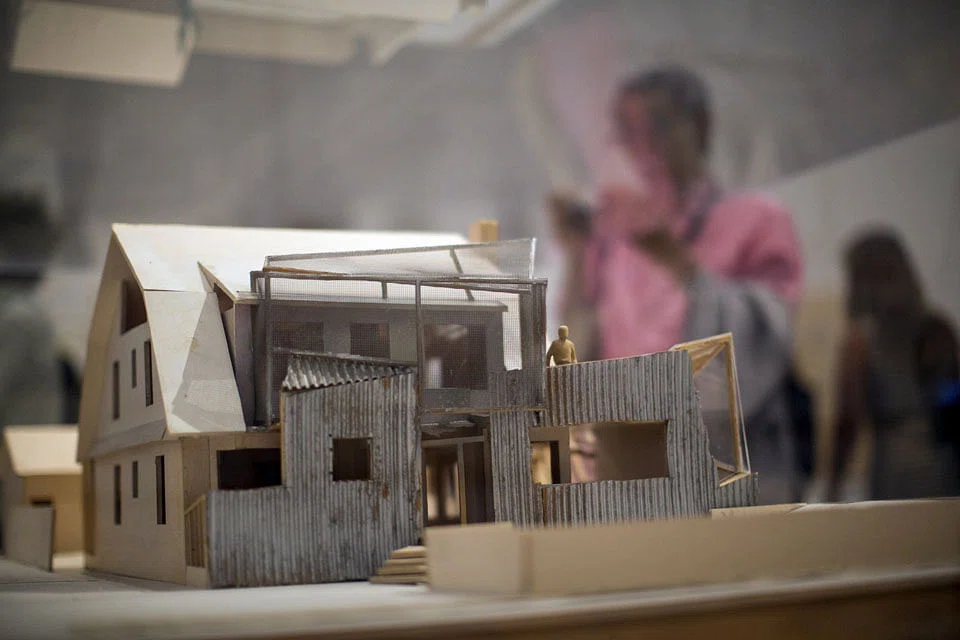
Then, in 1978, he designed his own house, which has been a tourist attraction ever since. It started as a modest Dutch-colonial in Santa Monica, at which point Mr Gehry set about chopping it up. He added jutting glass pockets, an exposed wood frame, and a corrugated metal wall that some neighbours confused with a construction fence. (A gate was added, we're told, when architecture enthusiasts kept ringing the doorbell, hoping to see the inside.)
By the 1980s, Mr Gehry enjoyed a certain level of fame. In 1984, the Walker Art Center in Minneapolis held an exhibition called the Architecture of Frank Gehry, which eventually travelled to the Whitney Museum in New York. He won the Architecture Prize, the profession's most prestigious award, in 1989. He was beginning to make money.
Offering a dramatic insight as to the costs his buildings have entailed, Mr Goldberger tells the story of when billionaire Peter Lewis, chairman of Progressive Insurance, commissioned a house from Mr Gehry in the Cleveland suburbs. Mr Lewis gave him a budget of US$5 million and carte blanche. The compound grew and grew, with Mr Lewis's blessing. Its budget - this is a house, remember - had risen to roughly US$82.5 million by the time the project was scuttled.
By the early 1990s, Mr Gehry was also beginning to use computer software to model his buildings, which played a key role in the submission of his design for the Guggenheim Bilbao. Unsurprisingly, this is also when the buildings became identifiably Gehry-esque - curving, disjointed shapes piled into an unlikely building - simply because they would have been impossible to engineer before the computer age.
Mr Gehry's software helped "design the structural framework, calculating the structural stresses at each point of the building, and determining the most economical way to construct the curving forms", Mr Goldberger explains. And because of the software, Mr Gehry managed to keep costs under control, coming in below the museum's US$100 million budget.
The success of the Guggenheim Bilbao put Mr Gehry on the map permanently, and his aesthetic has remained almost entirely unchanged in the subsequent 20 years. That's partially a result of client demands; if you shell out for a Frank Gehry building, you can be forgiven for wanting it to look like one (see: Biomuseo Panama). It's also because, to a remarkable extent, Mr Gehry seems to have found a language of his own, which he could finally and fully articulate.
To be sure, he's lucky to have reached this point, but that's hardly the same thing as genius; it's just hard work. Bloomberg
TRENDING NOW

Nvidia reinstates Jensen Huang as CEO; Trump says move poses no national security risk

Indonesia’s coal tycoon Low Tuck Kwong replaced as Bayan Resources president-director

Nvidia surges 33% after reinstating Jensen Huang, reviving AI trade; stocks soar in US and Europe

Consider lowering homeownership barriers for some non-resident foreigners

