

How some US baby boomers are ageing in place comfortably, stylishly and safely
For the country's swiftly growing older population, safety-focused attention to detail is essential to healthy home life
 Add BT as a preferred source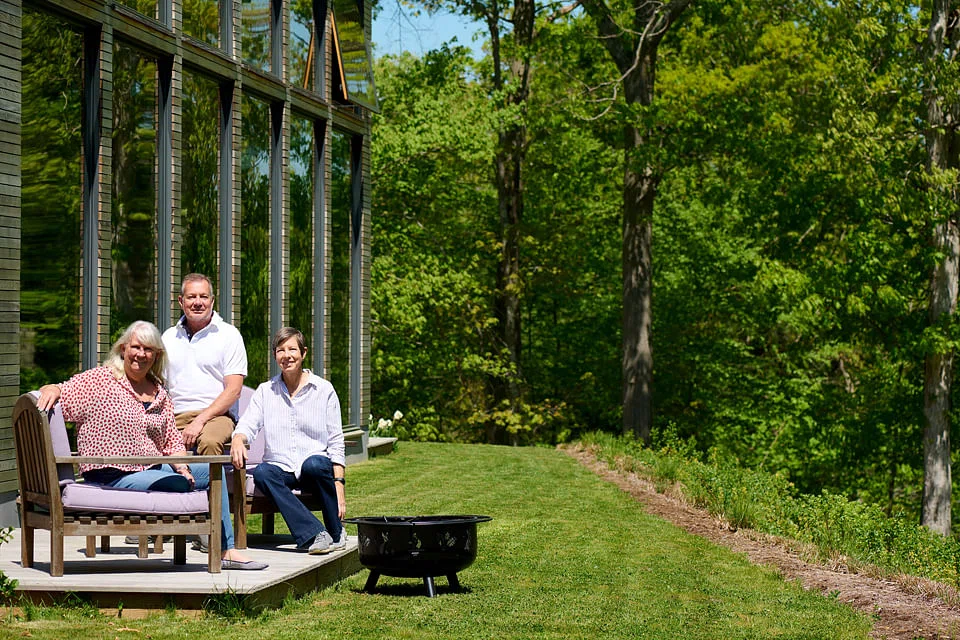
DeeperDive is a beta AI feature. Refer to full articles for the facts.
New York
THEY never wanted to call it retirement, but for Susan Farnsworth, Leigh Hough and Jean-Philippe Jomini, a throuple - a romantic partnership of three people - that has lived together as an intentional family for over 15 years, it felt important to get a head start on finding a home that would accommodate future needs for ageing in place.
Three consultants in their mid-60s, they share a home in Fort Lauderdale, Florida, but decided a few years ago to look for a second home in southern New England, where they have friends and family.
A string of open houses and home tours turned up nothing truly satisfactory. So on a whim, they checked out a "land for sale" sign during a day of driving around Guilford, Connecticut, and there it was: an unimproved 0.7ha lot of restored tidal marsh that had the allure of ever-changing scenery, natural light and an array of wildlife.
They purchased the land for US$320,000 in the summer of 2016. When it came to design, a few things were non-negotiable: enough privacy to allow for plenty of windows, tidal marsh views, and an easily maintained home and yard that would also be eco-friendly.
Their individual wishes became diplomatic discussions - was there room for a putter-worthy workshop for woodworking and gardening needs? How about a kitchen garden? These made the cut, as did a small salt-chlorinated pool. But being able to live comfortably there as they grew older together was their primary concern.
Navigate Asia in
a new global order
Get the insights delivered to your inbox.
"This is the first time we have worked for a three-person couple for whom gracious ageing - of materials and occupants - was part of the discussion from the outset," said Rustam Mehta, a founding partner of GRT Architects, the New York City firm that designed the 3,300-sq-ft house.
The one-storey house embodies universal design principles that are also senior-friendly, like versatile open spaces, minimal stairs, and wider doorways and hallways. The three-bedroom home is also wheelchair accessible and barrier free - there are no steps or thresholds across the entire principal floor. And there's not a tub in sight: All three bathrooms feature zero-threshold showers.
For the country's swiftly growing older population, this safety-focused attention to detail is essential to healthy home life. More often than not, changes are hurriedly made in response to a fall, accident or medical diagnosis. The website for the Centers for Disease Control and Prevention shows that for adults 65 and older, US$50 billion is spent annually on medical costs related to non-fatal fall injuries and US$754 million is spent related to fatal falls.
As baby boomers born between 1946 and 1964 continue to age, the US Census Bureau predicts that people over the age of 65 will outnumber those under the age of 18 as soon as 2034. To address the needs of this rapidly growing population, AARP (American Association of Retired Persons) encourages its members to carefully consider ways to make their homes places where they can comfortably and safely age in place.
These kinds of upgrades can start with simple things like installing task lighting in kitchens to accommodate fading eyesight and multi-height countertops to allow people of all abilities to both stand and sit while working in the kitchen, investing in non-slip tiles and grab bars in bathrooms, and relocating select electrical outlets to be 45 to 61cm high, up from the more typical 30cm off the floor, to make them more accessible. Bigger changes can include enlarged doorways to allow for wheelchair access or a walker, and ramps to eliminate stairs.
Rodney Harrell, vice-president for Family, Home and Community at AARP, says intentional planning to create an ideal space to age in place can be started at any time.
"When we're not planning ahead we need to react quickly," said Mr Harrell, who added that the best homes integrate universal design elements that can accommodate life for ageing, but also unexpected illness, injury or disability. "The vast majority of people want to stay in their homes as they age, and most homes in this country aren't designed to allow that to happen."
There are a growing number of resources that can help in this planning process.
AARP recently introduced HomeFit, a free augmented-reality app on iOS that can scan a room and suggest improvements to help turn a house into a "lifelong home", free of safety and mobility risks. It is an extension of the organisation's extensive HomeFit Guide, which is available online.
There are also certified ageing-in-place specialists, a wide range of professionals including remodellers, designers, architects and occupational therapists, who can recommend modifications to help people live independently in their home. This designation was developed in 2002 by the National Association of Home Builders in collaboration with AARP and other experts. Specialists can be searched by state at nahb.org, which offers a three-day certification programme.
Even the smallest safety updates can potentially be lifesaving.
Ted Porter, a co-chair for the Design for ageing Committee for the New York City chapter of the American Institute of Architects, said making an apartment or home ageing-friendly can be relatively easy, inexpensive and done gradually over time.
Simple upgrades include professionally installing grab bars along long corridors and replacing toggle light switches with glow-in-the-dark rocker switches that are easier to turn on and off.
Mr Porter also suggests increasing the output of available electric light sources by using larger wattage or lumen bulbs and recommends contrast between wall and floor colours, and between floor hues or finishes wherever height levels change.
Sharon Sherman, an interior designer from Wyckoff, New Jersey, often promotes design elements that are senior-friendly but also appropriate for residents of any age, even young couples. In recent projects, Ms Sherman incorporated a pullout microwave drawer and dish drawers into a kitchen island, saving clients the effort of constantly reaching overhead.
Where balance and stability is a concern, wall oven units with French doors at eye level eliminate any need to lean over a hot oven door. Ms Sherman also recommends induction stovetops for clients, especially useful for those with memory problems or young children.
"As soon as the magnetic connection is broken, the heat disappears," she said.
"ageing in place starts at birth," said Florence C Macauley, founder of AgeWise Home, a non-medical consulting company that also provides concierge services to elderly and disabled people in Washington, DC.
Ms Macauley, an ageing-in-place specialist and dementia practitioner with two decades of experience working with seniors as a physical therapy professional and advocate, launched her business in 2019 following abdominal surgery and weeks of strict medical orders not to lift, bend or walk stairs.
At the time, the elevator in her building was out of commission. Her sister flew in to assist her in her recovery, but the whole experience got Ms Macauley, who is 42, thinking, "If I needed all this help, what would my elderly patients do?"
Ms Macauley said that the pandemic exacerbated stress for families suddenly sheltering with older loved ones at home. Many, she said, were unprepared for the realities that came with caregiving. Even a basic set of stairs could quickly become a problem.
One question she poses to every client: "In case of an emergency, would you be able to get yourself and your loved ones safely out of the home?"
At a minimum, anyone considering their forever home should prioritise dwellings with limited steps, widened doorways, doors with lever handles, and elevator access, she said.
Equally important are your greater surroundings, said Ms Macauley, who intentionally lives within walking distance from the Metro, a grocery store and the bank. "ageing in place isn't just about an accessible home but also an accessible community."
For some families, retrofitting an existing home isn't a viable solution, so they have turned to accessory dwelling units, or ADUs. Often called a "backyard cottage", they are one way to facilitate multi-generational living on the same lot.
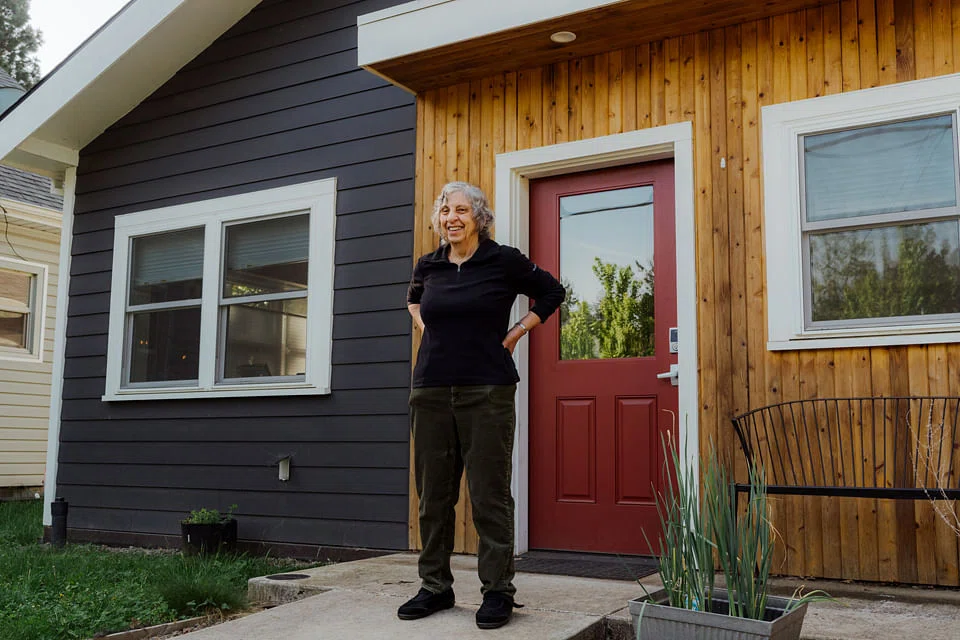
For Alice Savage, 74, a retired college professor and dean, a one-bedroom ADU in the backyard of her daughter's home in Portland, Oregon, became even more of a haven when she received a cancer diagnosis last January.
Its cozy, manageable size has been a blessing, Ms Savage said of her single-storey 576-sq-ft home, which was completed in late 2016 by Environs, a local design-build company. A stepless front entry and a concrete walkway sloped to the sidewalk allows easy passage between indoor and outdoor spaces. A shared outdoor courtyard connects her home to the one where her daughter, Megan Savage, and son-in-law, Rick Freed, live.
Although she had downsized from a larger condo to the ADU, it did not mean there was any skimping on personal preferences.
"I wanted a 'real' full kitchen and a small area for a desk. I wanted lots of natural light, crucial in Portland in winter, and ended up with three skylights plus good windows," said Alice Savage, who spent about US$125,000 on the home.
The bedroom is moderately sized with a long closet, and the bathroom, which is purposely large at 11 by 7 feet, features a curbless shower, grab bars, and a showerhead with a detachable hand-held sprayer that can be used sitting or standing.
There's also ample room between fixtures for a walker or wheelchair, should they become necessary. Interior pocket doors are one space-saving measure and also create wider doorways in an instant.
For the throuple in Connecticut, final touches for their custom-built home, which cost approximately US$1.3 million, were put into place at the beginning of 2020, right before Covid-19 hit.
"This was the conclusion of a process started six years ago. It was fortuitous that the home was ready just before the pandemic hit," Mr Jomini, 64, said.
"It's hard to imagine a better place to adapt to and weather the pandemic," Ms Farnsworth said. "We feel very fortunate". Small details mattered in big ways, they found, and they were glad to have taken the time to select lever-style door handles and programmable lighting and locks, along with automated smart-home features to track water flow and monitor security and lighting.
A separate wing, which contains a half-flight of stairs, was built to accommodate a live-in caregiver if the need arises. Currently, the area features an office, home gym, laundry room and small bathroom. A private outdoor courtyard centralises the herb garden, pool and patio area.
In the last year, the house and the town have both felt like a safe haven, Ms Hough said, and, thanks to the family's commitment to landscaping and gardening the property themselves, the land "has taken shape beyond my wildest expectations". Indoors, life in the airy home revolves around the vast great room, everyone's favourite space, which has floor-to-ceiling windows facing marshland.
"It's spectacular," Mr Jomini said of the view. "We have an endless 'Cinemax' of birds, foxes, deer and bobcats under our windows." NYTIMES
Decoding Asia newsletter: your guide to navigating Asia in a new global order. Sign up here to get Decoding Asia newsletter. Delivered to your inbox. Free.
Share with us your feedback on BT's products and services
TRENDING NOW

‘Boring’ is the new black: The stars are aligning for a Singapore stock market revival

Near sell-out launches in March boost developer sales to 1,300 units after four slow months

China pips the US if Asean is forced to choose, but analysts warn against reading it like a sports result

Genting Singapore’s Lim Kok Thay receives S$7.5 million pay package for FY2025

