

How the pandemic left the US$25b Hudson Yards eerily deserted
The largest private development in US history is struggling with unsold luxury condos and a mall barren of shoppers
 Add BT as a preferred source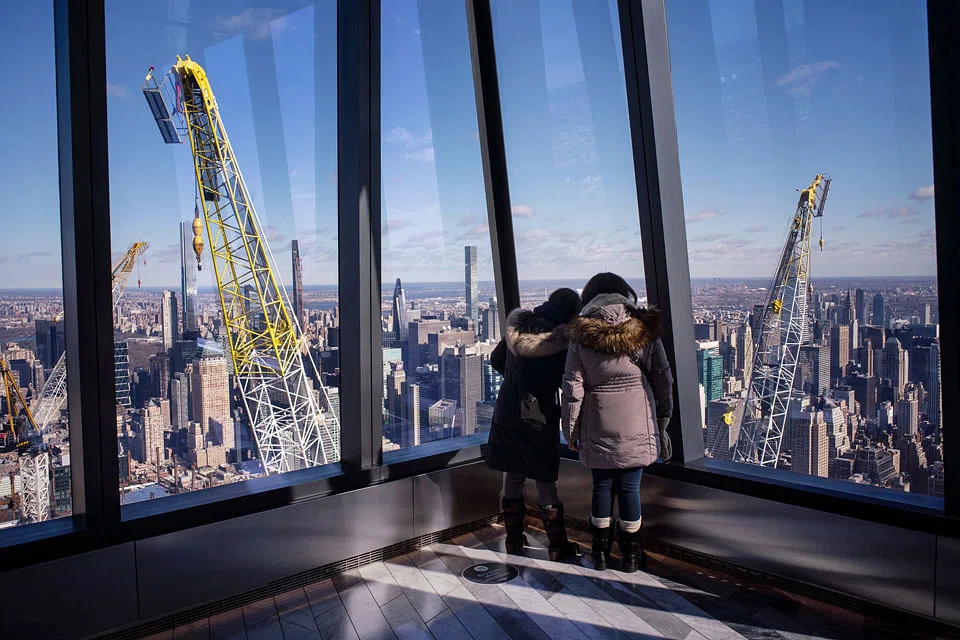
DeeperDive is a beta AI feature. Refer to full articles for the facts.
New York
WHEN Hudson Yards opened in 2019 as the largest private development in American history, it aspired to transform Manhattan's Far West Side with a sleek spread of ultra-luxury condominiums, office towers for powerhouse companies like Facebook, and a mall with coveted international brands and restaurants by celebrity chefs like José Andrés.
All of it surrounded a copper-coloured sculpture that would be to New York what the Eiffel Tower is to Paris.
But the pandemic has ravaged New York City's real estate market and its premier, US$25 billion development, raising significant questions about the future of Hudson Yards.
Hundreds of condominiums remain unsold, and the mall is barren of customers. Its anchor tenant, Neiman Marcus, filed for bankruptcy and closed permanently, and at least four other stores, as well as several restaurants, have also gone out of business.
The development's centrepiece, the 150-foot-tall scalable structure known as the Vessel, closed to visitors in January after a third suicide in less than a year. The office buildings, whose workers sustained many of the shops and restaurants, have been largely empty since spring.
Navigate Asia in
a new global order
Get the insights delivered to your inbox.
Even more perilous, the promised second phase of Hudson Yards - eight additional buildings, including a school, more luxury condos and office space - appears on indefinite hold as the developer, the Related Cos, seeks federal financing for a nearly 10-acre platform on which it will be built.
Related, which had said the entire project would be finished in 2024, no longer offers an estimated completion date. The project's woes are in many ways a microcosm of the broader challenges facing the city as it tries to recover.
Related said it was counting on wealthy buyers filling its condos and deep-pocketed customers packing the mall to make Hudson Yards financially viable. But that was before the coronavirus arrived in New York.
With the pandemic forcing white-collar workers to stay home - and keeping foreign buyers and tourists away - it is not clear when, or if, demand will reignite for the vast supply of upscale aeries and blue-chip office space crowding the city's skyline.
"The challenges facing Hudson Yards aren't unique," said Danny Ismail, an analyst and lead of office coverage for real estate research firm Green Street Advisors. "All commercial real estate in New York City has been impacted by Covid-19. However, I would argue that post-pandemic, Hudson Yards and the area around it will be one of the better office markets in New York City."
The creation of Hudson Yards capped nearly 30 years of planning for the last large, undeveloped parcel in Manhattan, industrial land between Pennsylvania Station and the Hudson River.
It is New York's largest public-private venture and the city's biggest development since Rockefeller Center in the 1930s, aided by roughly US$6 billion in tax breaks and other government assistance, including the expansion of the subway to the West Side. Even with the subway expansion, Hudson Yards is still relatively isolated from the rest of Manhattan, off the beaten path from the busiest avenues for tourists, shoppers and workers.
Related acknowledged that it was facing the same financial problems as the rest of the city, but said tenants were still moving into the project's office buildings and that Hudson Yards would eventually rebound.
Four office buildings at Hudson Yards - including 50 Hudson Yards, which is under construction - are 93 per cent leased, a spokesperson for Related said, though it is unclear how much of that occurred last year. Facebook signed a lease in late 2019 for roughly 1.5 million square feet.
"Our strong office leasing, even during the pandemic, is why we're well positioned to lead New York's comeback from Covid and why the adjacent neighbourhoods and the entire West Side will recover faster," the spokesperson, Jon Weinstein, said.
Still, the troubles confronting Hudson Yards have caused Related to rethink its plans.
Led by its billionaire founder Stephen Ross, the company set out to build Hudson Yards in two phases. The first phase, which opened in 2019, has four office towers, two residential buildings, a hotel and the mall. The second part was supposed to include 3,000 residences across eight buildings closer to the Hudson River, as well as a 750-seat public school and hundreds of low-cost rental units. At least 265 apartments are meant to be "permanently affordable", according to a 2009 agreement between City Hall and Related.
Related is also facing pressure from its investors to deliver a fuller accounting of the project's finances. A group of 35 investors from China - a sliver of the roughly 2,400 who contributed US$1.2 billion to Hudson Yards - sued the company last year, accusing it of refusing to open its books or say when it might repay their investments.
An arbitrator in the case recently denied the investors' claims and ruled that Related was not required to disclose detailed financial information.
The company's lawyers said that Hudson Yards was facing "significant headwinds as a result of Covid-19" and that because of the economic downturn and lockdown restrictions, it may be unable to recoup its investment in at least one property there, 35 Hudson Yards, a mixed-use tower with a hotel, according to filings in the case obtained by The New York Times.
Another group of Chinese investors, whose contributions of US$500,000 per person were part of a United States visa programme that can grant them a path to citizenship, are said to also be considering filing a similar lawsuit against Related, according to a person familiar with the situation who was not authorised to speak publicly.
Related made it clear before the outbreak that it intended to earn the bulk of its money at Hudson Yards through its condos and mall since Mr Ross said it had been leasing office space at cost, without taking a profit.
The pandemic has laid bare the tough road Related faces. In 2020, 30 residential units sold at Hudson Yards, compared with 157 the year before, according to an analysis for the Times by appraisal firm Miller Samuel. So far this year, several condos are under contract at Hudson Yards, according to Related, a possible sign that the market may be stabilising.
Still, Manhattan has a record number of condos for sale right now, especially luxury units like those at Hudson Yards, and it could take years for sales to truly bounce back, according to Nancy Wu, an economist at StreetEasy.
"Hudson Yards was built for a buyer that's no longer there and maybe partly a tenant that's no longer there, and that was someone who wanted to live in Manhattan but not live in the city per se," said Richard Florida, a professor at the University of Toronto's Rotman School of Management and School of Cities, referring to the development's homogeneity and somewhat isolated location.
The retail picture is also bleak. The vast space occupied by the failed Neiman Marcus store will no longer be taken by another retailer. Instead, Related will convert it into more offices.
While the mall was closed by lockdown orders from mid-March to early September, shoppers are still largely absent. Related has battled its other beleaguered retail tenants, even threatening stores with US$1,500 per day fines for failing to stay open after the mall reopened. Several stores, including Forty Five Ten, a luxury clothing store from Dallas that opened alongside Neiman Marcus, have shuttered permanently. The mall opened with 79 stores and now has 89, Related said.
Related said the mall had added at least 11 stores since September, including Herman Miller, Levi's and Sunglass Hut.
Despite the uncertainty, Hudson Yards has already helped turn the neighbourhood into a key business district and part of a stretch of Manhattan along the West Side that is becoming a major tech corridor.
The development has attracted a who's who of companies, including HBO, CNN, L'Oréal USA, BlackRock and Tapestry, the parent company of Coach, Kate Spade New York and Stuart Weitzman. NYTIMES
Decoding Asia newsletter: your guide to navigating Asia in a new global order. Sign up here to get Decoding Asia newsletter. Delivered to your inbox. Free.
Share with us your feedback on BT's products and services
TRENDING NOW

Shelving S$5 billion office redevelopment plan proved ‘wise’ as geopolitical risks mount: OCBC chairman

Eurokars Group introduces rental car franchises Enterprise Rent-A-Car, National Car Rental, and Alamo to Singapore
20 photos that show how dramatically Singapore has changed in two decades
Singapore’s key exports up 15.3% in March from electronics surge, exceeding forecasts

