Jewel Changi Airport regains its glitter, but for some tenants it’s too little, too late

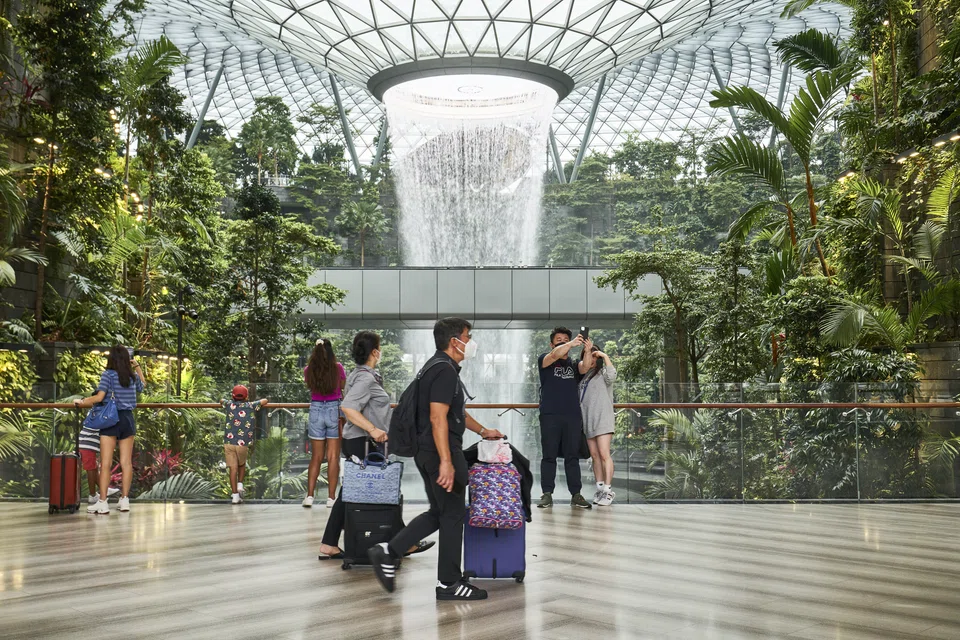
JEWEL, the 1.46 million square feet (sq ft) mall at Changi Airport, recorded its best ever monthly retail sales in December 2022 as shoppers and tourists returned in force.
Prospects look rosy with airport passenger traffic and retail footfall recovering strongly. But the going has been tough on tenants at the glossy new mall that opened some nine months before the Covid-19 pandemic paralysed businesses.
Some 74 tenants have exited the three-year-old mall over the last two years, more than half due to a revamp of Jewel’s Basement 1 space. British retailer Marks & Spencer will soon shut its Jewel store too. The mall, connected to the arrival hall of Terminal 1 of Changi Airport, opened in 2019 with more than 280 tenants operating.
Jewel is run by Jewel Changi Airport Development (JCAD), a joint venture between Changi Airport Group (CAG) and CapitaLand, with CAG holding a 51 per cent share.
The tenant churn at Jewel crystallises all the difficulties facing retailers across the island, exacerbated by factors specific to the airpoint-linked mall.
Lee Siew Ling, senior director of retail at JLL, noted that low footfall and discouraging retail sales over a prolonged period during the pandemic resulted in considerable losses for tenants and led to exits.
While the return of tourists in the later part of 2022 certainly helped boost sales, “Jewel is a leisure and lifestyle destination with its own unique value proposition. It has seen a significant proportion of local visitors who have contributed more than half of Jewel’s sales,” said James Fong, chief executive officer of JCAD.
During the pandemic, tenants were affected by the “challenging operating climate”, Fong said, but JCAD provided rental rebates and waivers to help tide them through.
In 2021, Jewel was shut for a month from May 13 to Jun 13 following the detection of positive Covid cases at Changi’s passenger terminal buildings.
During the closure, tenants received rental waivers, and full waivers were extended by a week after the mall reopened. Additional rental assistance was given the following week.
“While rental rebates and waivers helped lower tenants’ overall operating costs, some of these businesses remain unsustainable as other components of rising business costs such as salaries and utility continue to drain operational cash flow and deplete business reserves,” said JLL’s Lee.
“These issues hurt all retailers and malls but more so for Jewel due to its proximity to the airport,” said Lee.
She noted that Jewel retail is perceived to be tourist-centric compared to malls in the city that have a larger domestic consumer base, broader outreach and incidental traffic. “Based on observations, fewer tenants left suburban malls as compared to Jewel.”
Lam Chern Woon, head of research and consulting at Edmund Tie, said rents at Jewel softened by about 5 to 10 per cent during the pandemic. In the second half of 2022, median rents were observed to be from about S$10 to more than S$40 per square foot (psf) per month, depending on size and floor-level. Jewel declined to give leasing details.
In comparison, average gross rents for prime Orchard Road retail space were S$29.10 psf per month in Q4 2022, up by 2.2 per cent from the previous quarter, according to Knight Frank data. In popular suburban malls such as Nex, average gross rents were S$26 psf per month in Q4, 2022, up 1 per cent from the previous quarter.
Jewel houses several different types of retail space, including huge duplex-type stores, F&B outlets with garden terraces and F&B outlets at the Canopy Park. These are spaces where tenants would likely be paying a premium in rents, Lam noted.
“Anecdotally, the duplex-type stores, including Muji, Nike and Starbucks, were mostly able to see through the pandemic while some of the F&B stores renting such unique spaces were hit harder and saw more closures,” said Lam.
“Most of these stores featured conceptual F&B dining experiences or were relatively new in their expansions within Singapore,” he added. “One consideration could be the heavier amortisation of the extensive fit-outs which hurt the bottom line.”
In 2021, JCAD initiated a revamp in the mall’s Basement 1, taking the opportunity to rework some space during the downtime when borders were closed and tenants’ leases ended. Enhancement works included merging corridors and combining units.
Affected tenants were served a notice of renovation and some relocated to other units in the mall, said Fong. Jewel declined to comment on which tenants moved out, but said a new concept was in the works for the B1 area.
A check of Jewel’s store directory showed most of the existing tenants at B1 to be household names such as Charles & Keith, Chomel, GG5, Owndays, Lenskart, SK Jewellery, Uniqlo and Zara.
In 2022, works at some areas that started in January were completed ahead of schedule and 54 new tenants opened in Jewel, said Fong. Fresh entrants into the B1 level include popular Japanese discount stores Don Don Donki and Miniso, fast food chain McDonald’s and patisserie Paul bakery. New names on other levels include a Michelin Bib Gourmand concept from Hong Kong, Tai Er, and conveyor belt sushi joint Sushiro.
Retail sales at Jewel for December 2022 were 8 per cent higher than in December 2019, which was the strongest month the mall has seen since opening its doors to the public, said JCAD’s Fong. Footfall in 2022 was twice the volume seen in 2021. Jewel declined to give details.
The strong December showing at Jewel reflected a similar recovery in sales at the airport’s stores. Stores in the airport’s transit and public areas rang up total sales of S$1.1 billion (including online sales) in 2022, about 37 per cent of sales in 2019. Sales rebounded in December on the back of a recovery in passenger traffic, to about 58 per cent of 2019 levels.
Passenger traffic in Changi Airport hit 4.6 million movements in December 2022, reaching 72 per cent of pre-pandemic traffic in 2019. More than 1.1 million passengers were handled from Dec 12 to Dec 18, or 82 per cent of the weekly average in 2019, making it the busiest week of the year. For the full year, the airport handled 32.2 million passengers in 2022, or about half of the traffic in 2019.
Top performing retailers include fashion brand Coach and sportswear and footwear brands such as Foot Locker and Nike. Top performing restaurants include hot pot chain Beauty in the Pot and Din Tai Fung.
“We also observed repeat spending from shoppers at stores such as Pokemon Center Singapore, indicating a strong presence of its followers and the unique positioning of its store at Jewel,” said Fong.
“With new brands set to open at Jewel in the coming months, we would be reaching full occupancy soon,” said Fong. Currently, 35 per cent of tenants are food and beverage (F&B) outlets, and the rest are retail.
Wong Xian Yang, head of research at Cushman & Wakefield, said being connected to the airport provides brand exposure to tourists for both local and international brands at Jewel.
Edmund Tie’s Lam said: “Retail sales in Jewel will likely continue to see an upward trend in 2023, following the tourism revival with increasing international visitor arrivals.”
The rebound may have come too little, too late for some.
On Feb 6, Marks and Spencer announced the closure of its Jewel store. The store was part of the original crop of brands setting up shop at Jewel and occupies 11,840 sq ft of space. The net lettable area of Jewel is about 592,000 sq ft.
Troubled homegrown retailer Naiise closed its 9,500 sq ft Jewel store in April 2021 after also shutting down its other Singapore outlets in Paya Lebar and Orchard. The company subsequently filed for liquidation after struggling to pay its consignment vendors.
The pandemic has changed some tenants’ outlook, risk appetite and operating requirements, said Lee from JLL.
Many retailers now prefer to expand into locations with a wide customer base, seven-day trade potential and greater opportunity to leverage the delivery sales part of the business and a reduction in size requirement for greater efficiency.
TRENDING NOW
UOB found ‘grossly negligent’ over Stamford Land rights issue advice, to pay S$1.9 million
MAS allocates S$1.45 billion to five asset managers in third EQDP batch: Chee Hong Tat
He built the Vingroup empire. Now South-east Asia’s richest man is handing some key roles to his sons
NoMad Singapore marks brand’s arrival in Asia