

Keppel aims for at least 20% reduction in energy use intensity for assets under sustainability fund strategy
Its approach makes decarbonisation and sustainability integral to investments

[SINGAPORE] While urban rejuvenation often involves a new build from scratch on vacant, undeveloped land, Keppel has taken a different tack with its sustainable urban renewal (SUR) strategy.
The real asset manager and operator acquires older buildings and retrofits or redevelops the brownfield assets, with the aim of the strategy to reduce energy use intensity by at least 20 per cent on a portfolio basis, compared to pre-retrofit levels.
“Keppel’s SUR strategy is one of the few funds in Asia-Pacific to embed clear sustainability targets at the fund level. Our approach makes decarbonisation and sustainability integral to the investment thesis itself,” said Christina Tan, Keppel’s chief executive officer for fund management and chief investment officer, in an interview with The Business Times.
“Buildings account for around 40 per cent of global carbon emissions. The large stock of ageing buildings in Asia’s gateway cities presents a compelling opportunity for decarbonisation and value creation.”
In August, Keppel private funds under the SUR strategy announced the acquisition of the office component of Jem for S$462 million. The Grade A office asset is expected to undergo targeted upgrading works to reduce its energy use intensity.
More of such acquisitions are in the pipeline, Tan said, with Keppel’s private funds looking at the commercial, living, life sciences, hospitality and logistics sectors in gateway cities across Asia-Pacific.
To date, Keppel’s SUR strategy has total funds under management of about S$4.3 billion, after securing an additional S$760 million in capital commitments in April 2025, including from one of Europe’s largest pension funds. The strategy targets real estate assets which can generate returns in the low to mid-teens upon divestment.
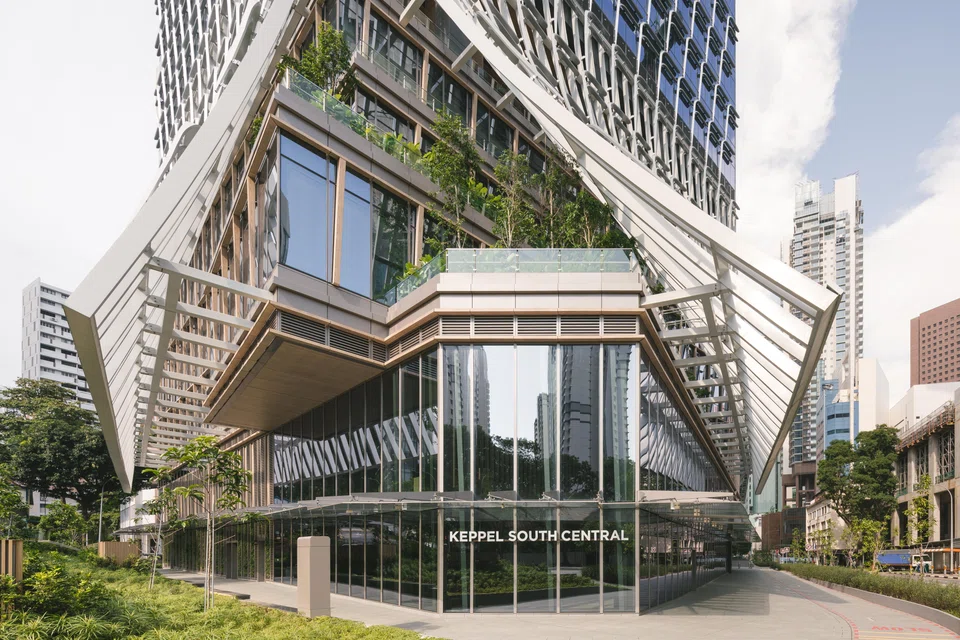
Sustainability initiatives have also been implemented in assets within Keppel’s own portfolio, such as the newly completed Keppel South Central, a 33-storey development in Tanjong Pagar rebuilt from the former Keppel Towers.
The building includes solar panels, smart lighting, high-efficiency chillers and a micro-zoned air-conditioning system that allows tenants to cool specific areas of their spaces instead of entire floors.
Keppel South Central’s green features allow it to save about 6.2 million kilowatt-hours of energy a year, enough to power 1,300 households for a year.
“Currently, nearly 50 per cent of the office space and retail units at Keppel South Central are either committed or being negotiated. We have received interest from prospective tenants, including large multinational corporations in the technology, transport, consultancy, insurance and finance sectors, especially among those who are looking for ready, high-performance spaces that align with their sustainability goals,” Keppel said.
Rents at the building are comparable to other Grade A office buildings in the Central Business District, which range from S$11 per square foot per month (psf pm) to S$13 psf pm, the asset manager added.
Beyond energy savings, Keppel’s sustainability initiatives have translated into tangible increases in return on investments.
The decision to retrofit Keppel Bay Tower in the HarbourFront area instead of rebuilding it led to a reduction of approximately 34,000 tonnes of embodied carbon emissions, Tan said.
“Now, Keppel Bay Tower operates at about 30 per cent higher energy efficiency than it used to in 2017, and about 40 per cent higher energy efficiency than the average large office building in Singapore.”
These upgrades also boosted the building’s net operating income by 31 per cent in the first year after the retrofitting was completed, and generated an estimated S$150 million uplift in asset value, Tan added.
“Retrofitting is inherently more complex than new developments because you work with existing structures, systems and tenants,” she noted. “It often requires extensive planning and testing, staged implementation and work done during off-peak hours, in order to minimise disruption to the building operations and tenants.”
Cost-effective method
While retrofitting may seem more time-consuming and operationally challenging, it remains the more cost-effective method to rejuvenate older buildings, especially once the cost and environmental impact of demolition and construction are factored in, Tan said.
Redeveloping a new building on the scale of Keppel Bay Tower would have cost about S$250 million, whereas Keppel invested only about S$12 million in asset enhancement initiatives (AEIs) for the building. The retrofits were further supported by S$1.3 million from the Building and Construction Authority’s Green Buildings Innovation Cluster Programme grant.
Cost savings were also achieved at Inno88 Tower, an office building in Seoul that Keppel acquired in 2022 together with its private funds.
Tan said: “As part of the AEI, we incorporated various sustainability features – such as high-performance building facades, energy-efficient cooling and heating systems, smart lighting systems, indoor environmental quality monitoring as well as intelligent building controls – to improve the asset’s operational efficiencies and performance.”
The project is on track to deliver a 26 per cent increase in gross floor area, and targets a 30 per cent decrease in energy consumption on achieving steady state, which would result in estimated annual cost savings of approximately S$1.2 million, she said.
Tan added: “By quantifying and demonstrating the tangible returns from sustainability upgrades, we show how environmental enhancements are not just good for the planet, but also a driver of long-term value creation for our investors.”






