

Manhattan's Farley Post Office will soon be a grand train hall
New York
AFTER 25 years of talk about turning the main post office in Manhattan into an extension of Pennsylvania Station, construction toward that ambitious and expensive goal is about to get underway.
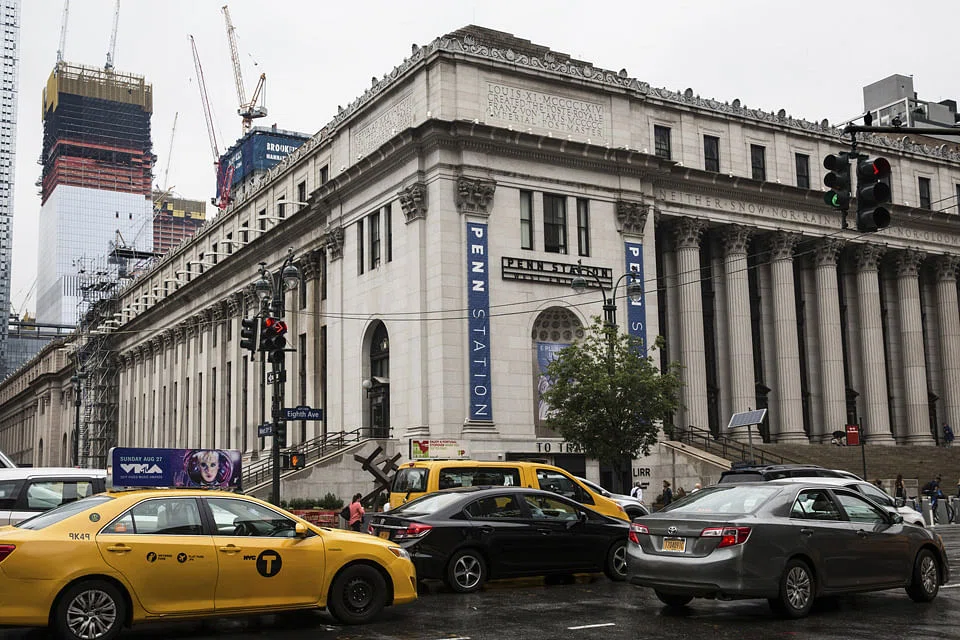
Next week, workers will shift from demolishing sections of the 105-year-old James A Farley Building to transforming it into a grand train hall for passengers of Amtrak and the Long Island Rail Road. The US$1.6 billion project is one of several high-cost improvements to New York's transportation system championed by Governor Andrew Cuomo, who has made transforming the region's infrastructure, including the airports and the subway system, into a central focus of his tenure.
When it comes to grand construction projects under his purview, the governor does not traffic in understatement.
On a tour of the Farley building this week, Mr Cuomo compared it favourably to Grand Central Terminal, which is generally considered one of the country's most awe-inspiring public spaces.
"Architecturally, you could argue this is going to be even more powerful than Grand Central," the governor said.
Mr Cuomo, a Democrat, spoke in grand terms about the acre of glass that will cover the vast hall and the original steel trusses that will hold the skylights aloft. Over the whir of drills and the crackle of welding torches, he explained how workers had spent the past several weeks demolishing the concrete-and-steel floor of the huge room where the city's mail once was sorted. The entire complex takes up two city blocks, from 31st Street to 33rd Street between Eighth and Ninth avenues.
Critics may differ about the current design - it is the fifth iteration of a plan first presented by Senator Daniel P Moynihan in the early 1990s - but there is little doubt that it will be a vast improvement over the existing Penn Station.
That building, across Eighth Avenue from the Farley, was already one of the most reviled transit hubs in the region before two trains derailed there this spring, spurring emergency repairs that have disrupted the routines of thousands of commuters this summer.
The Farley project will not solve Penn Station's operational problems or add capacity for more trains, but it will provide many passengers with a more pleasant place to wait to board trains. For diversions, it will contain 700,000 square feet of shops, restaurants and commercial space.
Two major private developers, Related Cos and Vornado, have agreed to contribute US$630 million toward the conversion in exchange for a 99-year lease on the Farley Building - excluding space along Eighth Avenue that the post office will retain.
The other US$970 million will come from public sources. The state, through the Empire State Development agency, has committed to invest US$550 million.
An additional US$100 million will come from the state-run Long Island Rail Road, said Rick Cotton, a counsellor to Mr Cuomo who this week assumed the top executive job at the Port Authority of New York and New Jersey. The Port Authority, controlled by Mr Cuomo and New Jersey Governor Chris Christie, is putting in US$150 million, Mr Cotton said. Amtrak and the federal government have also agreed to contribute to the project, he said.
Cuomo said the current arrangement is a much better deal for New Yorkers than an earlier plan that had the state contributing about US$500 million toward a train hall whose only tenant would have been Amtrak.
"We have more people coming to New York through Penn Station than JFK Airport, La Guardia Airport and Newark Airport combined," Mr Cuomo said. "That shouldn't be the first thing you see of New York, coming through the old Penn Station." When the new train hall opens, which is expected in late 2020, he said, "This will be an entrance befitting New York." NYTIMES
TRENDING NOW

World’s largest offshore wind platform by Seatrium consortium on track to be completed by 2028

Is stamp collecting enjoying an analogue revival or are its best days over?

GovTech retrenches another 38 staff in second round of layoffs

MBS adjusted property Ebitda falls 20.6% in Q3 with fewer high-roller visits, weaker hold

