

Mapletree aims to double AUM: CEO
Five-year target of S$40-50b comes amid move to diversify beyond Asia, because regional real estate markets are at "bubbling stage"
Singapore
MAPLETREE Investments is shooting for a doubling of assets under management (AUM) to S$40-50 billion over a five-year period to March 31, 2019 as it scours for opportunities beyond its core Asian markets.
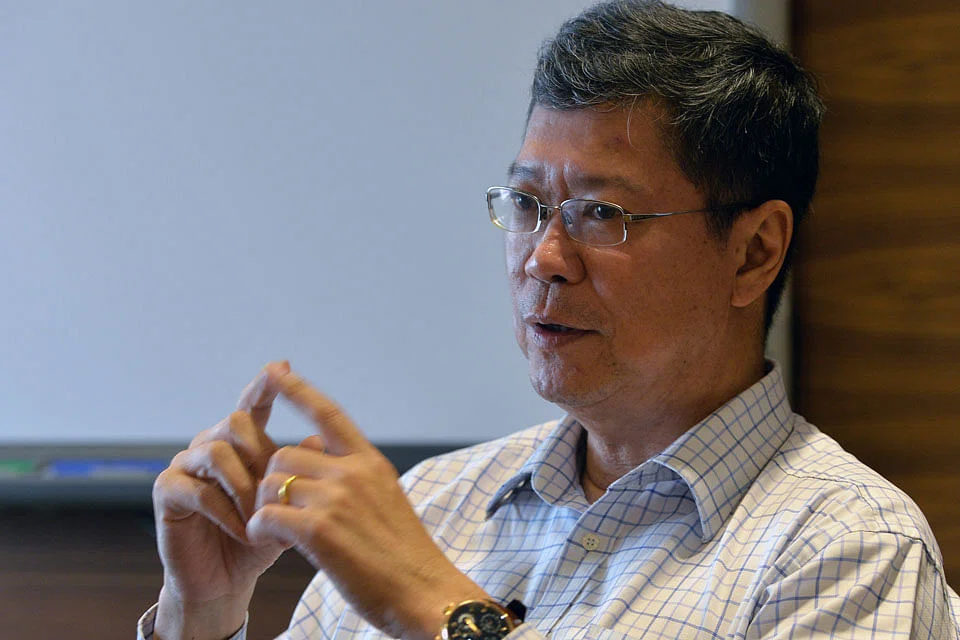
Chief executive Hiew Yoon Khong stressed, however, that size was not the end-game. The Temasek unit is gunning for sustainable returns as it maintains its target of an average return on invested equity (ROIE) at 10-15 per cent. It also hopes to achieve compounded growth of 10-15 per cent for net asset value over the five-year period.
New sources of growth are also expected to come from the US and Europe amid efforts by Mapletree to diversify outside of Asia, where markets are deemed highly correlated.
"Scale is not an end in itself," Mr Hiew told The Business Times. "To us, scale allows us to generate the returns that we want. We don't target scale for the sake of targeting scale. The primary focus is still the sustainability of the right level of returns."
Mapletree's AUM as at March 31, 2015 is already in excess of S$27 billion, Mr Hiew pointed out. It had reported AUM of S$24.6 billion as at March 31, 2014 in its FY13/14 annual report, when it first spelt out the new five-year targets.
The move to diversify beyond Asia is in fact a diversification of opportunities and risks, prompted by the view that the US market is on a recovery while Asian real estate markets are at "bubbling stage", Mr Hiew explained.
In the US, Mapletree hopes to leverage on its partnership with corporate housing and serviced apartment provider Oakwood Worldwide, which is sourcing for acquisition and development deals for Mapletree in North America. Mapletree's tie-up with Oakwood last year, when it took a 49 per cent stake in Oakwood's Asia arm, also gave Mapletree the right to use the Oakwood brand for serviced apartments that it buys and develops.
Mr Hiew explained that the corporate housing segment that Oakwood focuses on in the US entails lower operating costs, higher margins, and greater efficiency in tenant arrangements, compared to the traditional serviced apartment product in Asia.
Oakwood's relationships with many multinational companies and Fortune 500 companies enable it to originate rental contracts - not unit by unit, but in multiple units and on longer-term tenures.
In Europe, Mapletree is evaluating and assessing certain deals in the more transparent, liquid and larger markets of the UK and Germany.
It is eyeing decentralised high-quality office assets in London that could yield 6-8 per cent returns, higher than the 4-6 per cent yield in core locations. Mapletree is also scouring for decentralised office assets in German cities such as Frankfurt, Hamburg and Munich where yields are estimated to be 5-7 per cent. Given the lower cost of financing in euro compared to the British pound, the resulting margins to be derived in Germany should be similar to the UK, Mr Hiew said.
Its earlier five-year targets to FY13/14 were largely met - AUM more than doubled to S$24.6 billion as at March 31, 2014 with 74 per cent being third-party AUM; average ROIE of 14.1 per cent surpassed its 10 per cent minimum target; while fee income crossed S$200 million in FY13/14, its annual report shows.
In line with an asset-light strategy, Mapletree is expecting third-party AUM to be more than three times of owned AUM by FY18/19 and to earn fee income in excess of S$1.5 billion over five years to FY18/19.
Mapletree manages six private real estate funds and four listed Reits. Last year, it created two Japan-dedicated funds - one to acquire income-generating office space in or around CBD fringe within Greater Tokyo and the other to buy logistics properties in Japan.
Mr Hiew is expecting yields from office and logistics assets in Japan to come in at 5-7 per cent. "A couple of years ago, we saw the commercial office market in Tokyo has come off quite a fair bit," he said. "We thought that some of the proposed government policies and economic activities that could be generated from the Olympics will provide some boost to the office sector. Based on what we have observed in the last two-three years, we think that that view was probably correct."
Its Japan office fund named MJOF has a committed capital of 65 billion yen (S$730 million), of which one-quarter is pumped into six assets in Greater Tokyo. The Japan logistics fund named MJLD has a committed capital of 51 billion yen and has invested 6 per cent of that in two development projects in Greater Tokyo.
Elsewhere, Mapletree marked its maiden acquisition in Australia - a freehold Grade-A office building in South Brisbane - last year. It plans to ramp up the Australian portfolio before injecting it into either a private fund or a listed Reit.
To navigate the soft patches in key markets, Mapletree is taking a focused approach in micro-markets, Mr Hiew said. In China, it is interested in residential projects only if they are catered to owner-occupiers. It hopes to tap strong demand for modern logistics facilities by seeking out development sites to build such facilities while keeping an eye on office assets only in cities like Beijing and Shanghai.
In its home ground Singapore, the group is slated to complete Mapletree Business City phase two (MBC II) in the first quarter of 2016 and hopes to achieve full commitment for the 1.2 million square feet of business space by the end of next year.
"We are keen to have long leases," Mr Hiew said. "We think the stability of cashflows is very valuable to us especially when you are thinking of injecting the asset into a Reit."
MBC II is now about 30 per cent committed. With asking rents a fraction of that in Singapore's prime business district, the spanking new business park with Grade-A office specifications is reportedly luring Google, Microsoft and other tenants from their existing spaces in the CBD.
TRENDING NOW

He built the Vingroup empire. Now South-east Asia’s richest man is handing some key roles to his sons
US dollar falters after Iran’s offer to reopen Hormuz sends oil lower
Temasek’s Wan Chee Foong to helm PIL, Lars Kastrup to be board adviser

Despite the de-dollarisation debate, demand for dollar liquidity in Asia is growing

