

Mapletree Investments eyes average ROE of 9% to 12% by FY2029, bets big on four sectors
Property giant will continue to invest prudently and take on a more active syndication and monetisation strategy, says group CEO

MAPLETREE Investments will sharpen its focus on four core sectors – data centres, logistics, offices and student housing – through strategic investments and increased development activity, it said in its annual report for the financial year ended Mar 31.
It is also aiming for an average return on equity (ROE) of between 9 and 12 per cent by FY2029 under its new five-year plan.
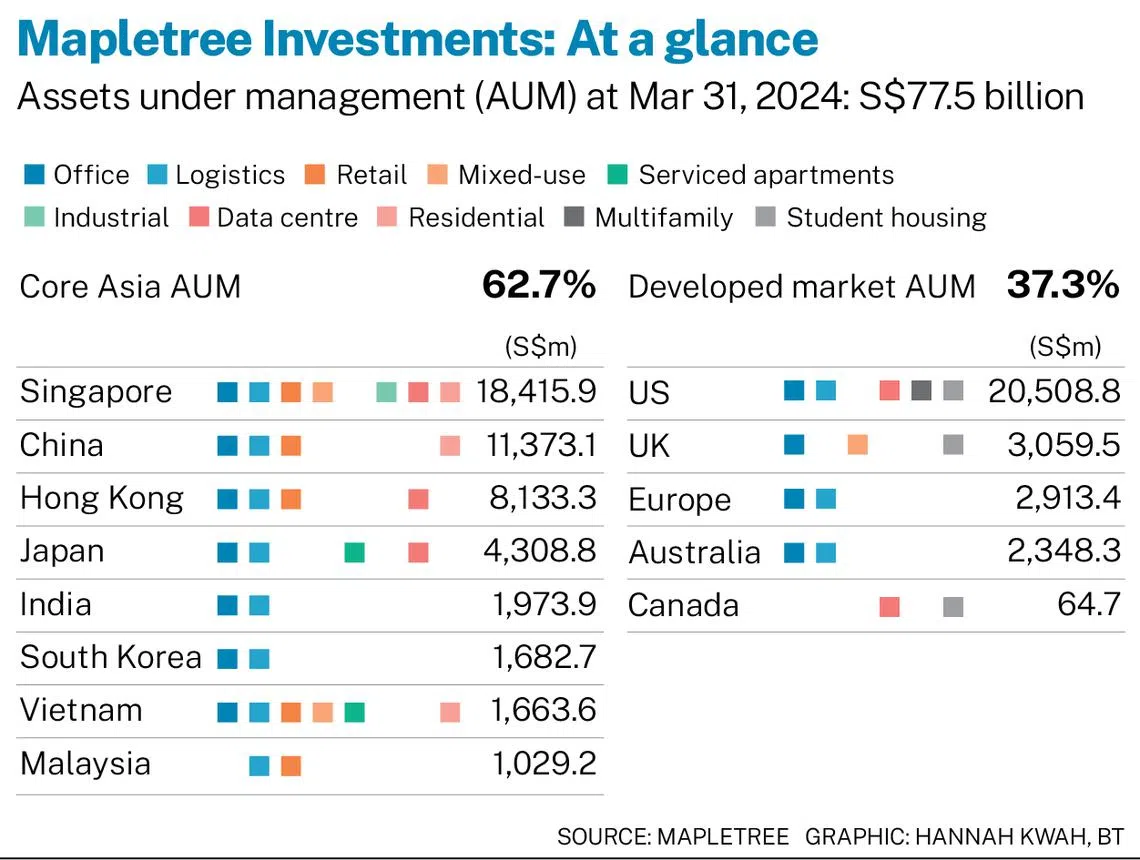
The property giant – wholly owned by state investment firm Temasek and with assets under management (AUM) at S$77.5 billion as at Mar 31 – will continue to invest prudently and take on a more active syndication and monetisation strategy, said group chief executive officer Hiew Yoon Khong in his message.
“Our investment decisions continue to be guided by prudence and discipline, focused on asset classes and markets with good growth potential over the next five years.”
Logistics, data centres, student housing and offices
The group will undertake and structure more development projects and funds in the logistics sector, especially in the US and Europe – on top of its development activity in Asia – for higher returns and better-quality products, Hiew said.
The data-centre market, with its strong fundamentals, has become a core focus area for the group, which will continue to invest in and develop assets in this sector globally, he added.
Mapletree Investments’ acquisitions in the US, Japan and Hong Kong have sent its AUM for data centres from just 2 per cent (S$1.1 billion) in FY2019 to 8 per cent (S$6.1 billion) in FY2024.
The group also continues to make significant inroads into student housing, a sector known for its resilience.
The group kicked off FY2025 by sealing an agreement to acquire 31 student-housing assets across the UK and Germany, and an operating platform. Hiew said of the deal: “The acquisition gives the group direct control as the manager and operator of the acquired portfolio, and makes it one of the largest owners of student housing in the UK, with over 17,000 beds.”
Financials and revaluation losses
For the financial year ended Mar 31, Mapletree Investments posted a net loss of S$577.2 million, from a net profit of S$1.2 billion last year.
Hiew said: “The heightened interest-rate environment had the largest impact on the group’s performance, resulting in revaluation losses, mainly from the commercial properties in the Western markets.”
Group revenue for the financial year stood at S$2.8 billion, down marginally from S$2.9 billion in the previous financial year. Recurring earnings were down 8.2 per cent to S$715.6 million from S$779.7 million; AUM gained slightly to S$77.5 billion, from S$77.4 billion the year before.
The group reported a negative ROE of 3.2 per cent, compared to its average of 6.9 per cent positive ROE between FY2020 and FY2024.
Strategic divestments to ‘de-risk’
For the financial year, the group recorded net proceeds of about S$1.4 billion from capital recycling activities.
These included the divestment of a retail tower in Osaka, Japan, the syndication of an India office asset to the strategic partnership fund with Ivanhoe Cambridge, and proceeds from the stake sale in Mapletree Logistics Trust (MLT).
MLT, with Mapletree Pan Asia Commercial Trust (MPACT) , were removed from the MSCI Singapore Index at the end of May.
The group noted in its annual report that strategic divestment is “a crucial way to de-risk and lock in profitability”.
In May, MPACT, one of the group’s three Singapore-listed real estate investment trusts (Reits), announced that it would divest Mapletree Anson, a 19-storey office building in Tanjong Pagar, for S$775 million.
The Business Times reported this month that Mapletree Investments is selling an eight-storey office building in Pasir Panjang to an entity linked to Keppel Education Asset Fund for S$160 million.
Hiew identified successful fund syndications as one of the group’s achievements in the last five years.
The seven new private real estate funds that were incepted contributed to a record of S$4.6 billion in funds raised, with the group’s total private fund AUM doubling in the five-year period to about S$22 billion.
As for the group’s Reits, Hiew said he was positive that they would continue to perform as the interest rate cycle normalises.






