Mapletree Investments shoots for high sustainable returns, eyes more acquisitions and development activity
The property giant achieved a 10.9% average annual return on invested equity in the last decade, and aims for between 9% and 12% average annual returns by FY28/29

[SINGAPORE] Mapletree Investments is homing in on targets in its fourth Five-Year Plan, eyeing more strategic acquisitions and ramping up development activity to generate high, sustainable returns.
Over the past 10 years, the Temasek-owned property giant has generated a 10.9 per cent average annual return on invested equity, and hit a record S$80.3 billion in assets under management (AUM).
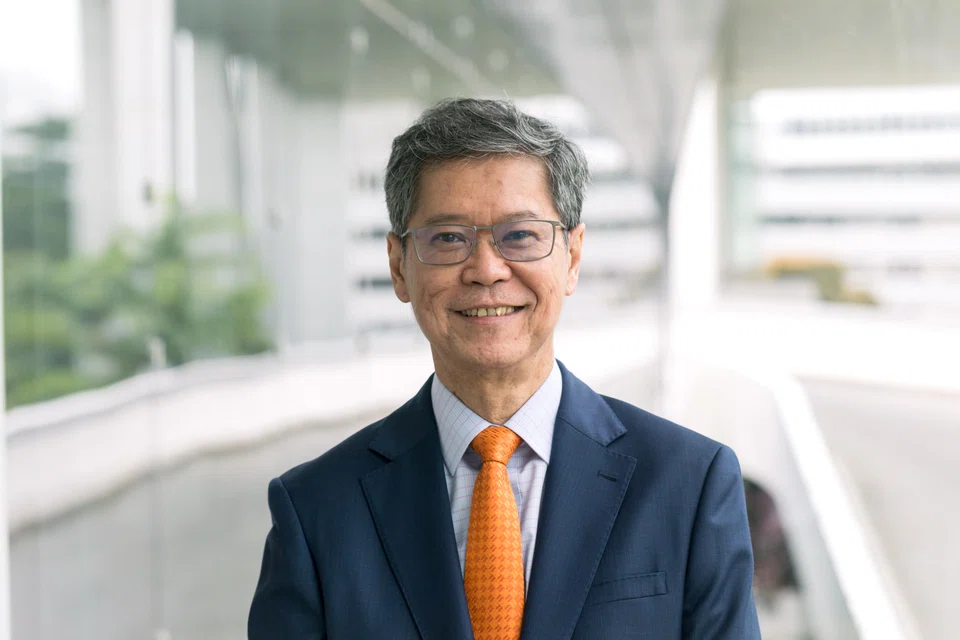
Its long-serving group chief executive officer Hiew Yoon Khong, in an e-mail interview with The Business Times, said: “From a Singapore-centric company, we have evolved into a global real estate leader with a diversified portfolio of over 930 assets across various asset classes in 13 markets.”
In the 25 years since Mapletree was formed as a holding company for PSA Corporation’s non-port properties, its AUM grew from S$2.3 billion in 2003 to S$80.3 billion as at Mar 31, 2025.
Third-party managed assets similarly swelled from S$700 million in FY05/06 to S$60.3 billion as at Mar 31 last year.
Over the same period, shareholder equity grew from S$2.5 billion to S$24.3 billion, with no new equity injections, Hiew noted.
As at Sep 30, 2025, its three real estate investment trusts – Mapletree Pan Asia Commercial Trust, Mapletree Logistics Trust and Mapletree Industrial Trust – had a combined market capitalisation of about S$20 billion.
A business model integrating real estate development, investment, capital and property management “has enabled us to navigate multiple market cycles and scale”, said Hiew.
Over the past five years, the group posted an average annual return of 8 per cent. This compares with its 15-year average annual return of 11.9 per cent, and 20-year average annual return of 10.2 per cent.
Mapletree is targeting an average annual return on invested equity of between 9 and 12 per cent by the end of its fourth Five-Year Plan in FY28/29.
In its latest earnings report, Mapletree reported a net profit of S$227.2 million for the full year ended Mar 31, 2025, reversing from a net loss of S$577.2 million the year before.
Hiew added: “We have grown our recurring-fee income significantly from S$8 million in FY05/06 to S$458 million in FY24/25.
“This recurring and growing income is a cornerstone of our business model, and the underlying value of recurring-fee income has yet to be appropriately appraised by the market.”
While it racked up S$403.5 million in net revaluation losses on investment properties and properties under development in the financial year ended Mar 31, 2024, such losses shrank to about S$25 million in the following year.
Banking on development
In recent months, talk was reignited of a possible merger between Temasek-owned Mapletree and publicly listed CapitaLand Investment, in which Temasek has a controlling stake of about 54 per cent. This comes as Temasek prepares for a major overhaul in April, under which it will restructure its operations into three entities: Temasek Global Investments, Temasek Singapore and Temasek Partnership Solutions. Hiew declined to comment.
While the market continues to speculate on when and what shape the long-rumoured merger would take, Mapletree is doubling down on its core competencies to continue to scale globally in four core sectors – logistics, office, data centre and student housing.
Aside from enhancing the operational performance of existing assets and capital raising, the group is focused on strategic acquisitions and leaning on its development expertise to increase the value-add to its portfolio, Hiew said.
“Development properties offer better risk-reward ratios compared to stabilised investment properties, particularly in a high cost of capital environment. It also helps us to differentiate ourselves from pure capital management players.”
The group plans to tear down and rebuild its HarbourFront Centre into a 33-storey integrated development comprising 26 floors of Grade-A office space, a retail podium and a elevated park. The complex, which will see a 26 per cent increase in gross floor area to 123,000 square metres (sq m), is expected to be completed by the first half of 2031.
Mapletree declined to comment on the estimated development cost of the project.
Next to HarbourFront Centre, VivoCity – Mapletree’s flagship retail asset in Singapore – recently underwent a major two-phase enhancement and is expected to deliver over 10 per cent in returns.
In Asia, Mapletree has established itself as a powerhouse in the logistics asset class, Hiew noted.
“Our focus is on delivering modern, high-specification assets in well-located markets that effectively support the needs of our tenants while generating double-digit returns for the group. We are now leveraging this expertise globally – including in other markets such as the US, Europe and Australia.”
In the US, Mapletree kicked off six development projects in the logistics sector, and plans to continue with its development strategy.
In Hong Kong, it acquired a large warehouse site in Tsing Yi, near Hong Kong’s Kwai Chung Container Terminals, for HK$3.68 billion (about S$610 million). The parcel, next to an existing Mapletree facility in the city, was reportedly acquired at a price that was 57 per cent below that for a nearby site sold in 2022.
As a developer, Mapletree manages the complete development life cycle, from feasibility and project initiation to design development, pre-construction, construction and project delivery, Hiew pointed out.
“Our teams on the ground are equipped with the expertise to navigate local legal and cultural complexities. They work closely with the local authorities and stakeholders to better understand the markets, which is essential for the effective management of development projects.”
Tapping the student housing boom
Already the fourth-largest student housing owner in the UK, Mapletree entered the booming Australian market last year. In August 2025, it acquired a plot of land in Perth, where it plans to develop an 835-bed student housing asset, its first in the sector in Australia.
Australia has attracted robust investor interest due to its large student population and potential for new supply to be developed and delivered, Hiew said.
“In most countries, the student housing sector is facing structural undersupply amid growing demand for higher education and enhanced student mobility. This combination of limited quality supply and rising demand presents favourable rental prospects and offers good potential for scalability,” he added.
“Another important factor driving investor interest is the sector’s resilience during economic downturns. The continued pursuit of higher education sustains demand for student accommodation, providing a steady stream of income.”
In the UK, where Mapletree holds assets housing more than 17,000 beds, the group is launching the syndication of a fund seeded with seven student housing assets, and with an AUM of £500 million (S$864 million) in early 2026. This is targeted to close by the end of the year.
And despite policy-driven headwinds, the US remains a huge student housing market, with one-third of the group’s 26,485 beds, Hiew said. “We will continue to strengthen our US student housing portfolio through strategic investment opportunities and operational improvements. We will also explore opportunities in new markets in continental Europe and selectively in Asia.”
The data-centre drive
Mapletree is also sharpening its focus on data centres, which it sees as a sector that is “fast-growing and resilient”. The group is pursuing opportunities in Tier-1 markets with strong connectivity, demand from hyperscalers, robust infrastructure and stable regulations such as London and Paris.
“We are also assessing high-growth secondary markets like Milan and Madrid for attractive yields and favourable risk-return profiles,” Hiew said.
Office and logistics
The office and logistics sectors have long been core to Mapletree’s portfolio. However, in the US, Europe, UK and Australia, persistent weakness in office demand and capital markets has led to a more challenging operating environment, he noted.
“We are beginning to see green shoots in our US portfolio, with vacancies getting filled up as more companies mandate return-to-office policies. We will continue to prioritise operational excellence to ride through the market cycle.”
The US is Mapletree’s largest market, accounting for a quarter of total AUM. Asked about plans for the region, Hiew said: “While inflation, tariffs and broader economic uncertainty continue to create challenges for businesses, the long-term outlook for the US logistics sector remains optimistic.”
He added: “Several forces are contributing to its momentum: rising consumer sales, continued growth in e-commerce, the reconfiguration of global supply chains and the on-shoring of manufacturing – all of which drive demand for US warehouse space.”
At the same time, the group continues to divest strategically to unlock value and free up capital. Over the year, Mapletree cashed out of three US logistics portfolios held by a private fund for a total of US$671.8 million, and sold a data centre asset in the US for US$11.8 million.
It also divested a logistics facility in South Korea for eight billion won (about S$7.4 million), and unloaded an Australian asset for A$60 million (S$51.6 million).
It let go of three Singapore industrial properties for S$535.3 million and two Japanese office assets for 8.7 billion yen (about S$78 million); it is also selling the office component of Festival Walk in Hong Kong.
The group is currently building a fresh European logistics-focused fund, seeded with assets in key European cities. Last year, it acquired a portfolio of 10 warehouses in Spain and two UK logistics assets for 315.1 million euros (about S$474 million).
In India, it is expanding its office footprint, building a Global Business City in Bengaluru and Global Business City in Pune.
In Vietnam, it acquired a land parcel in Hanoi to develop a 92,000 sq m Grade-A mixed-use office project with retail amenities.
Mapletree is maintaining its long-term commitment to China, which accounted for 14 per cent of total AUM as at March 2025, Hiew said. It owns over 140 assets in 70 cities in China.
While demand has been subdued in the office and residential market there, Mapletree has been employing proactive marketing and asset-management strategies to improve leasing and property transaction, Hiew added.