

Marina Bay transformed: a new chapter in Singapore’s urban planning story
The district is a new nexus with a mixture of offices, residences, hotels and event facilities
COME New Year’s Eve, as part of the One Countdown series of celebratory events islandwide, the Marina Bay Singapore Countdown will mark the year’s end with a flurry of activities.
Visitors can look forward to a light projection showcase at The Fullerton Hotel Singapore themed Brightening Lives, as well Sharing Joy, Celebrating with our Communities on UOB Plaza 1, and a spectacular 30-minute fireworks display choreographed to a curated hour-long music score.
The Marina Bay countdown event, an annual highlight presented by the Urban Redevelopment Authority (URA), will usher in 2026 while also wrapping up a milestone year of SG60 celebrations.
One landmark development for Singapore’s built environment was the Master Plan 2025, the statutory land use plan that guides the country’s development over the next 10 to 15 years. Unveiled in June as the Draft Master Plan 2025, it was officially gazetted by the URA on Dec 1, 2025.
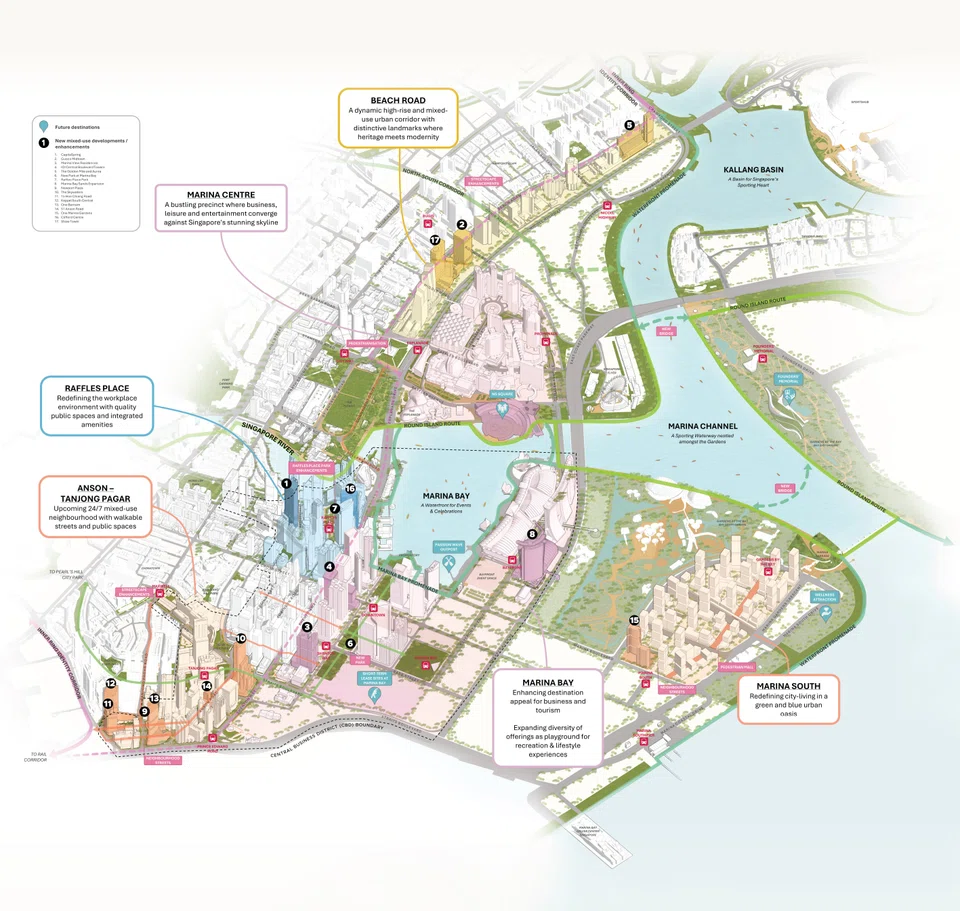
The year 2025 is also the 20th year anniversary of the launch of the Marina Bay brand. Back in 2005, then-minister for national development Mah Bow Tan outlined plans to promote the area as a new focal point for the city. Urban planning strategy centred on the concept of “work, live and play” would create a vibrant, 24/7 integrated precinct with residences, businesses and leisure facilities.
Plans for Marina Bay were first conceptualised in the 1970s as an extension of the Central Business District (CBD). Today, Marina Bay is a new nexus with a mixture of offices, residences, hotels, and event facilities, and is expected to continue to grow in prominence.
How did the district grow and evolve, and what other new developments can be expected in the years to come?
Work
Initial plans were for the area to be a state-of-the-art business and financial district, alive with business opportunities and conference venues.
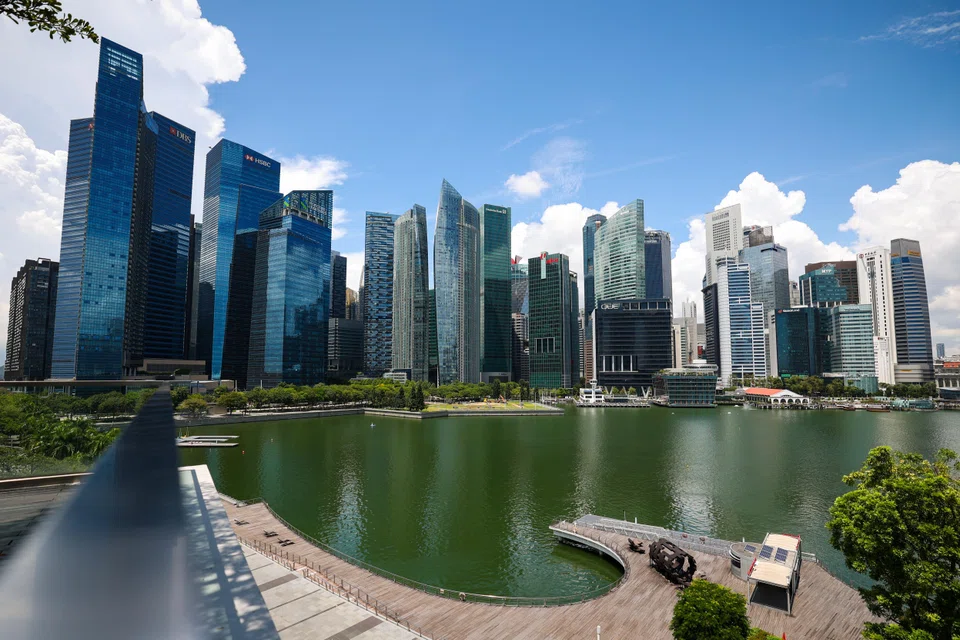
Since the completion of One Marina Boulevard in 2004 as the first office development, the Marina Bay office sub-market now boasts seven mixed developments with 12 office towers amounting to approximately 10.6 million square feet of net lettable area.
SEE ALSO

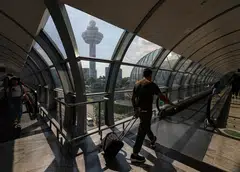
Developed by major Singapore players and partners from Hong Kong, Qatar and Malaysia, the precinct is today a highly sought-after address among multinational corporate occupiers.
Marina Bay is now home to a plethora of international occupiers from various industries from banks to wealth management firms, professional services and legal firms, technology companies as well as occupiers from the commodities, energy and shipping industries.
International players recently taking up office space in the precinct include Zoom and Jane Street at IOI Central Boulevard, and Robeco Singapore at Marina One East Tower.
Rents for the Grade A offices lead the office markets, supported mainly by low vacancies at sub-5 per cent rates. This is despite right-sizing decisions from some major occupiers and decentralisation options made available over the past few years.
The lure of a prestigious internationally renowned address remains vital for occupiers with a hub-and-spoke occupier strategy as well as for talent attraction.
Live
Cities around the world are evolving and placing greater emphasis on becoming multi-experiential places. Likewise, URA has been working to transform the Marina Bay area into a place of work, live and play.
Out of a government land sale (GLS) site tendered in 2002, the winning consortium led by City Developments Ltd (CDL) and AIG Global Real Estate built the first residential development in the new Marina Bay district, leveraging on the flexibility of the site’s white zoning.
The Sail @ Marina Bay Tower 1 was completed in 2008, and the second tower in 2009. The project was launched during a period of cautious economic recovery and market uncertainty in 2004, but its success has led to many “what ifs” and regrets from investors today.
Today, there are 3,653 completed residential units in the Marina Bay precinct. In addition to The Sail @ Marina Bay, other projects include Marina Bay Residences, Marina Bay Suites, Marina One Residences as well as V On Shenton and One Shenton.
Another 1,900 new residential units will be added to the enclave in the near future. Projects already launched for sale, such as One Marina Gardens and W Residences Marina View, are coming up on GLS sites.
Two more sites at Marina Gardens Crescent and Marina Gardens Lane are currently on the GLS Reserve List. Nearby, Newport Residences – slated to be launched in January 2026 – is a rejuvenation of the former Fuji Xerox Towers by CDL under the CBD Incentive (CBDI) Scheme.
These residential developments edging towards completion, together with the CBDI and Strategic Development Incentive (SDI) Schemes designed to nudge urban renewal, will certainly entrench the “live” element and transform our city centre and the CBD from an office-heavy business zone into a vibrant, 24/7 mixed-use district.
The CBDI and SDI Schemes were launched in 2019. The two schemes have since been refreshed in February 2025 and were extended for another five years.
The main vision of the CBDI scheme was to encourage sustainable rejuvenation of older, predominantly office buildings in areas such as Anson Road, Cecil Street, Robinson Road and Shenton Way.
Outside the CBD, the SDI scheme focuses on encouraging redevelopment of preferably two adjacent sites located in key areas such as Orchard Road, Marina Centre and the wider CBD fringe (such as the Singapore River).
Upcoming developments supported by the CBDI scheme in the Anson-Tanjong Pagar area include The Skywaters and Newport Plaza, while across the bay at Marina Centre, Singapore Land is redeveloping Marina Square into a hyper-mixed development under the SDI Scheme.
Play
Marina Bay has also emerged as the nation’s focal point for leisure and entertainment activities.
The glitz and glamour of the annual Formula 1 night race has drawn crowds both local and global for 16 seasons since 2008. It is worth mentioning that Marina Bay came into the international spotlight in 2005, with the F1 Powerboat World Championship Singapore Marina Bay Grand Prix.
For any precinct to be successful, there must be a strong balance of software curation and hardware provision. The URA works closely with private sector stakeholders under the pilot Business Improvement District (BID) programme, enabling place management projects such as Discover Tanjong Pagar, Marina Central, Raffles Place Alliance and Singapore River One to activate the precincts with events and activities.
The expansion of the iconic Marina Bay Sands will inject additional event facilities, a new rooftop attraction, and more retail and entertainment options in Marina Bay. This US$8 billion project will add a fourth hotel tower featuring all-suite luxury rooms as well as a 15,000-seat entertainment arena.
At the same time, the Singapore Tourism Board (STB) and relevant agencies are studying the development of a new meetings, incentives, conventions and exhibitions (Mice) hub in the downtown area, leaning on synergies of existing Mice venues and attractions located in the city. These efforts will boost Singapore’s capacity to host major international events and conferences.
On the local front, joggers, cyclists and families can be seen in the evenings and during the weekends crossing the iconic The Helix bridge to connect from the ArtScience Museum to the Esplanade – Theatres on the Bay while enjoying the views of the bay. At the same time, the waters of the bay play host to daily sightseeing cruises, dragon boating and sailing activities.
One can look forward to new additions like NS Square (to be completed in 2027) and Passion Wave Outpost @ Bayfront (to be completed in 2026) that will introduce more recreational offerings such as kayaking, dragon boating and pedal boating with new community sports facilities.
The definition of nightlife has also diversified over generations. Activities such as clubbing and alcohol-fuelled parties may not be as popular with the younger generation, as silent discos and sober or soft clubbing take hold. “Coffee raves” are also a new hit. Instead of pints, baristas serve high-end pour-overs and cold brews while DJs spin underground music.
Then there are also night activities focused on health and fitness, such as night cycling and night bouldering.
Marina Bay is poised to play host in the new nightlife scene.
By 2029, there will be two new bridges that will improve access to surrounding attractions, including Founders’ Memorial located at Bay East Garden that is slated to open at end-2028.
A new pedestrian bridge linking Bay East Garden to Bay South Garden will make it easier for visitors to explore both destinations and the wider Marina Bay precinct. The second bridge, targeted for completion by 2029, will provide pedestrians and cyclists with a more direct connection between the city and East Coast, along the Round Island Route.
There are also plans to roll out short-term sports uses while longer-term plans take shape. Other potential short-term uses could include destination food and beverage, retail and lifestyle offerings. Cyclists on overnight round island routes can make a pitstop at Marina Bay to refuel and freshen up, and pickleball fans can meet for a post-midnight game at a recreational club.
Marina Bay now has an additional feather to its cap: wellness. Going full circle in the Marina Bay story, it was reported that Mah, now out of politics, has led European spa operator Therme Group’s Singapore unit to win an STB tender to build Singapore’s first dedicated S$1 billion wellness attraction in Marina South, set to open by 2030.
What to look out for?
Looking ahead, Marina South is set to be further transformed into a lively mixed-use neighbourhood comprising a combination of residential, retail, hotel and office uses. When fully developed, the 45 hectare precinct will see about another 10,000 homes, supported by a wide range of amenities including parks, public spaces, sports facilities and recreational options for residents and visitors alike.
Envisioned to be a “People’s Bay”, the precinct is designed to host vibrant activities around the clock and brings together people from all walks of life. As part of its place management efforts, URA works closely with stakeholders and the community to manage a well-designed public realm around the Bay, and to enliven the area with year-round activities and programming.
Marina Bay has stood out as one of Singapore’s most successful urban transformation projects, and exemplifies the nation’s long-term and integrated approach to urban planning.
The writer is group CEO of Realion (OrangeTee & ETC) and member of the Design Advisory Committee for URA
Decoding Asia newsletter: your guide to navigating Asia in a new global order. Sign up here to get Decoding Asia newsletter. Delivered to your inbox. Free.
Share with us your feedback on BT's products and services
TRENDING NOW

LTA proposes combining car COE categories, adding rebate-surcharge system
StarHub to acquire MyRepublic’s mobile business amid ongoing telco consolidation

DBS, OCBC, UOB rout lops billions off STI as inflation, rate concerns spook investors

Grab CEO’s wife Chloe Tong on life with Anthony Tan and finding her purpose

