

Market watchers see value in branded residences in Singapore despite slow take-off
The rising number of high-net-worth individuals and their desire for elevated lifestyles bode well for the segment

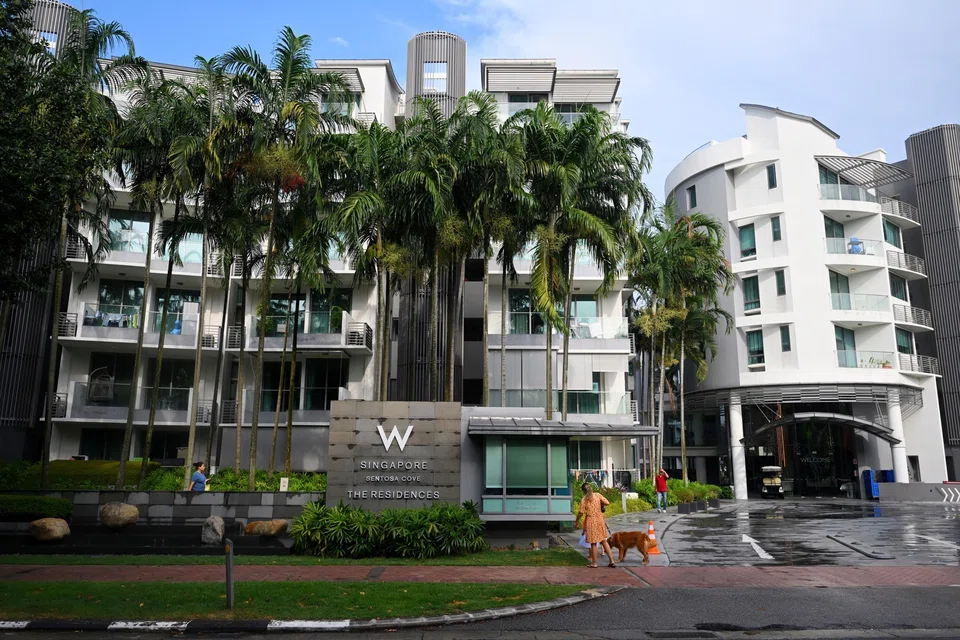
AT THE luxury end of the private housing market, does providing hotel-like amenities and concierge services tied to a brand provide an edge?
Such high-end residential properties are known as “branded residences”, and are generally considered among the “creme de la creme” property types in Singapore.
What is a branded residence?
Cho Kai Siang, JLL Hotels and Hospitality’s senior vice-president for advisory and asset management for the Asia-Pacific, said that these properties are developed and operated in partnership with a premium brand, typically from the hospitality, fashion or car sectors.
They thus combine the quality, services and prestige associated with the label, he added.
Savills Singapore’s executive director of research and consultancy, Alan Cheong, said that such a brand association “instils buyer confidence” by assuring a high level of service and exceptional amenities.
The enhanced services and amenities include dedicated concierge services, housekeeping, hotel-standard security and privacy, wellness facilities and other on-demand services.
He added: “The services offered are aimed at mirroring the reputation and ethos of the associated brand, and this ensures that residents receive the finest experience.”
Getting a branded home can also represent an emotional purchase of a “trophy asset” to buyers.
There is also less perceived risk for the project, given that the brand has vetted the developers before granting them a licence.
JLL’s Cho added that moreover, some branded residences offer rental programmes that help owners generate income to offset the service charges and returns when leasing out their units.
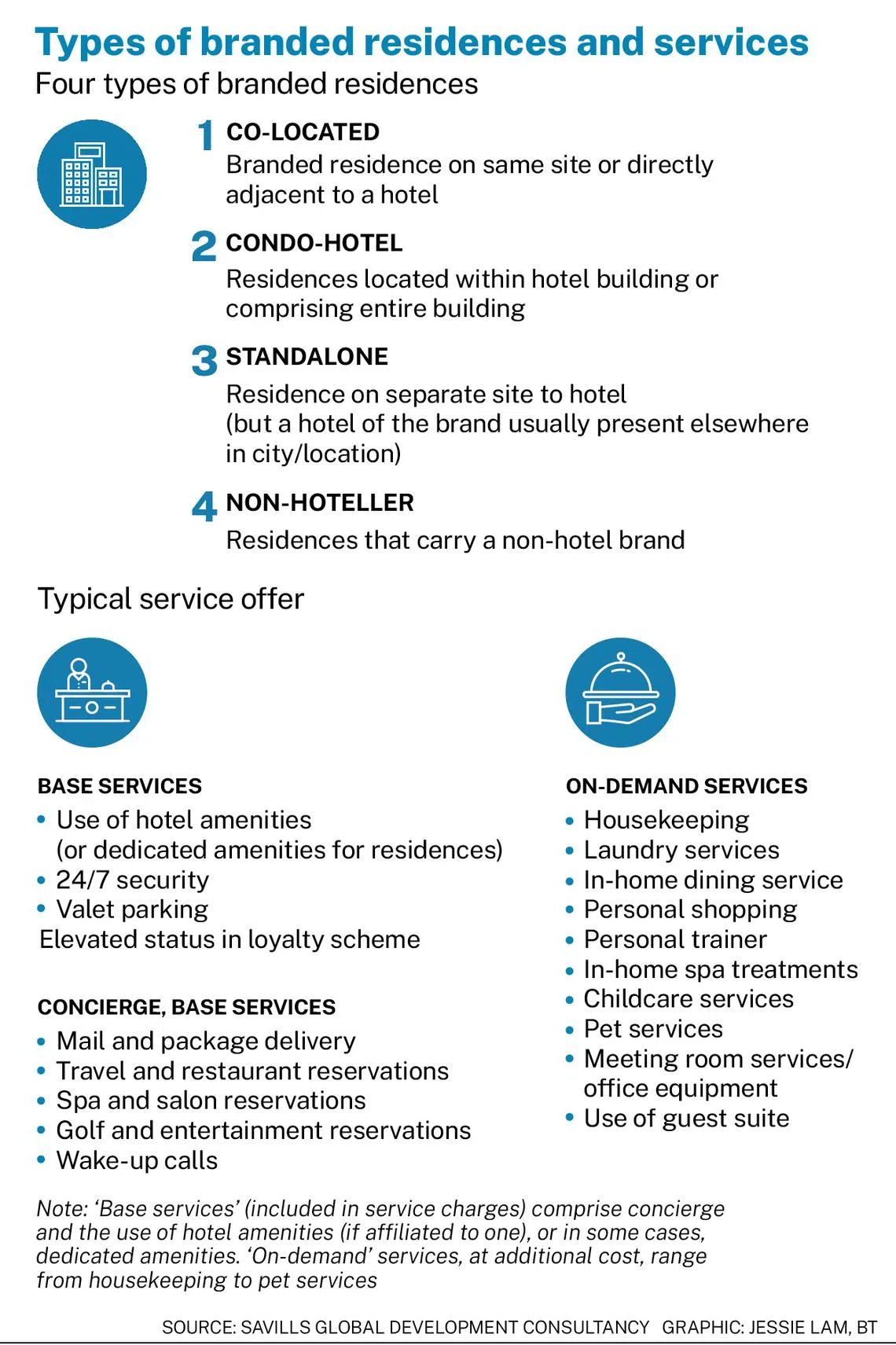
Traditionally, branded residences were hotel-led developments, with a portion of the development area allocated to a for-sale residential scheme linked to the hotel facilities and branded under the hotel brand.
Increasingly, more standalone branded residence schemes are being developed across the region, noted JLL.
How the branded residence scheme works
The hotel operator usually grants a licence to the developer to market and sell residences incorporating their brand in project marketing.
In many cases, the hotel operator also manages and services the residential units. Developers must comply with the operator’s brand standards, both at the development and operations stages.
Cho said that the management of branded residences is usually supported by the brand via audits and annual reviews, ensuring consistency with standards.
On the other hand, high-end apartments are often managed by property-management companies or homeowners’ associations, which may vary in approach and quality.
“As a result of the brand association, service offerings and management standards, branded residences may often command a higher price premium at the launch and resale phases,” Cho added.
Prices and supply
Bruce Lye, co-founder and managing partner of Singapore Realtors Inc (SRI), said that compared with other high-end luxury condominiums, on average, the price premium ranges between 10 and 20 per cent for branded residences.
The price difference varies depending on individual projects, locations, amenities and range of services.
He added that maintenance costs are also proportionate to the calibre of services provided, coming in at a premium of between 20 and 30 per cent higher than in non-branded high-end condominiums.
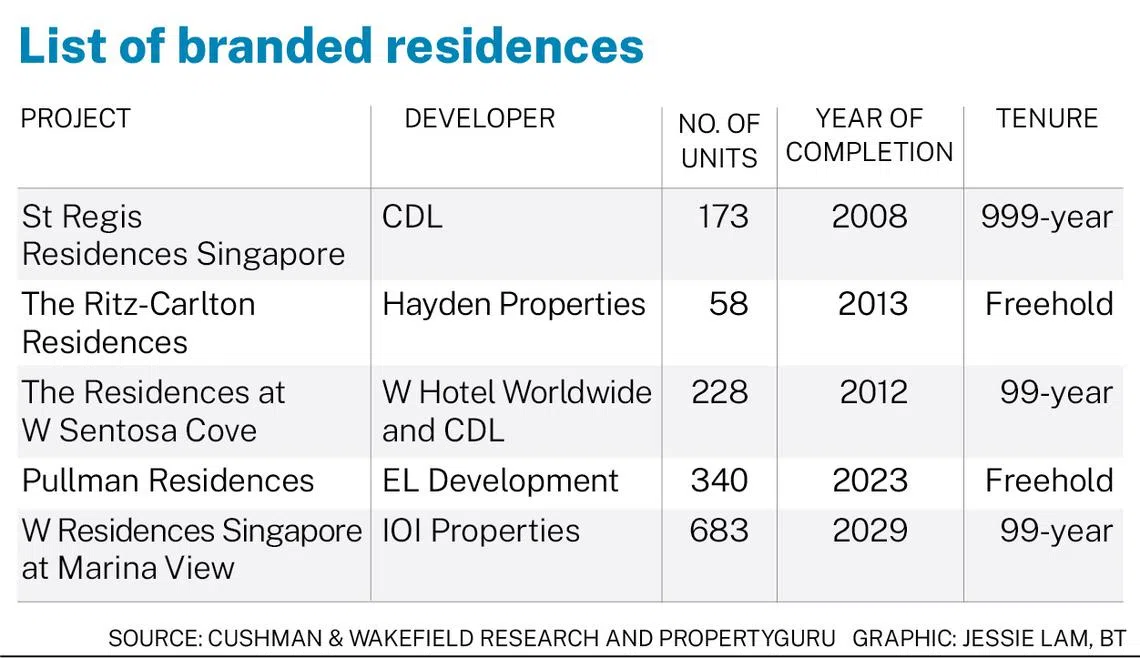
There are only a few branded residences in Singapore, indicated data from real estate company Cushman & Wakefield.
Wong Xian Yang, head of research for Singapore and South-east Asia at Cushman & Wakefield, told The Business Times that the value proposition of branded residences is less compelling in Singapore because of a well-established high-end residential market, where high-end stock is “typically (of) good quality”.
JLL’s Cho added that the ongoing property cooling measures and high stamp duty imposed on foreign buyers have also dented the growth of branded residences here.
“The presence of highly competent and experienced local developers, in effect with their own brand recognition in the region, also reduces the need for a brand to confirm credibility,” he added.
Adding to the stock of branded residences is IOI Properties’ 683-unit W Residences Singapore at Marina View. It will be managed by W Hotels – a brand under Marriott International – when completed in 2029.
IOI Properties won the mixed-use site in a state tender in 2021 for S$1.508 billion. This translates to a land rate of S$1,379 per square foot per plot ratio.
The 84,000-square-foot (sq ft) plot can generate a maximum gross floor area of 1.09 million sq ft. Out of this, at least 548,959 sq ft must be for residential use.
Room for growth
With a limited supply of branded residences so far, market experts noted that the segment has room for growth.
The number of single-family offices (SFOs) in Singapore stood at 1,650 at the end of August 2024, from just the 400 which were awarded tax incentives by the Monetary Authority of Singapore in 2020.
SRI’s Lye said he believes that the growth in the number of high-net-worth individuals and their desire for elevated lifestyles bode well for the branded residences segment. The number of millionaires in Singapore hit 333,204 in 2023, making up 6.6 per cent of the adult population.
JLL’s Cho added that in markets where the supply of quality condominium development has reached saturation, developers can use brand association to differentiate their project from the competition, thus increasing sales velocity.
“Brand association and enhanced services in branded residences enable developers to benefit from solid price premiums compared to unbranded, high-quality residential projects,” he said.
Savills Singapore said that globally, there are now 740 completed branded residential developments today, and another 790 projects are expected to be ready by 2031, with market share shifting from North America to the Asia-Pacific in the near future.
Across the world, hotel brands account for 79 per cent of the branded residence sector. Out of these brands, Marriott International took the top spot, followed by Four Seasons and Accor.
Marriott’s portfolio of completed residences has gone up by 50 per cent since 2019, and its pipeline represents about 90 per cent growth over its current footprint.
Savills’ Cheong said: “This is a strong testament to the confidence that homebuyers have in Marriotts’ development and operational expertise.”
However, Savills noted that operators and their brands are limited by their resources, which are usually manpower-related.
“Business development is restricted to the bandwidth of an operator’s or a brand’s development team and their support functions, including in-house design, technical and legal support, among others,” the company added.
TRENDING NOW

NEA identifies 7 firms responsible for haze fires, notices issued urging action: Grace Fu

DBS remains analysts’ pick ahead of Q3 earnings after Singapore banks’ share slump

High Court rules against Julius Baer’s Singapore trust arm in US$50 million family trust dispute

Could stablecoins be the future of money?

