

Millennials eschew traditional housing for co-living in microflats
Co-living microflats market now accounts for 5-10% of Britain's £25 billion build-to-rent private rental sector

Bengaluru
MILLENNIALS priced out of London's traditional housing market are opting to rent tiny apartments in so-called "co-living" developments, a fast-growing area that private investors and venture capital are eager to tap into.
Investors have put more than £1 billion (S$1.7 billion) into "microflats", where residents share facilities such as dining areas, lounges, work spaces, laundry rooms and gyms, and the investors are looking to do more.
The Collective, a property company founded in 2010, is one of London's major co-living developers. Its Old Oak co-living apartment building in west London is the world's largest, with 546 people living across 10 floors, according to its website.
Reza Merchant, chief executive of The Collective, said: "There's a complete lack of affordable and good quality accommodation for young working people." He said that The Collective was looking to secure more sites across London as well as in other major global cities.
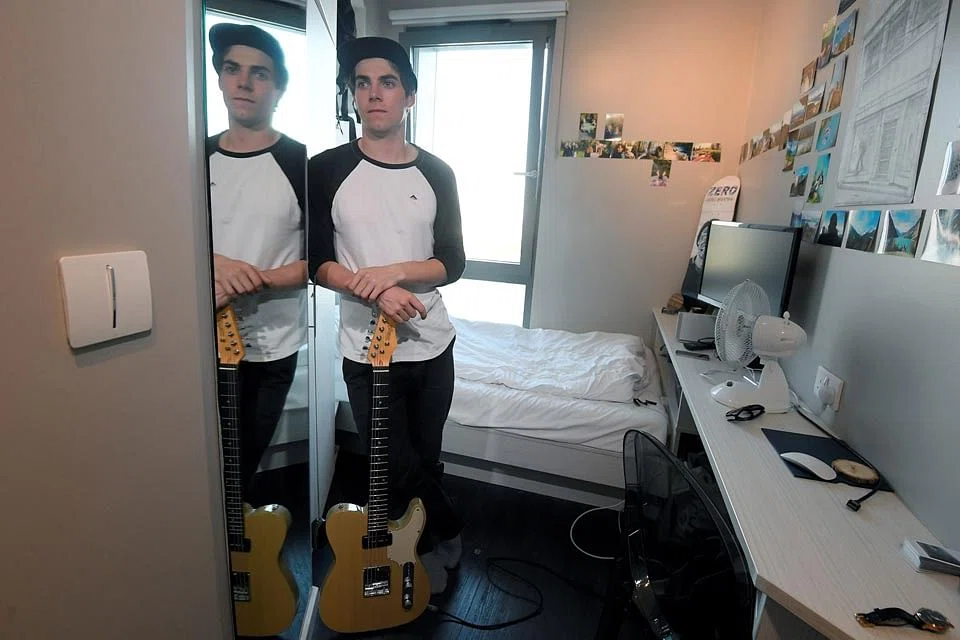
Microflats - which typically range from 200-300 sq ft for a studio apartment - are already being built across the world, from Hong Kong to New York.
The Collective said that tenants at Old Oak have a median age of 28 and a median income of £32,000 per year. They pay £230 to £360 per week, including bills.
"For people at certain stages of their career . . . it definitely makes a lot of sense," Ivan Soto-Wright, a 27-year-old resident of The Collective Old Oak, told Reuters.
The co-living microflats market now accounts for 5-10 per cent of Britain's £25 billion build-to-rent private rental sector, made up of institutionally-backed blocks of flats built for families to rent, said James Mannix, head of residential capital markets at property group Knight Frank.
Investors said that the micro-units create more attractive income streams as the more efficient use of space means that the rent per square foot in each flat is 10-15 per cent more than for traditional rentals.
"This strategy will provide us with an investment that has long-term, defensive characteristics," said Arron Taggart of hedge fund Cheyne Capital Management, which has invested in one of The Collective's schemes.
Although investors said that they expect demand for microflats to grow, planning restrictions could become an issue because specific local authority permission is needed for new builds.
Native Finance, backed by venture capital firm Passion Capital, is seeking to get London's local authorities on board. Native's co-founder Prasanna Kannan said that by working with local authorities, it can be possible to build more of these innovative schemes.
But large property investors in Britain's private rental market have tended to focus instead on developing more traditional apartment blocks designed for families to rent.
And others in the industry see limits to co-living developments as an investment class. "While it is hugely socially encompassing, it does have its drawbacks from an operational perspective. You might have high voids, it costs a lot to run," said Toby Nicholson, a director in property company Colliers' private rental sector team.
"It is going to be relevant, but it's not going to overtake or outweigh the traditional approach to residential in terms of studios, one and two bedroom regular flats," he added.
In central London, small apartments now make up a big chunk of the rental market. In the year to July 31, 42 per cent of the flats let in prime central London have been studios and one-bedroom units, as single people and couples opt for location over size, said property investment fund London Central Portfolio.
Residents such as Mr Soto-Wright said that the benefits of micro-flats outweighed any drawbacks. "The spaces are definitely small . . . (but) as an entrepreneur, you really want to bootstrap and be smart around your expenses."
But size remains an issue. "On the micro-sites . . . people are starting to rethink how small should they be going," said Roger Southam, a director in Savills' property management team. People do not want to stay in another format of student accommodation when they are starting their journey into business life, he added. REUTERS
TRENDING NOW

South-east Asia has lost Nvidia’s best salesman

Demand, tech capabilities position Apac and AI as Skyscanner’s next growth frontiers: CEO Bryan Batista

Peter Kwee’s Ridley Park bungalow on the market with S$100 million asking price

Beyond the greenback, Vietnam’s big borrowers turn to Asian-currency bonds

