

MND, SUTD launch S$30 million Built Environment AI Centre of Excellence
Artificial intelligence-driven solutions will be aimed at addressing key challenges in the sector

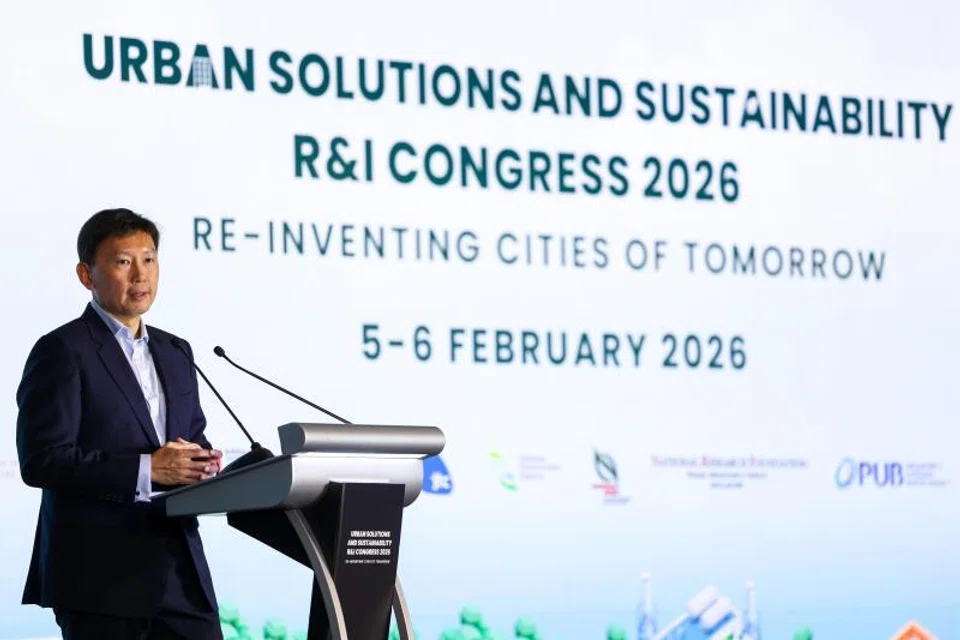
[SINGAPORE] The Ministry of National Development (MND) is partnering the Singapore University of Technology and Design (SUTD) to launch a new S$30 million Artificial Intelligence Centre of Excellence for the Built Environment.
The centre aims to kick-start the development of impactful applied artificial intelligence (AI) solutions for the built environment sector, and to anchor local AI capabilities, said Minister for National Development Chee Hong Tat on Thursday (Feb 5).
Chee, who was speaking at the Urban Solutions and Sustainability Research and Innovation Congress, added that the centre will bring together research and industry partners to co-develop AI solutions for the built environment sector and accelerate their translation.
MND said industry partners include large local enterprises, multinational corporations, small and medium-sized enterprises (SMEs) and practising qualified persons.
The centre will tap the National Research Foundation’s Research, Innovation and Enterprise funds.
SUTD is the host institution of the centre, and will serve as a convenor of institutes of higher learning, research institutes and industry partners for cross-institutional research, to support the sector’s adoption and application of AI.
The centre is aimed at transforming work processes across the sector by developing AI solutions that “enhance productivity, sustainability and liveability”. It will also foster partnerships among government agencies, academia and industry.
The centre will also build AI capabilities by developing local expertise and nurturing talent.
AI-driven solutions developed at the centre will aim to address key challenges in the built environment sector. For instance, manpower shortages in the labour-intensive construction and facilities-management sectors can be addressed through AI-augmented robotics and automation.
Meanwhile, climate change impacts can be tackled using advanced modelling and simulation to better analyse environmental impacts, improve energy efficiency, and design more resilient systems for extreme weather events.
“AI is also a critical enabler to ensure that MND’s key priorities, such as large-scale estate rejuvenation, are effectively met,” said the ministry.
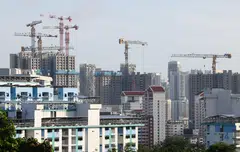
It added that estate rejuvenation is a complex, long-term effort that can benefit from AI-enabled solutions at every stage of the built environment life cycle, from urban planning and building design to construction and facilities management.
For instance, potential research projects include AI surrogate models that can speed up computer simulations to test how resilient neighbourhoods are against the urban heat island effect.
The centre will also strengthen Singapore’s long-term research and industry capabilities by attracting and nurturing professionals with both technical AI expertise and a practical understanding of the sector’s challenges.
New fund
Separately, Chee also announced the new S$40 million Urban Solutions and Sustainability (USS) Translation Fund.
Chee said the initiative will fund local companies to turn prototypes from USS-funded projects into products for real-world use, helping to overcome high upfront costs and early-adoption risks.
The fund will support key activities that commercialise research innovations – including engineering development, test-bedding and pilot demonstrations – across key USS sectors, such as the built environment, water and agri-food.
Eligible projects must address national priorities, originate from previous publicly funded research, possess a functional prototype and show a clear pathway to commercialisation.
Chee said that to complement the USS Translation Fund, MND will launch a new pilot green lane procurement programme.
The new scheme will streamline procurement and expedite government adoption of innovative research products. It will be piloted by MND’s agencies before being rolled out across the wider public sector.
Companies that qualify under the programme will be listed as approved vendors, allowing MND agencies to procure their solutions directly.
For instance, an SME with a built environment solution that has been successfully piloted by an MND agency can be referred to the programme to scale up.
Once approved, other MND agencies can also procure the solution directly, with the streamlined process expected to cut procurement timelines by about half.
Additionally, the Building and Construction Authority will launch a decarbonisation technology road map. It will guide stakeholders in adopting market-ready solutions to lower whole-life carbon emissions in building projects, and direct research efforts towards emerging technologies.
Decoding Asia newsletter: your guide to navigating Asia in a new global order. Sign up here to get Decoding Asia newsletter. Delivered to your inbox. Free.
Copyright SPH Media. All rights reserved.
TRENDING NOW

Once staunchly pro-China, Malaysian Chinese businesses are now distancing themselves from Beijing

Looking beyond looming CEO succession, should UOB potentially pursue a transformative merger?

Could stablecoins be the future of money?

Grab CEO’s wife Chloe Tong on life with Anthony Tan and finding her purpose

