

More incentives needed to encourage wider use of solar panels among building owners: NUS poll
Samuel Oh

THE majority of building owners seem unconvinced that the adoption of building-integrated solar panels will contribute to higher valuations of their property assets, with only 30 per cent of them viewing these installations favourably, according to the findings of a survey.
The results from the quarterly survey, conducted by the Institute of Real Estate and Urban Studies at the National University of Singapore (NUS), suggest that developments fitted with building-integrated photovoltaics (BIPVs) are expected to enjoy “only a modest lead over their counterparts, both in terms of capital appreciation and rental rates”. This is regardless of property type, the survey noted.
BIPVs are photovoltaic materials that are used in parts of a building such as roofs, facades, windows or canopies, to replace conventional building materials with solar photovoltaic panels, to provide an ancillary source of electrical power.
The main advantage of BIPV panels over the traditional roof or ground-mounted solar panels is that they allow buildings to retain their intended look without compromising on solar adoption.
Sing Tien Foo, provost’s chair professor of real estate at NUS, believes that as the technology for BIPV is still evolving, landlords will be able to gain learning experience from first-mover advantage from implementing such a system, thereby reducing the long-term fixed costs of BIPV investments over time.
However, the poll results show that most respondents remained “conservative” when asked how much premium BIPV installations will add to their properties, believing that such fittings would add value by only between 1 per cent and 3 per cent.
'%3e%3cpath%20d='M12.1475%2025.5262C13.7713%2025.4295%2014.94%2023.913%2014.94%2021.8832C14.94%2019.5359%2013.474%2018.093%2011.5917%2018.093C11.3745%2018.093%2010.9582%2018.093%2010.8393%2018.1413V25.2086L11.8891%2025.5745C11.8891%2025.5745%2012.207%2025.5262%2012.1475%2025.5262ZM11.4934%2017.6281C13.2567%2017.6281%2014.3843%2016.4292%2014.3843%2014.4501C14.3843%2012.372%2013.275%2011.2973%2011.4339%2011.2973H10.8393V17.6305H11.4934V17.6281ZM6.66078%2025.6482L7.39265%2025.5492C8.02617%2025.4502%208.26403%2025.3053%208.26403%2025.1097V11.6149C8.26403%2011.4193%208.1451%2011.3709%207.23484%2011.249L6.68137%2011.173L6.6219%2010.7588H11.9508C15.7153%2010.7588%2017.0624%2012.0797%2017.0624%2014.1578C17.0624%2015.9666%2015.7748%2017.1909%2013.4969%2017.6305V17.7041C16.111%2017.948%2017.6571%2019.5382%2017.6571%2021.7636C17.6571%2024.3318%2015.8937%2026.0417%2012.1109%2026.0417H6.60132L6.66078%2025.6482Z'%20fill='%232B2B2B'/%3e%3cpath%20d='M20.6287%2025.6505L21.5596%2025.5515C22.1725%2025.4779%2022.4104%2025.3076%2022.4104%2025.112V11.249H21.9346C20.073%2011.3479%2018.982%2013.0095%2018.408%2014.6227L18.1907%2015.5018H17.6555L18.1701%2010.7588H29.3837L29.6421%2015.4787H29.1664L28.9491%2014.6227C28.3728%2012.8645%2027.3047%2011.2743%2025.5002%2011.249H24.9856V25.1856C24.9856%2025.3812%2025.1251%2025.4548%2025.9965%2025.5515L26.7695%2025.6505L26.829%2026.0417H20.5693L20.6287%2025.6505Z'%20fill='%232B2B2B'/%3e%3c/g%3e%3cdefs%3e%3cclipPath%20id='clip0_5242_21648'%3e%3crect%20width='24'%20height='16.8'%20fill='white'%20transform='translate(6%2010)'/%3e%3c/clipPath%3e%3c/defs%3e%3c/svg%3e)
“Responses were fairly consistent across different property types, ranging from office and industrial to residential and retail,” added Prof Sing.
The top four cited reasons for slow adoption of BIPV include: high upfront costs for installations, high maintenance costs, a lack of government incentives to support the adoption of such technology, and a lack of clear revenue and business models for BIPV.
The report cited that the main factor motivating companies to adopt the technology is an increase in economic incentives and cost subsidies from the government.


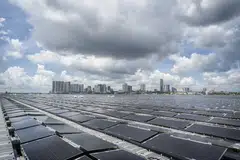
Prof Sing said that the benefits of installing such sustainable solutions may be felt only over the long term, as the time horizon for returns on investment is similarly long.
He added that “it may be timely for the government to first provide financial support through subsidies to help defray higher initial costs of adopting renewable energy”. “Hopefully, when clean energy becomes more prevalent, companies could reap the economic benefits of going green”.
Besides of the lack of incentives from the government, the report shared that high construction costs and a shortage of manpower continue to pose a risk to companies.
With the clean energy segment still at its infancy stage – with neither the economies of scale nor an established ecosystem of transmission and distribution to a wider user base – “it is understandable that companies are reluctant to take on additional cost commitments at this juncture”, Prof Sing said.
Decoding Asia newsletter: your guide to navigating Asia in a new global order. Sign up here to get Decoding Asia newsletter. Delivered to your inbox. Free.
Copyright SPH Media. All rights reserved.
TRENDING NOW

Philippine power giant First Gen rebuffs foreign offers, plans up to US$2.6 billion in expansion

Cliff Tan has 7 million followers and a 4-month waitlist. Why won’t he expand his business?

Could stablecoins be the future of money?

From finance aspirant to Asean CEO: TUV SUD’s Jonas Strahberger on finding people who believe in you

