The mysterious past and murky future of the mansion on Ocean Avenue
It is a temple of profligate neglect
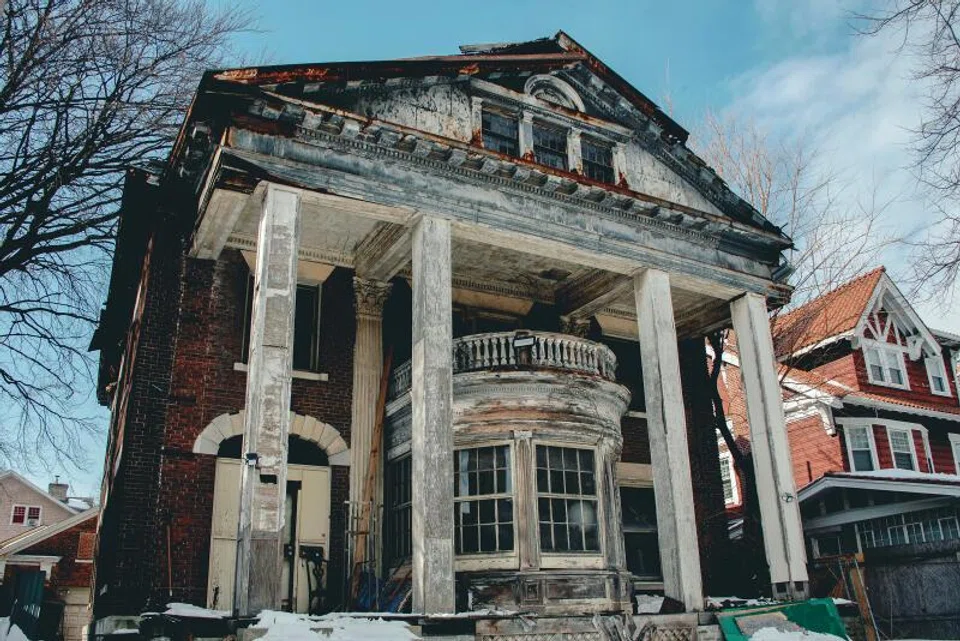
[NEW YORK] Near the end of a block of single-family homes in the Ditmas Park section of Brooklyn, a once-majestic mansion is falling apart.
The four square pillars of its Federal-style entranceway are rotting. The Venetian windows are cracked and ridden with holes. The roof is slightly crumpled, bent on one side like the tilted, uneven brim of a worn-out baseball cap.
It is a temple of profligate neglect, the sort of structure that seems capable of giving you a splinter just because you looked at it.
A wall of green boards runs where the property, 1000 Ocean Ave, meets the sidewalk, but a square opening in the fencing reveals a view of the decrepit home and its front yard, strewn with junk: a glass bottle, some tools, a reusable grocery bag.
Neighbours say they believe squatters have been living inside.
The story of how 1000 Ocean Ave fell into this condition is somewhat murky. Its future is even murkier. Neighbours recently flooded a community Facebook page with ideas for its restoration, and last year, its owner put it up for sale – at the improbable asking price of US$2.6 million.
Any buyer could have to reckon with a tangle of bureaucratic challenges: the colonial revival home was declared a landmark in 1981, limiting what changes can be made to it.
Some neighbours are pessimistic that anyone will restore the home any time soon. They are divided on who or what is to blame. But they are united in awe of the building.
“It’s an absolute tragedy for a house with that type of history and that value to the neighbourhood to be just languishing like that,” said Orli LeWinter, 45, who has lived on the block for about 13 years. “People just want to see it restored and put to good use.”
The house at 1000 Ocean Ave is one of Brooklyn’s most dilapidated. It is also one of the most impressive. Built in 1899, it is nearly 6,000 square feet altogether, with an imposing facade that stands out even in Ditmas Park, a quiet neighbourhood made up of elegant homes with commanding porches and tidy front yards.
Sitting beside 1000 Ocean Ave is a similar and equally imposing Victorian-era palace, 1010 Ocean Ave. Both were designed by architect George Palliser at the turn of the 20th century. But 1010 has been preserved; today it houses a doctor’s office and apartments.
For decades, 1000 Ocean Ave has been crumbling, its bricks loosening and its roof degrading.
As early as the 1960s, children who lived in the neighbourhood referred to it as “the scary house” and would sprint when they passed it, remembered Lanis Levy, 68, who grew up on the block and now lives in London. The front steps were caving in, and pigeons were often flying around the roof.
“As spooky as it was to us as children,” she said, “it always seemed to me that it must be magical inside.”
A man who owned the building would sometimes emerge, walking a dog and smoking a cigar, Levy said. “He never really spoke to anyone,” she recalled.
In 1975, Bernice Schleicher, previously of Brighton Beach, purchased the house, according to city records.
Schleicher and her partner, Sam Kekis, who ran an antiques business in Park Slope, got the house at a discounted rate, about US$25,000, because it had limited electricity and water damage from the roof down to the basement, said Ron Schweiger, the Brooklyn borough historian.
Schweiger was long fascinated by the building, having come across a colourised picture of it in its Gilded Age glory.
Driving by the house one day in the late 1970s or early ’80s, Schweiger saw a man working outside. The man turned out to be Kekis, who invited Schweiger in for a tour. Upon entry, Schweiger found that there were holes in the walls and that the wallpaper was peeling off.
The interior of the house, though weatherworn, was still stunning in its size and detail, Schweiger recalled. The facade was separating from the house, though, and Kekis installed wooden beams, angled from the front yard, to hold up the front of the structure.
Schleicher and Kekis had made a makeshift bedroom and kitchen upstairs, Schweiger remembered.
“Their goal, I believe, was to restore the house,” Schweiger said. “I don’t know what happened.”
What is clear is that the house crumbled further. Schleicher was eventually confined to the single bedroom, allowing the rest of the building – the grand dining room, the library, the parlours – to deteriorate.
But the couple’s attachment to the home seemed to grow even as its condition worsened. At one point, Kekis turned down a proposal in which the city would turn the house into a museum. He refused to allow city officials inside.
Kekis, a tinsmith with a bushy handlebar mustache and few friends, wanted to do all the work on his house himself and rarely allowed visitors in, recalled Susan Goodstein, Schleicher’s sister. “They never had the time or the wherewithal or the money to really fix it up,” said Goodstein, 79.
During the Covid-19 pandemic, Kekis died of bone cancer, and Schleicher moved to sell the home, giving up her “pride and joy,” said Gemma Sokoletsky, a real estate agent and family friend who listed the home in 2021. Not long after the house was sold, Schleicher died of complications of Covid.
One neighbour, Tyler Larson, 44, recalled touring the building with a group that had discussed pooling funds to try to restore it. But the group was also driven by curiosity about the “haunted house” on the corner, Larson said.
And so they headed in.
“We were blown away by the things that we were seeing,” Larson said of the tour, remembering, with wonder, how a woman was bedridden in the sole second-floor room that remained usable.
Everywhere was dust.
Packed through the house were piles upon piles of assorted antiques. One room, on the third floor, was filled with old dolls. Another room was chock-full of objects related to taxidermy. The kitchen no longer had a ceiling, offering a view up to the collapsing roof. In the back was a graveyard of rusting antique automobiles.
Ultimately the building was purchased in 2021 by Asif Jhangir for about US$1.3 million. But Jhangir was apparently unaware of the red tape he would run into in trying to alter the house, given its landmark status, said Laura Rozos of Compass, the broker handling the current listing. Now Jhangir is giving up, hopeful that someone else might take on a prodigious restoration project.
Standing in the way of renovation work is the house’s designation as part of the Ditmas Park Historic District. Under the Koch-era designation, the city’s Landmarks Preservation Commission must sign off on any exterior work on the building, or any interior work that affects the exterior or requires a permit from the Buildings Department.
In extremely rare cases, it is possible to demolish structures that have landmark designations but are in especially poor condition. Razing such a building requires unique circumstances and the approval of the Landmarks Preservation Commission. The commission said that it would work with anyone who buys 1000 Ocean Ave to resolve the violations and authorise permits for restoration work.
David Maggiotto, a spokesperson for the Building Department, said that city inspectors had not identified structural damage to the house that would require emergency orders for demolition, a condition that allows for the razing of a building with a landmark designation.
Experts on renovation projects estimated that restoring the home would cost between US$3 million and US$5 million. Eli Moyal, founder of the residential renovation firm Chapter, said that such a project would probably take at least two years to complete, and that it could be a challenge to find a team with the experience to restore the building’s vintage interior.
Andrew Whinery, 39, who has lived on the block for about two years, said that he viewed 1000 Ocean Ave as an “extremely impressive” structure, and that he would love to see someone return it to its former glory.
Still, Whinery doubted that anyone would come along with the money to do so. And he said he worried that city rules would obstruct opportunities for the plot to be used for, well, anything else.
Larson, who toured the house a few years ago, said the current state was unacceptable and potentially dangerous for anyone who might be squatting inside. He is concerned that the building might collapse one day.
But given the building’s grandeur, he argued, the house is a prime example of why the city deploys landmark designations in the first place.
“I think it’s savable now,” Larson said of the house at 1000 Ocean Ave. “I don’t think the idea of ‘Let’s just allow this one to collapse’ is a better alternative than trying to save it. The problem is: Who is going to do that?” NYTimes
Decoding Asia newsletter: your guide to navigating Asia in a new global order. Sign up here to get Decoding Asia newsletter. Delivered to your inbox. Free.
Share with us your feedback on BT's products and services