

The newest hotel amenity? Virus-scrubbed air
Hotels, and even some cruise ships, are installing state-of-the-art filtration systems that claim to tackle the coronavirus where it is believed to be the most dangerous: in the air
 Add BT as a preferred source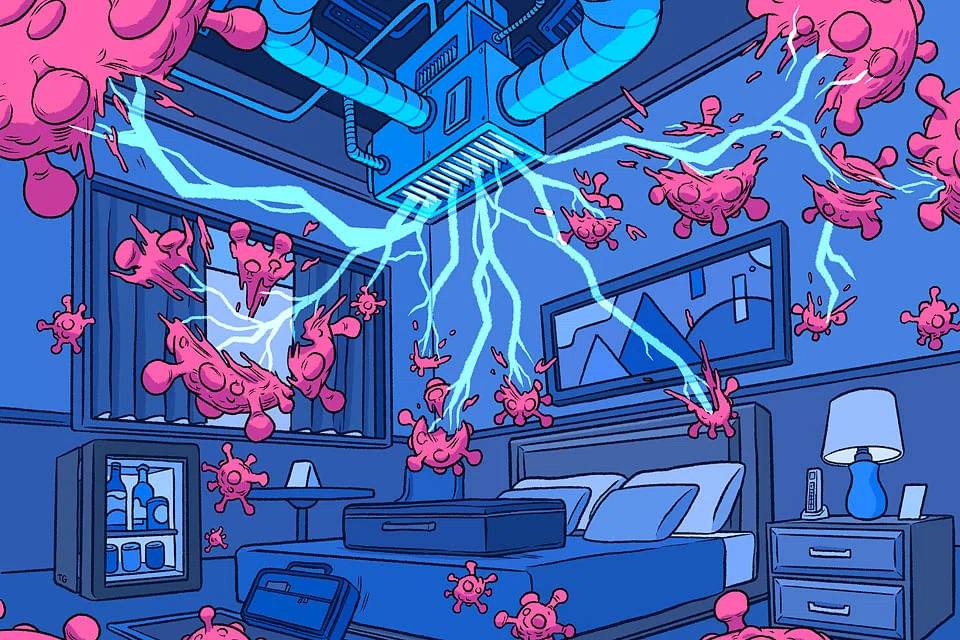
New York
WHEN the coronavirus first hit, hotels quickly adopted enhanced cleaning policies, including germ-killing electrostatic spraying and ultraviolet light exposure in guest rooms and public areas. But as research on virus spread has shifted focus from surface contact to airborne transmission, some hotels and cruise ships are scrubbing the very air travellers breathe with a variety of air filtration and treatment systems.
"The best amenity that any hotel could provide under those circumstances is safety, especially in the air," said Carlos Sarmiento, the general manager of the Hotel Paso del Norte in El Paso, Texas. The 1912 vintage hotel recently reopened after a four-year renovation that included installing a new air purification system called Plasma Air that emits charged ions intended to neutralise the virus and make particles easier to filter out.
With the new air-scrubbing campaigns, hotels are following airlines, many of which have hospital-grade, high-efficiency particulate air (HEPA) filters that are said to be over 99 per cent effective in capturing tiny virus particles, including the coronavirus.
Hotels and cruise ships can more easily ensure social distancing than airplanes, but, given the recent research on the importance of enhanced air filtration, some are adding air-cleaning dimensions to their heating, ventilation and air conditioning (HVAC) systems, which already aim to remove dust, smoke, odours and allergens.
Researchers, including those at New Orleans' Tulane University, have found that the tiny aerosol particles of SARS-CoV-2 that are emitted when someone with the virus speaks or breathes can remain in the air for up to 16 hours. Along with social distancing, mask wearing is the first line of defence against breathing contaminated air indoors, said Dr Philip M Tierno Jr, a professor of microbiology and pathology at New York University School of Medicine, who has consulted with HVAC companies. "HVAC systems are of great significance in reducing the amount of airborne particles since this virus can be spread in an airborne fashion," he added, calling the tiniest aerosols "the most dangerous".
Navigate Asia in
a new global order
Get the insights delivered to your inbox.
There are several ways to remove these particles, he explained, including fresh-air ventilation, which dilutes the pathogens.
Air cleaning technologies include bipolar ionisation systems, which, according to their manufacturers, send charged ions out on air currents that damage the surface of the virus and inactivate it. They may also bind with the virus aerosols, causing them to fall or be more easily filtered out. Some antiviral HVAC systems feature germicidal ultraviolet light in the ductwork.
Filters with Minimum Efficiency Reporting Values (MERV) of 13 or higher are best at capturing the coronavirus, according to the US Environmental Protection Agency. According to its website, the agency "recommends increasing ventilation with outdoor air and air filtration as important components of a larger strategy that includes social distancing, wearing cloth face coverings or masks, surface cleaning and disinfecting, hand-washing, and other precautions."
"In a transient environment, like a hotel, motel or dormitory, you don't know who was there before you and what their health was," said Wes Davis, the director of technical services with the Air Conditioning Contractors of America, a trade association, adding that good housekeeping is a top priority in such places. "As for the other items like ultraviolet exposure or ionisation, every little bit helps, but I'm not quite sure any of them is the perfect solution. It's more like a concert."
Throughout the summer, the Madison Beach Hotel, part of Hilton's Curio Collection of hotels, in Madison, Connecticut, used its outdoor spaces for dining and even holding meetings in tents. But with the approach of cold weather, HVAC contractors installed an air purification system that uses UV light and ionised hydrogen peroxide in most public areas of the hotel. "We wanted to create an environment that was as safe as possible," said John Mathers, the hotel's general manager.
The 112-passenger SeaDream I from the SeaDream Yacht Club took many precautions before it launched its winter season from Barbados on Nov 7, and still a passenger got the virus within days of departure, cutting the trip short. Eventually nine infections were diagnosed and the line cancelled future 2020 sailings.
SeaDream's failed cruise exemplifies the challenges the entire industry faces. Some health experts think that upgraded air filtration could help. Adopting systems that are "aimed at reducing occupant exposure to infectious droplets/aerosols", and upgrading HVAC systems with MERV 13 filters were among 74 critical recommendations to ship lines made by the Healthy Sail Panel, a group of public health experts assembled by Royal Caribbean Group and Norwegian Cruise Line Holdings in September.
The Centers for Disease Control and Prevention maintains that ships remain vulnerable to spreading infection based on population density and the inability of crew in particular to maintain social distance in their workspaces and living quarters.
Still, cruising is expected to resume in US waters for ships carrying 250 or more passengers and crew in the first half of 2021, pending certification under the CDC's Framework for Conditional Sailing Order, which spells out minimum standards for social distancing, face coverings and hand hygiene, but does not mention air circulation systems.
Despite the CDC's lack of emphasis on air filtration, some cruise companies are upgrading their ventilation systems, in addition to designating quarantine areas and reconfiguring dining rooms. NYTIMES
Decoding Asia newsletter: your guide to navigating Asia in a new global order. Sign up here to get Decoding Asia newsletter. Delivered to your inbox. Free.
Share with us your feedback on BT's products and services
TRENDING NOW

‘We’re not a bubble tea brand’: Chagee aims to double Asia-Pacific footprint to 600 stores by 2027
Thai and Vietnamese farmers may stop planting rice because of the Iran war. Here’s why
Middle East-linked energy supply shocks put Asean Power Grid back in focus

As more Asean states turn to Russia for fuel, will Moscow boost its influence in the region?

