Outlook for Singapore retail rents favourable: analysts

Corinne Kerk
Published Fri, May 20, 2022 · 11:08 AM
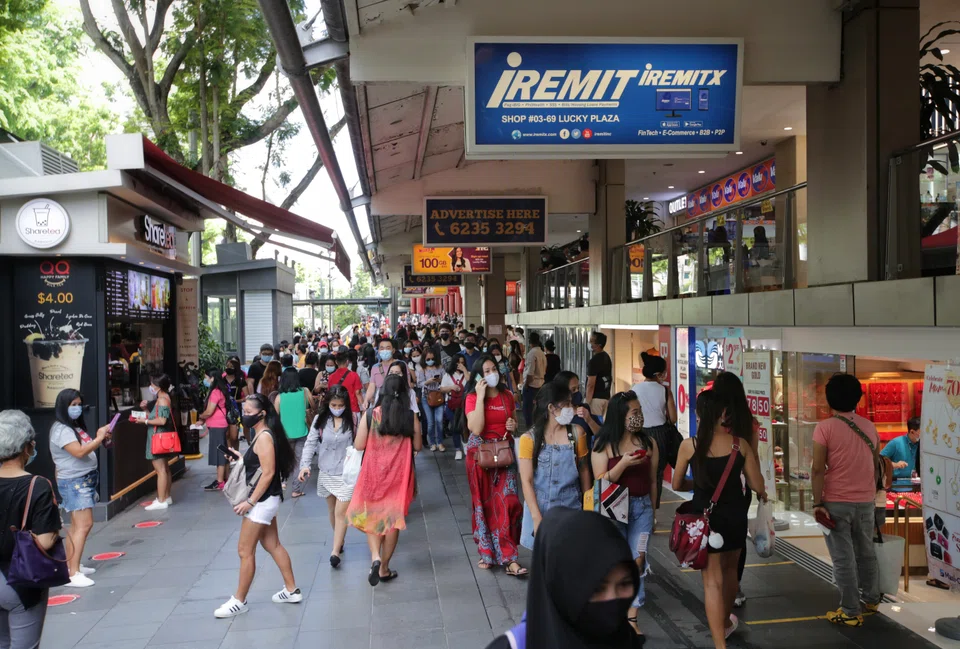
    • The relaxation of Covid-19 measures gives existing retailers, as well as new-to-market entrants greater confidence in their expansion plans.
    • The relaxation of Covid-19 measures gives existing retailers, as well as new-to-market entrants greater confidence in their expansion plans. PHOTO: THE STRAITS TIMES

    GIVEN sustained economic growth, increasing consumer footfall, the return of tourism spending and lifting of safe management measures, analysts say the outlook for retail rents appears favourable - though they are only likely to return to pre-pandemic levels next year. 

    The relaxation of Covid-19 measures gives existing retailers, as well as new-to-market entrants, greater confidence in their expansion plans, which in time would lend support to leasing demand, said Catherine He, head of research for Colliers in Singapore.

    Added Angelia Phua, JLL Singapore’s director of research and consultancy: “Retail rents of prime floor space are expected to grow 1.5 to 3.5 per cent year on year in 2022.”


    In terms of geographic segments, most analysts expect the tourist-dependent Orchard submarket to post a stronger growth in rent. 

    “The Orchard shopping belt will be boosted by the ever growing visitor arrival volumes with each passing month in 2022, supporting upward rental movement in the second half of the year and in 2023,” said Knight Frank Singapore’s head of research, Leonard Tay.

    In its H1 2022 report on the retail sector released in early May, Colliers said prime (locations with high footfall or main street frontage) rents in Orchard rose 0.4 per cent to S$35.10 per square foot in Q1 2022, with rents for this segment expected to grow around 1-2 per cent by the end of 2022. 

    It recommended that retailers lock in prime spaces before rents rebound. 

    Indeed, JLL’s senior director for leasing, Lee Siew Ling, said: “Key malls with luxury trades are seeing growing demand for expansion, thus we’ll expect to see growth in rent for this sector.” 

    On the other hand, as the resilient suburban market has experienced healthy rental increases since the start of 2021, rental increases may be more modest compared to other submarkets, said Tricia Song, CBRE’s head of research for South-east Asia. 

    “We believe selected prime retail spots in the Central Business District may also post stronger growth (from a low base) now that 100 per cent can return to the office, given their more significant declines during the pandemic when people were working from home.”

    However, Desmond Sim, chief executive officer at Edmund Tie, believes retail rents in the Fringe Area - defined by the Urban Redevelopment Authority as the area within the Central Region, excluding the Central Area - are expected to post the strongest rental growth. 

    Analysts told The Business Times they expect retail rents to return to pre-pandemic levels in 2023, which Colliers’ He notes will require inflationary pressures to moderate, more room for consumers’ discretionary spending, workers to be back in full force at their workplaces and tourist arrivals and spending to return to pre-pandemic levels. 

    There are no significant mall completions in 2022 that will impede retail recovery with oversupply either, as most comprise addition and alteration works to retail facilities outside the Central Area, added Knight Frank’s Tay.

    New supply in the next 3 years also remains significantly below historical average and should support a steady recovery in retail rents, said CBRE’s Song.

    She thinks that while suburban prime rents have been resilient during the pandemic as people work from home, Orchard Road rents may return to pre-pandemic levels by mid-2024, depending on the rate of return of visitor arrivals. Other locations such as the city centre and fringe retail could vary, due to shifts in consumption patterns and hybrid work trends.  

    “Based on CBRE’s data, average prime islandwide retail rents in Q1 2022 are 10.6 per cent below pre-pandemic levels (Q4 2019),” she said. And given the structural challenge of e-commerce, physical retailers and landlords have to be innovative and go omnichannel for sales and rents to return to, or surge ahead of pre-pandemic levels.

    Of course, rental recovery will also be impacted by rising costs, labour shortage, uncertainty of supplies and the possible emergence of new Covid strains that will hit growth capacity and thus retail space demand.

    “The business of retail is very much sentiment driven; external factors including heightened inflation, higher cost of capital and looming threats of recession may dampen spending habits,” said Edmund Tie’s Sim. “At the same time, while some Singapore retailers have enjoyed resilience stemming from domestic spending, outbound tourism may also curb the level of domestic spending retailers have enjoyed over the past 2 years.”

    And even though the Singapore government is resolute in transiting towards endemic living, there still lies the spectre of new and more infectious Covid-19 variants that could force nations to backpedal to stricter measures, said Knight Frank’s Tay. 

    “It is imperative that the retail sector has a reasonable runway of around 12 to 15 months without restrictions for recovery to take hold unimpeded,” he emphasised.