

Privatisation reset puts ‘simplified’ ESR on growth path from Singapore
It has pulled US$700 million in foreign capital to Singapore over the last two years, and aims to double core AUM to more than US$80 billion by 2030

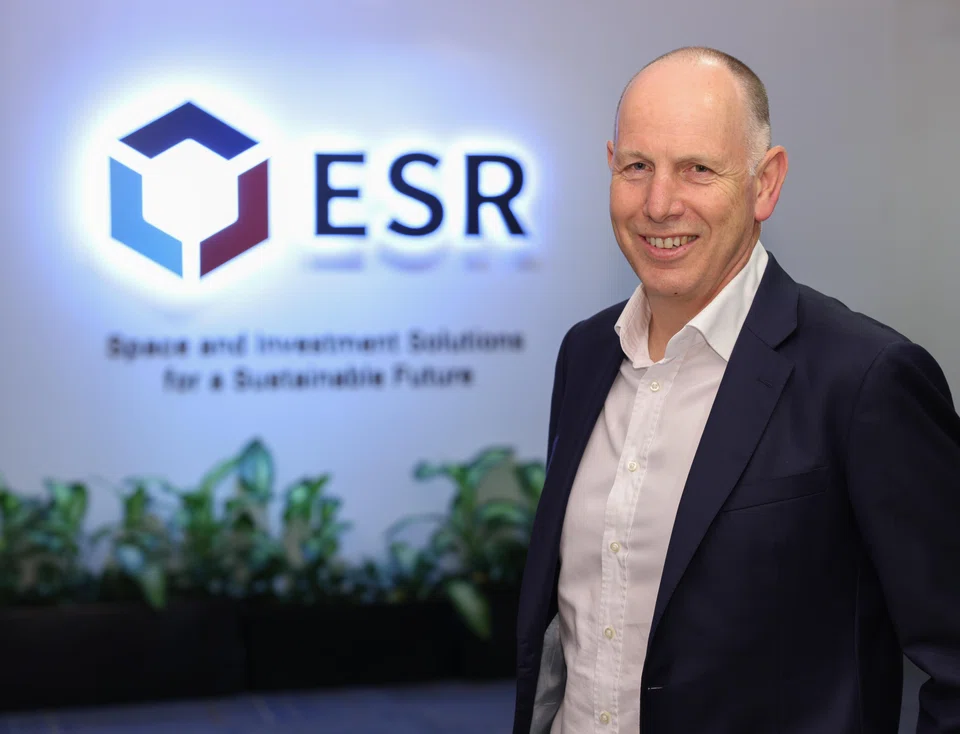
[SINGAPORE] Real estate fund management giant ESR Group’s decision to privatise, move its headquarters from Hong Kong and “clean up” its portfolios last year marked a strategic shift – and the capital is following.
The group has channelled roughly US$700 million of foreign capital into projects in Singapore through private funds over the last two years (*see amendment note), ESR Group president Philip Pearce told The Business Times in an interview.
These include logistics and industrial developments such as built-to-suit warehouse facility DSV Pearl in Taman Jurong; Sunview Logistics & Container Hub, a multi-storey warehouse and container depot in Jurong; and a high-specification manufacturing facility at 20 Tuas South Avenue 14.
“To be honest, Singapore was always a more significant office (and) base for us than Hong Kong,” Pearce said.
ESR was taken private in a US$7 billion deal by a consortium led by Starwood Capital Group, Sixth Street Partners and SSW Partners. It was delisted from the Hong Kong Stock Exchange in July 2025, some six years after its 2019 initial public offering.
In the words of Starwood Capital Group CEO Barry Sternlicht, the group had “grown almost too quickly and into too many verticals”, and the goal was to “clean it up”.
Homing in on its position as a leading logistics manager and developer in Asia-Pacific, ESR has been shedding assets over the last 12-15 months, reaping close to US$2 billion in net proceeds.
Since it was privatised, the asset manager has domiciled its operations in Singapore where it relocated senior management.
Key leadership changes followed, while co-founders Jeffrey Shen and Stuart Gibson remain co-CEOs.
Pearce was promoted to president, from group deputy chief executive officer. Matthew Lawson, previously group chief operating officer, was named chief financial officer.
ESR’s chief investment officer (CIO) role was split between incumbent Josh Daitch, who now serves as CIO for investor solutions and investments, and David Matheson, former Starwood Capital executive, as CIO for group strategy and investments.
Brett Robson, former global head of real estate with Macquarie Asset Management, was appointed independent board chair.
“(Singapore’s) also a strong hub for real estate or funds management generally… and we have a pretty significant real estate investment trust (Reit) here in Singapore,” Pearce said.
The group’s ESR Reit, first listed in 2006, holds a S$5.9 billion portfolio spanning logistics and industrial properties, and business parks, with properties across Singapore, Australia and Japan.
In 2018, the Reit merged with Viva Industrial Trust in what was the first merger between two industrial Reits in the history of the Singapore Exchange.
ESR’s US$5.2 billion acquisition of Singapore’s ARA Asset Management in 2022 subsequently led to the Reit being merged with ARA Logos Logistics Trust to form ESR-Logos Reit, later renamed ESR Reit.
The group also owned the manager of listed Suntec Reit, which holds S$11.8 billion worth of commercial assets including a one-third stake in Marina Bay Financial Centre Tower 1 and 2, and One Raffles Quay in Singapore.
ESR sold the Suntec Reit manager to Gordon Tang’s Acrophyte Asset Management for S$190 million in December 2025. In March 2026, it sold its direct 10.8 per cent stake in Suntec Reit to Hongkong Land for S$541 million.
Pearce said the office and commercial Reit “didn’t belong” in ESR’s strategy with the group refocusing on logistics and data centres.
“We got a very good price for the units… (sold) at above the trading price,” he added. “So if you look at the package in totality, it was a pretty good outcome for the group.”
Asked if the move to Singapore pointed to a listing on the Singapore Exchange in the future, Pearce said: “A listing, whether it be Singapore or Australia, is obviously (a) potential down the track. Given the headquarters is here, it would potentially seem logical… But I think that’s too early to talk about.”
‘Simplifying’ operations
Recent exits include selling its remaining stake in Australia-based Cromwell Property Group to Brookfield Asset Management for A$197 million (S$174 million) in July 2025, and its minority interest in Japan-based investment firm Kenedix to a regional fund manager for an undisclosed sum in October.
“Bringing down our leverage (also) gives us the opportunity to use the balance sheet strategically if the right opportunities present themselves,” he said.
The group currently has “a very strong foothold” in Japan’s data centre market and is working on several opportunities there. Other data centre projects are under development in Australia and South Korea.
In India, “we’re seeing strong demand from traditional logistics, but also industrial from the likes of Foxconn”, said Pearce. The Nvidia and Apple supplier has been rapidly expanding its presence in the country, investing US$1.5 billion in its India unit last year to expand production capacity.
China is still on the radar. “There’s probably a bit of opportunity to buy assets at a good value, and we do have capital partners that are seeking to invest in China,” said Pearce. These include domestic investors, as well as capital from Asia and other “non-US and non-European” investors.
“But we’re not going to be reckless with it… and it’s going to be in a balance sheet-light way,” he noted, adding that any divestments in China would form part of the group’s capital recycling strategy.
ESR currently manages about US$77 billion across its funds, with more than 60 per cent in core assets. Assets in Japan and South Korea accounted for around US$13.9 billion in AUM, Australia and New Zealand US$15.3 billion, South-east Asia US$13.6 billion and Greater China US$18.7 billion.
By 2030, the group intends to double core AUM to more than US$80 billion.
“Our expectation is that over the life of the business plan… our AUM will exceed what it was at the time of the privatisation, so there’s a lot of growth to ultimately happen.”
Funding growth
Investor appetite for Asia-Pacific real estate is “quite strong” amid disruptions in other markets from trade tariffs and geopolitical tensions, said Pearce.
“With what’s been going on in the world, and especially with the happenings in the Middle East… capital has been cautious,” he added.
ESR continues to see strong capital support from Europe and Asia, particularly sovereign wealth funds, and expects to see more capital to flow from the US.
Over the past five years, the group has raised an average of about US$3.8 billion annually.
In Singapore, as sponsor of ESR Reit, the group is looking to streamline the trust’s portfolio, cutting exposure to shorter-lease assets and acquiring more freehold or longer-lease across different markets.
ESR also has listed Reit vehicles in South Korea and China, and is eyeing Reits in markets such as Australia and Japan.
As for the prospect of combining with another Singapore Reit, Pearce said that was not on the group’s radar at the moment. “But you never say never... We’ve obviously done it before, but it’s not something that we’re (currently) pursuing.”
*Amendment note: An earlier version stated that ESR had channelled US$700 million of foreign capital into Singapore since privatisation, when it should be over the last two years.
TRENDING NOW
High Court rules against Julius Baer’s Singapore trust arm in US$50 million family trust dispute
MSCI proposes standalone status for Indonesia; Jakarta stocks plunge 8%

Once staunchly pro-China, Malaysian Chinese businesses are now distancing themselves from Beijing
No chicken feed: How Malayan Flour Mills built an empire from flour to fowl

