Singaporeans, PRs expected to fill demand gap by foreigners for luxe condos
Singaporeans are restrategising entry into the market to skip paying ABSD; rising rents may help overcome higher monthly instalments on mortgages arising from higher interest rates.
 Add BT as a preferred source
DeeperDive is a beta AI feature. Refer to full articles for the facts.
ON DEC 16, 2021, when the additional buyer's stamp duty (ABSD) rate for foreign buyers of private residential property was increased from 20 per cent to 30 per cent and for Singapore citizens buying a second residential property, raised from 12 per cent to 17 per cent, the faces of those who had a pecuniary interest in the high-end market segment turned sullen.
From developers saddled with unsold inventory or projects yet to be launched in the core central region (CCR), to agents targeting foreign buyers, to collective sale hopefuls and agents attempting to convince Singaporeans that it was still financially feasible to pay more ABSD for a second property, the revised rates sounded like a major blow to the market.
In this piece, we studied the demand from foreigners, permanent residents (PRs) and Singapore citizens for non-landed properties in the past decade for a period of 6 months running-up to the implementation of new ABSD rates to see how this will play out in the latest ABSD regime. (We are also using resale numbers for non-landed properties as these are unlikely to be confounded with the positive correlation between the number of new launches and new sales numbers).
The rates and dates are shown in Table 1 and the ABSD rates in the graphs will reference those dates. However, we have used the 6-month period prior to an ABSD rate revision because our goal is to observe the "steady state" foreign demand level after an ABSD rate change (using the period just after the adjustment throws little light on the longer-term effect(s) of the policy other than the immediate knee-jerk response.
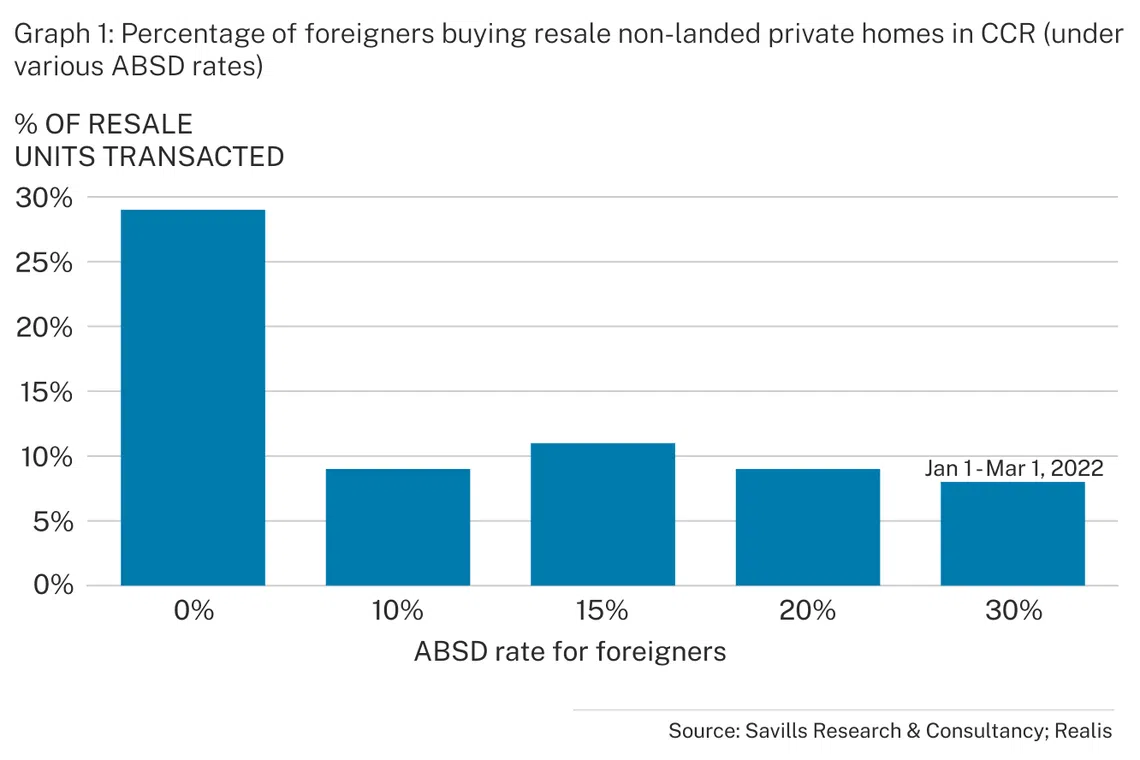
Graph 1 shows the percentage of total sales to foreigners declined in the 6-month period prior to the date when ABSD was first introduced or revised. In the period June to November 2011, before ABSD first kicked in on Dec 8, 2011, the percentage of foreign buyers in the CCR was 29 per cent.
As expected, the percentage fell sharply and in the 6-month period prior to the ABSD rate revision on Jan 12, 2013, the foreign buying share had fallen to 9 per cent.
Navigate Asia in
a new global order
Get the insights delivered to your inbox.
However, what was surprising was that when ABSD was raised to 15 per cent, the percentage of foreign buyers increased to 11 per cent, but when the rate was further raised to 20 per cent, the foreign buyers' share slipped back to 9 per cent.
For the increase in foreign buying share during the respective 6-month periods prior to the 2013 and 2018 ABSD revisions, we believe that it could be that the gap between the revisions, around 5.5 years, was significantly longer than the other intermediate periods, giving more time for foreigners to accept the add-on price of buying a private residential property here and/or more wealth having built up to overcome the higher duty payable.
For the latest ABSD revision, at the time of this writing, we only have data from the period Jan 1 to Mar 1, 2022 and the analysis showed that the percentage of foreigners declined to 8 per cent from 9 per cent in the June-November 2021 window. In absolute number terms, foreign purchases have been falling over the decade.
Has the latest 30 per cent ABSD rate effectively deterred foreigners from buying?
The earlier series of 5 percentage point increments appeared to have had hardly any major impact on reducing the percentage of sales to foreigners, but for the latest 10 percentage point hike, will this be the proverbial straw that will break the camel's back?
Also, we noticed that in the first 2 months of 2022, the average monthly number of non-landed resale transactions in the CCR fell by a sharp 38 per cent compared with December 2021 and 42 per cent against November 2021.
Thus, for the first 2 months of 2022, the effect of the changes that came into effect on Dec 16, 2021 seems to be restraining foreign demand but not to the point of a complete collapse.
What about the reaction of PRs? Their make-up in the proportion of sales has been declining ever since a 5 per cent ABSD had been levied on their first purchase. Nevertheless, the proportion of this group is still higher than the 2011 period when there was no ABSD.
For Singaporeans, the percentage buying in the CCR had been trending up ever since ABSD was imposed for the second property purchase. In an environment where ABSD rates are continuously being recalibrated higher, our belief is that Singapore citizens will, over time, increase their market share.
From ground feedback, it is unlikely that most Singapore citizens will be willing to pay 17 per cent ABSD (or even when it was 12 per cent) for their second private residential property purchase.
Many would therefore ensure that their property purchase will be counted as their first, and further increases to the ABSD rates for their second or more purchases would prima facie seem to have trivial effects over the medium to longer term.
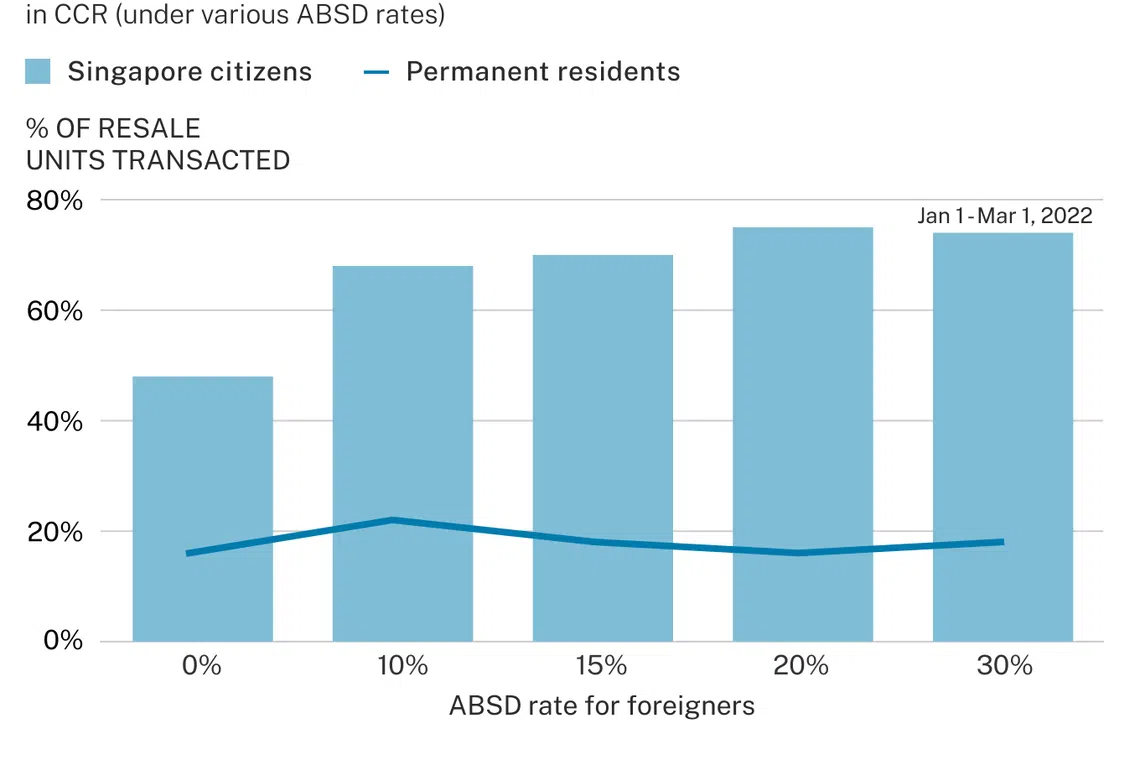
From Graph 2, we see that the percentage of PRs buying has risen slightly in the aftermath of the latest ABSD recalibrations while the percentage of Singapore-citizen buying has remained stable.
For the latter group, there could be a lag before their percentage share rises because they may now wish to first sell their existing property before signing the sale and purchase agreement for the next to avoid paying the 17 per cent ABSD.
Although the ABSD paid is refundable upon proof of sale of their first property within a specified period for married couples with at least 1 Singapore citizen spouse, it is nonetheless quite a sizeable amount, especially if the next purchase is substantial.
For example, a S$10 million purchase would incur a S$1.7 million ABSD which even if locked up for 6 months, is a significant opportunity cost for entrepreneurs.
While our initial observations have not changed our prior belief that the latest ABSD rate hike may have a significant impact on foreign buying, nevertheless, it has not changed our outlook for prices in 2022.
Although the percentage of foreign buying has fallen since December 2021, we believe that over time, Singapore citizens and PRs will step in to fill that gap.
The slight dip in the percentage of Singapore citizens buying in January and February 2022 is likely a case where they are sitting back to strategise on how to avoid paying the ABSD, even though it is refundable after selling their first property within a stipulated time.
Given the sharp decline in the number of new launches in 2022 and the presence of heightened inflationary pressures, for this year, Singaporeans and PRs should be able to overcome interest rate increases and global political uncertainties. We maintain the view that non-landed CCR residential property prices would still be rising about 5 per cent this year after increasing around 10 per cent last year based on SRX data.
Alan Cheong is executive director of research and consultancy at Savills Singapore.
Decoding Asia newsletter: your guide to navigating Asia in a new global order. Sign up here to get Decoding Asia newsletter. Delivered to your inbox. Free.
Copyright SPH Media. All rights reserved.