

Property agents bought up to 20% of some new condo launches: did ‘first dibs’ buying heighten Fomo?
Such activity does not breach regulations, but some in the industry are concerned that it crowds out the public

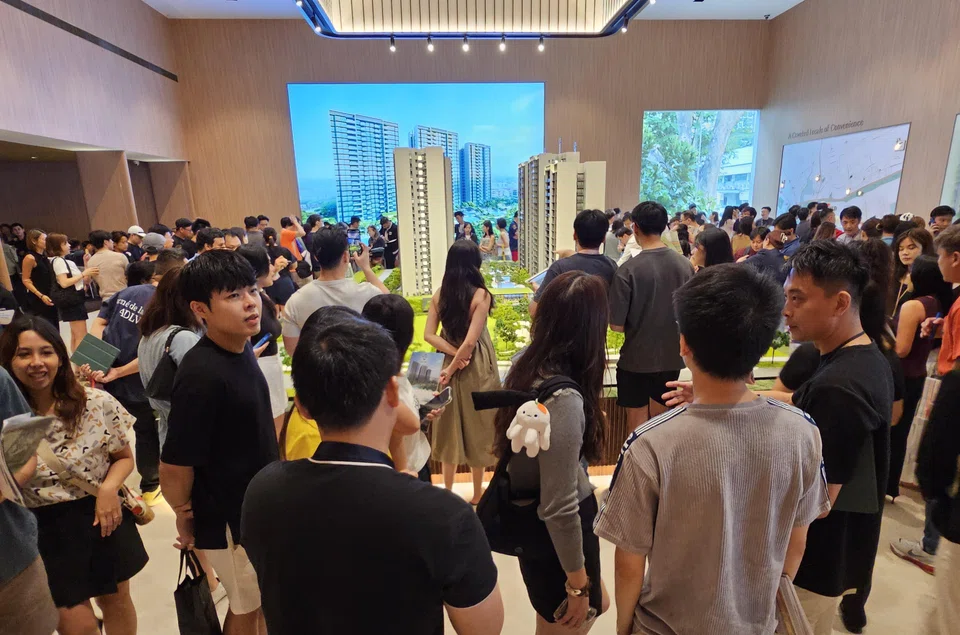
[SINGAPORE] Just before new private property projects are publicly released for sale, a quiet queue already forms – not made up of the developers’ VIP clients, but property agents. Buried in the past year’s surge in demand is data showing a concerning statistic: that agents bought up to 20 per cent of units at certain “hot” launches.
While such activity does not breach regulations, some in the industry have voiced concerns that the “insider” buying crowds out the public, feeds into the fear of missing out (Fomo) and could encourage speculative activity.
Data disclosed to The Business Times shows the incidence of agent buying is, on the whole, low. Between September 2024 and October 2025, property agents purchased 635 units through priority queues – around 4.2 per cent of all new private homes launched in that period.
However, a few projects saw much higher-than-average sales to agents, according to data from an industry source.
At Sim Lian’s Emerald of Katong, which launched in November 2024, agents bought 173 of 846 available units, about 20 per cent of the project. At CDL’s Norwood Grand, almost 10 per cent of the project’s 348 units were bought by agents. At Wing Tai’s Rivergreen, agents bought 43 – about 8 per cent – of 524 units. And at CapitaLand’s LyndenWoods launch, 25 out of 343 units (7.3 per cent) were sold to agents.
These projects recorded an average take-up rate of 91 per cent on their launch weekends.
BT understands that priority access for agents is not regulated by the government as it is a private commercial arrangement. Both the Urban Redevelopment Authority and Council for Estate Agencies declined to comment.
Developers contacted by BT did not respond to requests for comment.
Agent buying activity is not a new phenomenon, but observers said recent shifts in the market have intensified the trend.
Alan Cheong, Savills Singapore executive director of research and consultancy, said this is particularly prevalent when demand and prices are elevated.
This is a phenomenon of sentiment-driven purchases, where people believe there is “money on the table”, much like in certain initial public offerings, explained Professor Sing Tien Foo, provost’s chair professor of real estate at NUS Business School. “The last time we observed such a scenario, people queued outside showflats even many hours before the launch.”
Booming conditions also tend to attract speculators, some of whom could be property agents, said Nicholas Mak, Mogul.sg chief research officer.
“Of late, as the pool of agents increased and (with) the amount of motivation training agents receive, agents bought into their own story,” Cheong added. “This probably was the reason for the recent increase in the number of agents turning buyers in recent launches.”
On the supply side, Mak pointed out that the project launch is an opportunity for developers to set sales momentum. Developers may offer agents priority access to accelerate initial sales, or generate hype.
“It could create Fomo among the buyers, which would quicken the pace of sales during and after the launch,” he said. “It could also enable the developers to raise the prices of the units during the launch.”
Huttons Asia chief executive Mark Yip said developers may extend the priority queue to their business associates such as consultants and property agencies, but not all choose to take it up.
BT understands that agents’ priority access is typically granted following the project’s VIP preview and is generally limited to agents directly involved in a project’s joint marketing agency appointment. Purchases are only allowed under the agent or their spouse’s name, with other family members typically excluded.
Agent purchases are disclosed to the developer and the agencies marketing the project, as commissions are not paid on the agent purchases. The developer pays a fee to agencies appointed to market the project, which can range from 2 to 4 per cent.
Justin Quek, deputy group chief executive at Realion (OrangeTee & ETC) Group, said the priority queue is part of the overall sales launch process and an “operational incentive” for the agent’s involvement in these projects.
“Parameters may sometimes be applied – for example, limiting purchases to specific unit types or floor stacks,” Quek added. “Importantly, agents are also subject to the same purchase eligibility criteria and documentation requirements as any other buyer.”
ERA key executive officer Eugene Lim said priority bookings are also offered to other groups of buyers, such as those purchasing multiple units within the same project and those who are part of the developer’s loyalty programme.
Yip added: “This practice is seen in other industries, for example priority buying of concert tickets.”
PropNex, Singapore’s largest real estate agency with over 13,600 agents as at June, declined to comment.
Building momentum
Observers were mixed on whether agent buying boosts overall take-up or price momentum.
Prof Sing said that sentiment and herd instinct could lift sales and prices, and this sometimes spills over to other launches. “When prospective buyers fail to secure their units, they may become more impulsive when bidding for the next upcoming launch, and the situation needs to be carefully monitored to avoid overheating effects.”
This tends to happen when price momentum is fuelled by impulsive purchases, rather than being supported by economic fundamentals, said the professor. “This is (also) a marketing strategy…that works well in booming markets and may not be able to get traction in weak markets.”
Mak reckoned that only projects with strong price growth potential are likely to be affected, with general public demand still the main driver of sales and pricing. “Demand from property agents alone is not enough to move the needle,” he said.
Cheong added that while recent strong take-up rates have been partly fuelled by agent purchases, this is limited by additional buyer’s stamp duty rules “stymying” multiple purchases.
But given that new launches continue to anchor price trends across the market, should priority access for agents – especially at levels approaching 20 per cent – remain a private arrangement, or would clearer disclosures and a cap on priority access better serve buyers?
According to Prof Sing, clearer disclosures, particularly on pricing, would be beneficial.
Buying a home at a new launch can be a high-pressure affair. Price lists are typically now only shown to buyers on the day the developer starts taking sales bookings. If a launch nets more interest than units available, house hunters ballot for a spot in the queue to book a unit. If the unit they prefer is sold by the time their turn comes, they often have to make a decision within minutes on whether to buy a higher-priced unit.
Mak believes that with a growing number of property agents in Singapore – and a substantial pool having the financial means to buy properties – there is growing potential for speculative demand.
“The ability and opportunity for agents to buy choice units during the (early access) phase would encourage them to do so, especially in residential projects which offer short-term investment capital gain,” he said. Limiting this could help reduce property speculation.
Mak also questioned the practice of giving VIPs priority at property launches. Many of those invited to the early access queue already own at least one residential property, so purchases made then are often for investment rather than a housing need, he said.
“If the government’s objective is the fair and orderly distribution of housing resources… then priority should be given to people who have greater or more urgent housing needs, and not to well-connected people,” he said.
On the other hand, Cheong cautioned against implementing regulations for topical issues.
“Once implemented, they are often left in place,” he said. “Over time, the number of permits and processes a developer must adhere to for a project becomes a dense bureaucratic minefield.”
Rather, authorities should continue supplying land, factoring in vacancy rates and “getting on top of the cooling measures”, said Cheong. “The pool of agents is limited and no matter how they talk themselves into believing their spiel, given time, the economics will bring their psychological highs down to earth.”
TRENDING NOW

Two Singapore-listed palm oil firms named in Greenpeace report on Indonesian plantation fires

Singapore Airlines flight returns to San Francisco after ‘unruly’ passenger incident

Singapore looking into which companies responsible for haze-causing fires: PM Wong

Deluge IPO 3.86 times subscribed ahead of SGX debut

