Property agents' share of pie shrinks as their ranks swell further
Robust property prices likely attracted more to agency business but that increases competition: analyst

Singapore
THE total number of property agents in Singapore continued to rise last year, although on average they appeared to be closing fewer sales each.
This came as some agents looked to diversify their income streams, such as by shifting their focus towards rental properties, said the Institute of Real Estate and Urban Studies (IREUS) at the National University of Singapore.
IREUS deputy director Lee Nai Jia said many salespersons also took on additional jobs or gig-economy work, such as driving for ride-hailing platforms, while retaining their licences in the property agencies as a safeguard. This helped to mitigate the industry's attrition rate.
Robust property prices likely attracted individuals, including those retrenched during the Covid-19 pandemic, to join the agency business as well, he added.
The number of agents generally mirrors the ups and downs of the private residential market, albeit with a slight time lag, Dr Lee said, citing data from the Council for Estate Agencies (CEA) and the Urban Redevelopment Authority's Realis platform.
In 2020, there was an increase of 326 agents while the housing market sizzled despite the pandemic. The industry grew to 30,399 strong as at Jan 1, 2021, close to levels from the 2011-2013 property market upturn.
As at Jan 1, 2014, the industry had expanded to 31,783 real estate salespersons, from 31,169 on Jan 1, 2011.
After the total debt servicing ratio (TDSR) was introduced in June 2013, private home sales plunged. Caveats lodged for private housing, including executive condominiums, almost halved to 14,034 in 2014, from 27,181 in 2013. Meanwhile, 953 agents exited the industry in 2014, followed by 1,568 leaving in 2015 and 865 in 2016, CEA data showed.
The downtrend in the agency scene bottomed out in 2017 with 174 agents joining the industry, coinciding with the collective-sale fever then.
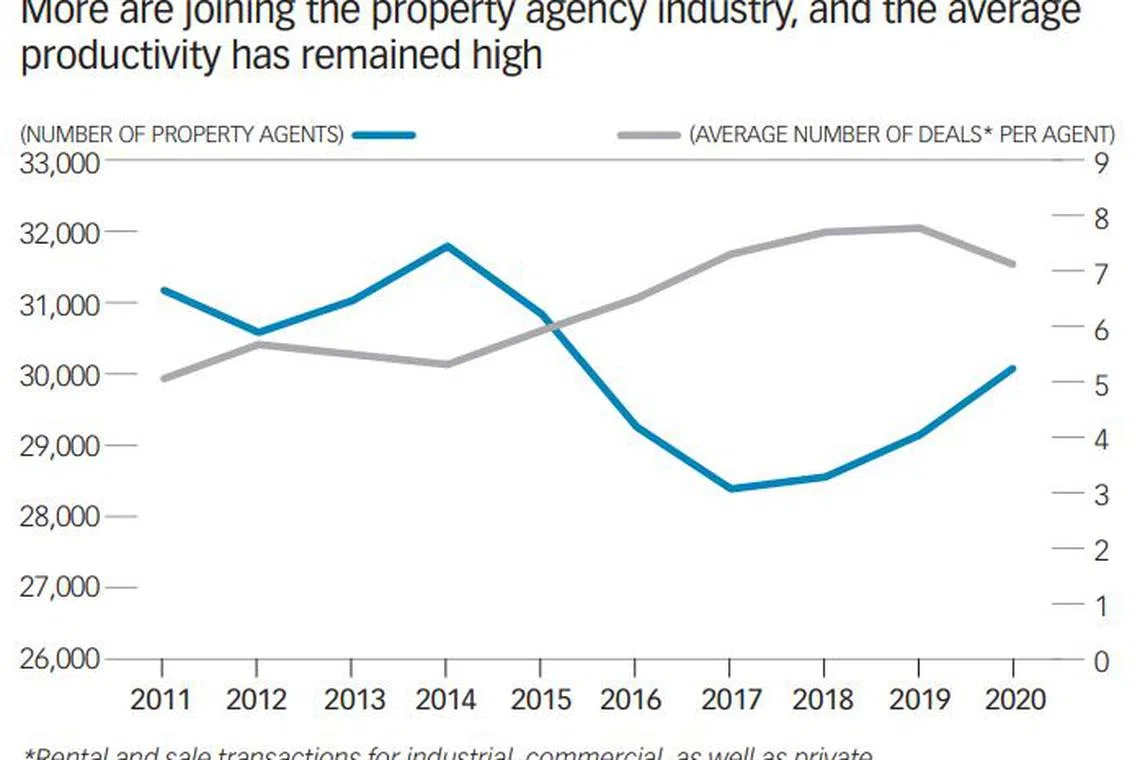
However, the correlation between the number of real estate agents and private home transactions stopped in the next two years. Fewer caveats were lodged in 2018 and 2019, falling 17.5 per cent and 16.7 per cent year on year respectively, after a round of cooling measures in July 2018. In contrast, the industry welcomed more salespersons - 575 in 2018 and another 927 in 2019.
This divergence could be attributed to some agents turning to rental markets for homes and commercial properties, to reduce their reliance on residential sales, Dr Lee noted.
While most salespersons would still prefer to handle sales of private homes, that became more challenging in the second half of 2018 and 2019 amid cooling measures and a widening price gap between buyers and sellers.
"There were also more residential project completions then. Hence, some salespersons pivoted to leasing to tide them over the dry periods, while waiting for private home sales to pick up again," he said.
The number of rental contracts for private residential properties rose progressively to 95,491 in 2019, from 83,918 in 2017. This uptrend corresponded with the completion of several condominium projects around that period. In 2020, rental contracts for private homes dipped in volume, but stayed elevated at 94,205.
Some agents from mainstream brokerages were also moving into the rental market for commercial space.
"However, they would have to contend with international property consultancies, which maintain a competitive edge for larger, single-owner developments due to their overseas networks," Dr Lee said.
The heightened level of activity in the rental markets seemed to boost overall productivity - based on transactions - of property agents.
Taking into account both rental and sale transactions for industrial, commercial and residential properties, each salesperson closed about 7.1 deals on average in 2020, more than the average of five deals in 2011.
That said, the actual number of deals brokered by a typical salesperson could well be lower than the computed average. Some rental contracts were inked without agents, as tenants renewed leases directly with landlords. For private and public housing, CEA data showed agents closed 62.2 per cent of rental transactions last year.
"Besides, a productive salesperson closes disproportionately more deals than the average salesperson, so we are likely looking at a highly skewed distribution," Dr Lee said. Still, the computed average can be useful as a comparative statistic.
"All things being equal, salespersons involved in rental activity in 2020 were more productive than in 2011."
On the other hand, agents' productivity appeared to tick down when it came to the number of sales of homes. Each salesperson on average brokered about 1.52 sales transactions of residential properties last year, fewer than the 1.66 deals in 2011 and the 1.9 deals in 2012.
More part-time and inexperienced practitioners could emerge when the agency scene gets more crowded, said Dr Lee. "And when the industry is highly competitive, salespersons are likely to focus more time on marketing efforts to attract clients and less on directly working with buyers and sellers," he said.
Dr Lee expects competition in Singapore's agency landscape to intensify, with fewer new launches and completions ahead implying a potential decline in new private home sales and rental transactions.
READ MORE: