

Real estate players brace for market curbs as housing debt climbs: NUS poll
Debt-limiting rules such as loan-to-value and mortgage servicing ratio are seen as more effective than ABSD

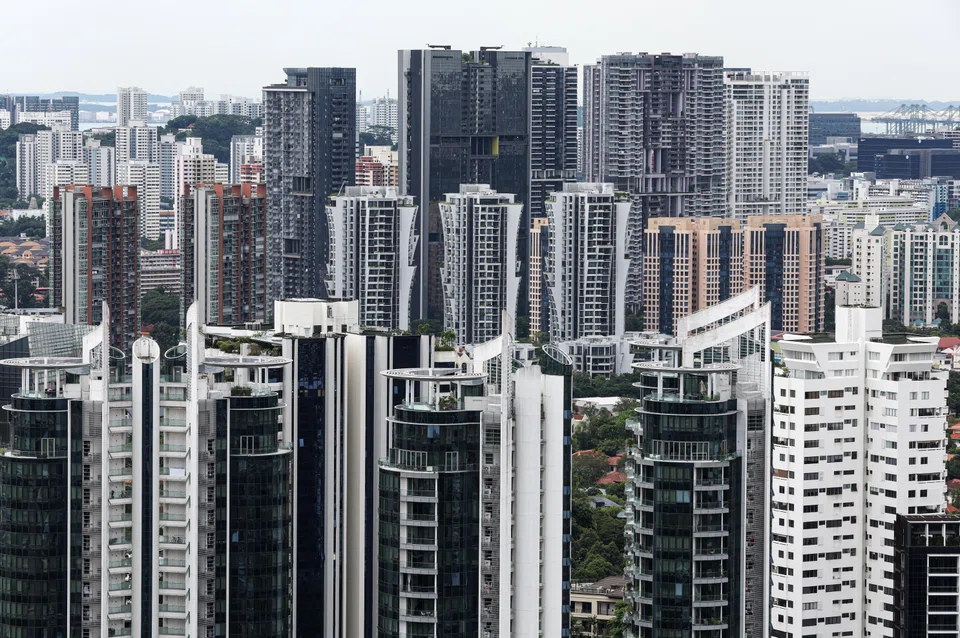
[SINGAPORE] Expectations of market cooling measures are rising among real estate players, as households continue to take on more housing debt amid falling interest rates, according to a National University of Singapore (NUS) survey.
“We have observed that households have been taking on more debt for their homes since the third quarter of 2024, coinciding with the US Federal Reserve’s commencement of interest-rate cuts,” said Professor Qian Wenlan, director of the NUS Institute of Real Estate and Urban Studies (Ireus).
The Fed cut interest rates twice in the second half of 2025 – by 25 basis points each in September and late October – bringing the current range to between 3.75 and 4 per cent.
Against this backdrop, the three-month compounded Singapore Overnight Rate Average (Sora) dipped from an estimated 1.45 per cent on Oct 1 to about 1.26 per cent on Nov 11.
Mortgage rates are likely to ease in line with the Sora, said Prof Qian. The survey, conducted in October, showed that 85 per cent of respondents expect more homebuyers to take out housing loans from banks and financial institutions.
Household mortgage loans grew 5.2 per cent year on year in Q2 2025 – the highest increase in six consecutive quarters, according to Singstat’s Household Sector Balance Sheet report.
“If this uptrend persists and outpaces economic fundamentals such as employment rates and wage growth, then another round of property curbs could possibly be rolled out,” said Prof Qian.
She noted that private home prices have continued to climb faster than incomes, with the price-to-income ratio reaching 14.6 times annual income in 2024, above the long-term average of 13.4 times.
Meanwhile, real median household income per member grew just 0.8 per cent between 2023 and 2024.
About 60 per cent of respondents in the survey highlighted that the government might intervene with new property cooling measures or tighten existing ones.
A majority of respondents (63 per cent) expect further tightening of the loan-to-value (LTV) ratio, followed by 47 per cent who anticipate stricter mortgage servicing ratio (MSR) limits, and 42 per cent who project tighter total debt servicing ratio (TDSR) restrictions.
In comparison, only 26 per cent of respondents anticipate that additional buyer’s stamp duty (ABSD) rates will be raised.
“This response suggests that macroprudential tools could be deemed more effective in curbing debt overreach compared to taxation measures that apply only after homebuyers have incurred mortgage loans,” said Prof Qian.
Currently, a Singapore citizen pays 20 per cent ABSD for buying a second home and 30 per cent for buying a third and subsequent home. A permanent resident (PR) pays 30 per cent ABSD on a second home and 35 per cent on a third and subsequent home. A foreigner buying any home pays 60 per cent ABSD.
The TDSR cap is set at 55 per cent, which limits the entire monthly debt obligation of borrowers at 55 per cent of their monthly income. The MSR cap is set at 30 per cent for housing loans granted by financial institutions for public housing flats and executive condominium units purchased directly from property developers.
The LTV ratio for HDB loans was cut from 80 to 75 per cent in 2024, in line with those granted by financial institutions.
More recently, the seller’s stamp duty (SSD) was revised. The holding period for private residential properties was extended from three to four years. SSD rates now range from 16 per cent in the first year to 4 per cent in the fourth year, with no SSD payable after that.






