Rental gains can make up for declining values in older leasehold properties
Experts say there could be merit in investing in an ageing 99-year leasehold property, given the higher rental yields

PROSPECTS are generally dim for older 99-year leasehold developments, with prices and property values declining as the tenure dwindles. But analysts said high rental yields from these ageing properties may sometimes negate potential losses from depreciation.
According to Nicholas Mak, chief research officer at Mogul.sg, a property’s rental value is independent of its tenure. “A freehold and leasehold property, with the same characteristics and in the same location, will command the same rental rate for the same type of housing unit,” he said.
Some investors may therefore opt for an older 99-year leasehold property – which is likely to be cheaper than freehold properties and new 99-year leasehold projects – to enjoy higher rental yields, said Wong Siew Ying, PropNex’s head of research and content.
Data crunched for The Business Times by property consultancy Cushman & Wakefield also showed that the rental yields for projects with a shorter tenure tend to be higher than that of longer-tenured properties.
For instance, the 99-year leasehold Southaven I condominium in Upper Bukit Timah recorded a median rent of S$3.35 per square foot (psf) between 2023 and July 2024. Given that its median resale price was S$1,196 psf, gross rental yield was about 3.4 per cent.
Meanwhile, the adjacent 999-year leasehold Southaven II had a median rent of S$3.65 psf and a median resale price of S$1,529 psf in the same period. This translated to a gross rental yield of 2.9 per cent.
In Clementi, the 99-year leasehold The Trilinq condo, which completed in 2017, registered a median rent of S$5.49 psf between 2023 and July 2024. Its median unit price was S$1,792 psf. This brought gross rental yield to around 3.7 per cent.
At the nearby 99-year leasehold Parc Clematis, which completed in 2023, median rent was S$5.55 psf and median unit price was S$2,011 psf. This worked out to a gross rental yield of 3.3 per cent.
Savills Singapore executive director of research and consultancy Alan Cheong noted that rents may not necessarily decline in line with capital values.
“The former is determined more by the condition of the property, rather than the expiry of an underlying lease term,” said Cheong. “So whether it is a 99-year or freehold property of similar age and condition, their rents should be the same.”
Still, newer condos tend to command higher rents compared to older properties, noted Christine Sun, OrangeTee Group’s chief researcher and strategist.
Sun studied the median rents of eight developments across Singapore – three older properties with 53 to 58 years remaining and five newer ones in their vicinity, with 76 to 88 years remaining. Her analysis indicated that rents at newer condos were 1.5 to two times higher than that of older properties.
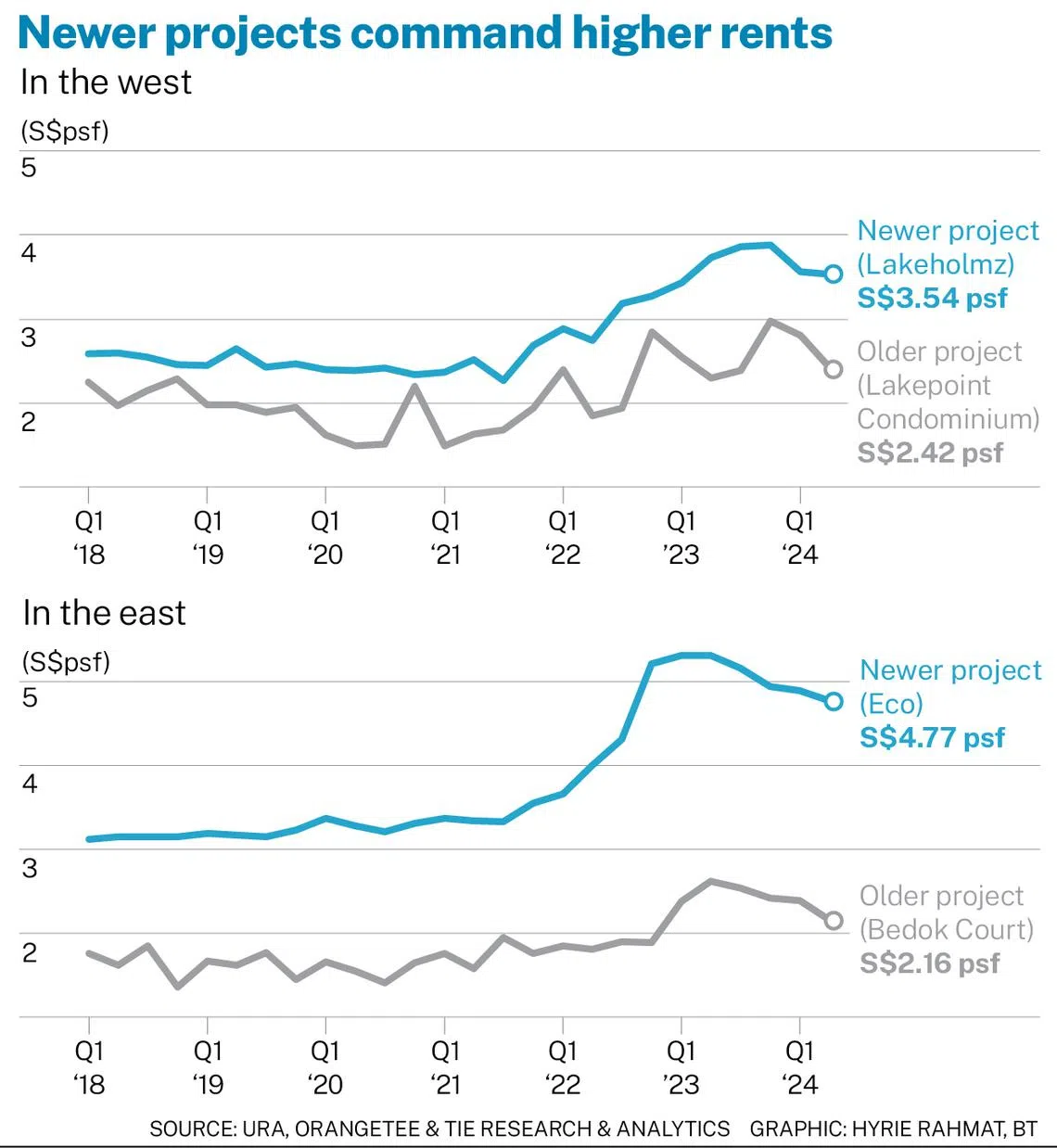
For example, Bedok Court, which has a 99-year lease starting from 1982, had a median rent of S$2.16 psf in the second quarter of 2024. The neighbouring Eco condo’s median rent was double that at S$4.77 psf. Its lease commenced in 2012.
In the central region, the 50-year-old Lutheran Towers recorded a median rent of S$3.09 psf in Q1 2024. This was S$6 psf for the nearby 11-year-old The Siena condo.
In the western region, median rent was S$2.42 psf for the 41-year-old Lakepoint Condominium. Projects in its vicinity – such as the 23-year-old Lakeholmz, 16-year-old Caspian, and 14-year-old The Lakefront Residences – witnessed median rents ranging from S$3.54 to S$4.89 psf.
Newer projects also saw a bigger jump in median rents between Q1 2018 and Q2 2024.
The only exception was Lutheran Towers, which recorded a nearly 70 per cent increase in median rent to S$3.09 in Q1 2024, from S$1.82 psf in Q2 2018. In comparison, median rent at The Siena grew 25.5 per cent, from S$4.78 psf to S$6 psf.
Mogul.sg’s Mak pointed out that there is usually lower rental demand for older properties, too.
An analysis of three older leasehold properties – Bedok Court in the east, Lakepoint Condominium in the west and International Plaza in the central region – indicated that older properties had consistently lower rental transaction volumes compared to newer counterparts.
At Bedok Court, for instance, the average annual rental activity – that is, the average number of rental contracts annually in proportion to the total number of units within the project – was just 8.3 per cent. It was 29.2 to 42.8 per cent at newer projects in its vicinity.
Likewise, Lakepoint Condominium recorded an average annual rental activity of 14 per cent. This figure was 23.6 to 39 per cent for other newer leasehold projects in the same area.
“This shows a clear inclination towards newer developments in terms of rental demand and activity,” said Mak.
International Plaza was, however, an outlier, with a notably higher level of rental activity of 33.4 per cent despite its age, Mak noted. It was also significantly higher than the nearby Wallich Residences, which had an average annual rental activity of 24.4 per cent. Its 99-year lease commenced in 2018.
“This anomaly suggests that while age may generally correlate with diminished rental transaction volumes in 99-year leasehold properties, (other factors) such as prestige and rental pricing dynamics can influence market behaviour significantly,” said Mak.
This includes properties in locations with good infrastructure and amenities, or those in areas with a limited supply of newer units, he said. “The 39-year-old Loyang Valley provides (another) notable example... Its unique location has no condominiums or private properties nearby, making it an attractive residential choice for those working in the vicinity.”
Cushman & Wakefield research head Wong Xian Yang added that an investor should also consider the total return of the property as well as expected returns of other investment products.
“Given a lower price for the leasehold property, an investor could invest the savings into other investment products, such as equities or bonds, to offset the weaker capital appreciation potential of the leasehold property, though there would be limits to this strategy,” he said.