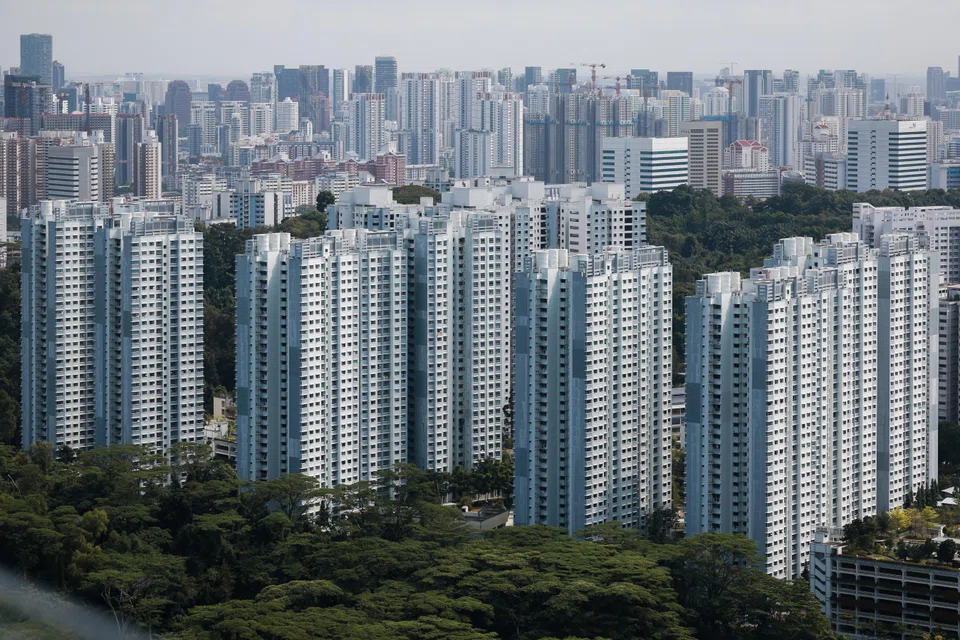
Residential launches and robust order books to hold up earnings for property, construction stocks
Property agencies also did well in 2025, but their outlook could be tempered by there being fewer property launches

[SINGAPORE] After a banner 2025 financial year, Singapore-listed property stocks look set to extend their run into 2026, supported by steady residential launch pipelines, multi-year order book visibility and ongoing capital recycling.
Growth is, however, likely to be more measured for agency players as transaction volumes normalise from last year’s standout sales.
New home sales fuelled top-line growth at developers City Developments Ltd (CDL) and UOL in the second half of 2025, when construction counters also delivered with strong project execution and healthy order books providing multi-year earnings visibility.
While global uncertainty, the conflict in the Middle East and supply-chain fractures will weigh on the outlook, RHB analyst Vijay Natarajan does not expect Singapore’s housing demand to take a hit for now.
But the residential market could take a hit if the war is prolonged and results in an economic slowdown, higher inflationary pressures and weaker job market, he said.
Still, Derek Tan of DBS Group Research reckoned demand for Singapore property could rise amid uncertainty, as the asset class is seen as a store of value with stable supply.
Among developers, CDL outperformed in the last half-year with a 374 per cent rise in net profit to S$538.5 million, as revenue grew 11.1 per cent to S$1.9 billion.
Growth came from revenue recognition from projects such as The Orie and Zyon Grand, as well as the sale of the Ransome Wharf site in London and the office component of Suzhou Hong Leong City Centre in China.
A revised dividend policy to pay out at least 35 per cent of total net profit could translate into dividend yields above 3 per cent, noted Natarajan, as the payout would include gains from asset sales currently carried at historical cost.
CDL is increasingly focused on capital recycling, and the group has identified S$5 billion to S$6 billion in assets that could be divested or injected into funds over the next three years, he added.
Analysts said this could improve returns and narrow the stock’s steep discount to its revalued net asset value of S$20.16 a share.
Strong showing keeps up
Natarajan also pointed to potential value from monetising CDL’s global living sector portfolio, which has a gross development value of about S$3.7 billion. The portfolio includes residential rental apartments and purpose-built student accommodation.
He suggested that this portfolio could be injected into a private fund, attracting strong institutional interest and better valuations.
Rival UOL booked revenue of S$1.7 billion in H2, up 11 per cent and similarly boosted by development revenue, up 16 per cent. Net profit rose 21 per cent to S$276.2 million.
The higher takings come from Upperhouse at Orchard Boulevard, Watten House, Meyer Blue and Pinetree Hill.
A steady pipeline of residential launches, redevelopment plans and divestments are expected to extend earnings growth for developers.
Citing CDL’s launch pipeline of about 1,820 units and the sale of its legacy UK portfolio that has a carrying value of S$800 million, UOB Kay Hian raised its 2026-to-2027 earnings estimates for CDL by 8 per cent. It maintained a “buy” call on the stock with an unchanged target of S$11.50.
OCBC said UOL also has a healthy pipeline of new launches, with its large-scale Thomson View project (1,268 units) set to hit the market in the fourth quarter of 2026, followed by a Dorset Road project in H1 2027 and a Hougang Central project in H2 2027.
DBS Group Research analyst Tabitha Foo pointed to significant value-creation potential from a highly anticipated revamp of Marina Square complex, which could generate an uplift of between 3.5 and 4.8 times in the asset’s value and “potentially kick-start a series of value-unlocking initiatives” for UOL.
She retained her “buy” call with a target of S$13, and raised FY2026/2027 earnings estimates by 4 to 22 per cent.
The Marina Square complex comprises the Marina Square mall and three hotels. A proposal submitted to the authorities envisions Singapore’s first “hyper-mixed” development with a residential tower, serviced apartments and a mixed-use tower with hospitality, office and performing arts spaces. UOL plans to release more details in H1 2026.
The mega project is unlikely to strain the group’s finances, OCBC reckoned, as most properties are majority-owned by its subsidiary Singapore Land Group, with net gearing at about 4 per cent as at end-2025.
OCBC raised its fair-value estimate for UOL to S$12.87, with a “buy” call.
GuocoLand, meanwhile, posted S$85.4 million in net profit for H1 2026, up 14 per cent year on year, despite revenue slipping 22 per cent to S$791.9 million.
Noting the developer’s “solid track record in residential sales”, DBS estimates that the group has less than 5 per cent of launched inventory unsold, while its upcoming launches should see “healthy take-up”, although it will need to replenish its land bank this year.
At the launch of River Modern on the weekend of Mar 7, GuocoLand sold 90 per cent of the project at an average price of S$3,266 a square foot. An 860-unit Tengah Garden Avenue mixed-use project is expected to launch in Q2 2026.
A near-term uplift to the recurring income base is expected from Lentor Modern mall and higher rental reversions at its CBD Grade-A offices. Foo lifted her FY2026/2027 earnings estimates by 16 to 22 per cent.
DBS maintains its “buy” call on the counter, with higher target of S$3.30.
Subdued growth for agencies
PropNex and Apac Realty, which dominate Singapore’s real estate sales force through their PropNex and ERA Realty agencies, also rode the surge in housing demand and posted stronger bottom-line growth.
PropNex’s results, however, came in slightly below expectations. In H2 2025, its net profit rose 28.3 per cent to S$28.1 million.
Still, it is dishing out a final dividend of S$0.045 a share for H2, bringing its FY2025 payout to a record S$0.095 apiece, for a dividend yield of 5.1 per cent.
Apac Realty posted a 196 per cent rise in net profit to S$9.3 million, and will pay a dividend of S$0.018 a share, up from S$0.012 in the year-ago period.
The outlook for property agencies is likely to be tempered by fewer launches.
Singapore’s private new-home sales are expected to come in at 9,000 to 10,000 units in 2026, about 10 to 20 per cent lower than in 2025, following a roughly 10 per cent dip in new supply, said Natarajan.
He projects Apac Realty’s FY2026 net profit to dip 5 per cent.
Foo said: “The launch pipeline comprises a larger proportion in the Outside Central Region, which typically is more price quantum-sensitive.”
She lowered her FY2026 earnings estimates for Apac Realty by 23 per cent on the back of fewer new-home sales, and downgraded the counter to “hold” with a lower target of S$0.70.
Still, analysts expect resale and rental transactions to remain stable, cushioning the impact of slower new-home sales.
Maybank Research’s Eric Ong said PropNex expects resale volume to range between 26,000 and 27,000 units in 2026. About 13,500 public housing flats are expected to add to the resale supply pipeline in 2026, up 69 per cent from 8,000 units in 2025.
An anticipated removal of the 15-month wait-out period imposed on private property owners seeking to downgrade could also boost the resale market. Ong retained his “hold” call on PropNex with a higher target of S$2.
Swelling order book underpins growth
For construction firms, robust order books and a multi-year pipeline of projects has clarified earnings visibility. Stocks have rerated, rising between 10 and 420 per cent over the past year, noted DBS Group Research.
The Building and Construction Authority expects total construction demand of S$47 billion to S$53 billion in 2026, supported by major projects that include Changi Airport Terminal 5, the expansion of Marina Bay Sands and MRT line extensions.
In the medium term, demand is expected to remain healthy at S$39 billion to S$46 billion annually.
Wee Hur booked revenue of S$139.5 million in H2 2025, up 52 per cent year on year, and returned to profitability with S$29.8 million in net profit, turning around from a loss of S$12.5 million previously.
Two public housing wins worth S$439.4 million lifted its order book to S$629 million as at end-June 2025.
Soilbuild Construction’s H2 net profit rose 84.1 per cent to S$35.3 million, as revenue climbed 33.6 per cent to S$317.9 million. Its order book stood at S$1.1 billion as at end-December 2025, after S$158 million in new wins, with project completion stretching to Q1 2029.
DBS said: “Backlog replenishment has generally outpaced revenue burn. This stronger pipeline not only de-risks near-term earnings, but also supports better project selectivity, allowing companies to prioritise margin-accretive contracts rather than purely volume-driven growth.”
Industry margins have grown despite higher construction costs, it noted. Contractors have been able to pass through higher labour costs as tender prices remain firm; building materials players have preserved profitability through disciplined procurement.
Hong Leong Asia posted a 26.2 per cent increase in revenue to S$2.5 billion in H2 2025, and a 48.6 per cent rise in net profit to S$56.8 million.
Pan-United Corp reported a 16 per cent growth in revenue to S$497.3 million, and a 35 per cent rise in net profit to S$30.1 million.
DBS has a “buy” call on Hong Leong Asia, with a target price of S$3.90. Wee Hur and Soilbuild Construction have been assigned fair values of S$0.80 and S$1.18, respectively. The brokerage is watching Pan-United Corp for potential upside.
Additional reporting by Ry-Anne Lim
TRENDING NOW
Grab CEO’s wife Chloe Tong on life with Anthony Tan and finding her purpose
Hwa Seng Builder, two China companies win S$1.2 billion Tuas Road Viaduct phase two contracts
Deal between tycoon friends sparks scrutiny of Philippine power sector
Canada is upping oil flows to Asia, but South-east Asia’s refineries aren’t ready to handle them yet