Good Class Bungalow sales volume in 2025 expected to match, if not exceed, last year’s tally
Generational wealth transfer, Singapore’s stability underpin demand for the creme de la creme of the city-state’s landed housing market

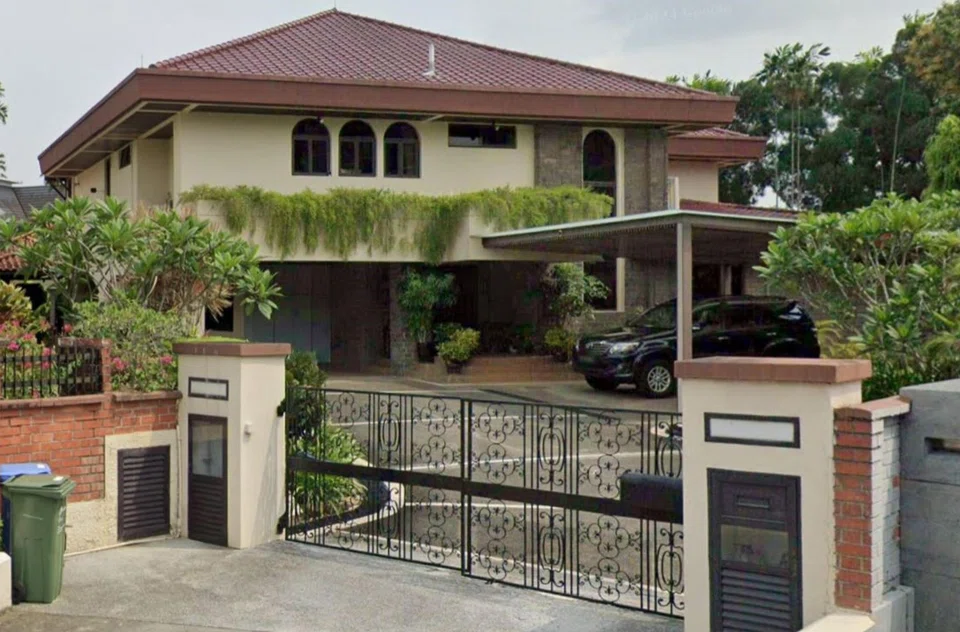
AFTER a strong performance in the Good Class Bungalow (GCB) market in the second half of 2024 lifted full-year sales above 2023 levels, market watchers are upbeat about prospects in 2025.
Julian Yip, managing director of Realstar Premier, said: “GCB buying activity will be supported by interest rates still continuing to go down, maybe by 100 basis points in 2025.”
He added: “Geopolitical conflicts and trade wars will continue to make Singapore even more attractive as a safe haven for new-citizen UHNWIs (ultra-high-net-worth individuals), be they from Taiwan, India or Europe.”
Among Singaporean families, wealth transfer from the baby boomer generation to Gen Z and millennials will add more centimillionaires – who will be able to purchase premium homes, he noted.
Among the factors that may impact buying sentiment in the GCB market this year are how the incoming Donald Trump administration in the US affects the global economy and geopolitics, and how interest rates move, Yip added.
Han Huan Mei, research director at List Sotheby’s International Realty (List SIR), said cooling measures, if any, imposed on Singaporeans buying their first private residential property would be a key factor affecting the GCB market in 2025.
Yip expects the number of bungalow deal transactions in GCB Areas this year to be similar to that of 2024, or higher. “Potentially, price records may be broken.”
Steve Tay, executive director Steve Tay Real Estate (STRE), said: “I see 2025 as a better year where well-priced GCBs will move as overall sentiments improve. Demand is healthy, although buyers will remain selective and go for reasonably priced GCBs with land attributes they find attractive.”
KH Tan, managing director of Newsman Realty, predicts a price increase of about 5 per cent on average in GCB Areas this year, with the volume of transactions slightly higher than in 2024.
“More buyers will be coming into the market because the economic outlook is good, interest rates are lower than last year’s, and there is pent-up demand,” he said.
“More UHNWIs from overseas have been setting up family offices here, and some of their family members will become Singapore citizens and thus qualify to buy GCBs for themselves and their next generation.”
One generally has to be a Singapore citizen to be allowed to buy a landed property in a GCB Area.
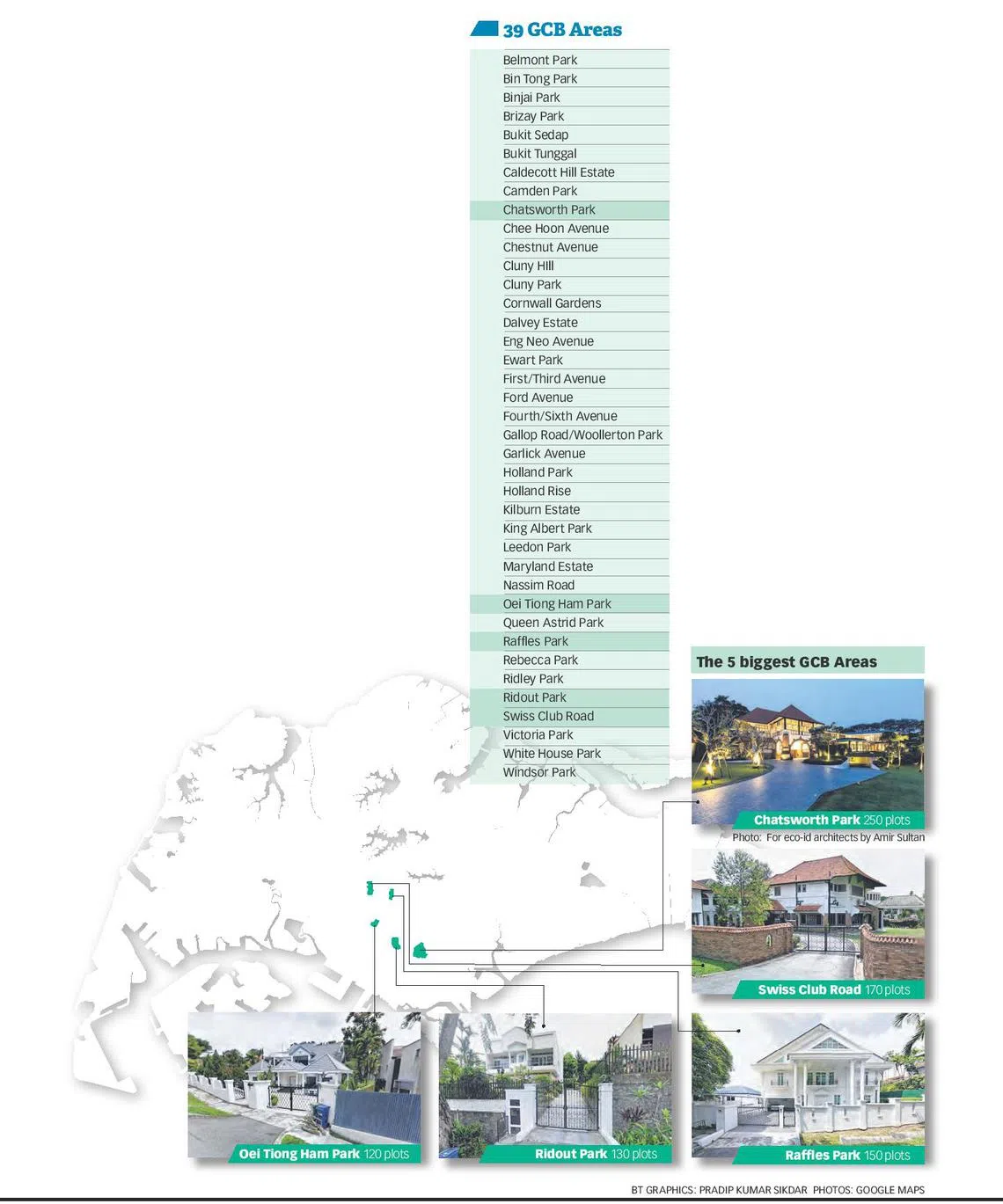
Bungalows in the 39 gazetted GCB Areas are the most prestigious form of landed housing in Singapore, with strict planning conditions to preserve their exclusivity and low-rise character.
Among other things, a minimum plot size of 1,400 square metres or 15,070 square feet (sq ft) is stipulated as the planning norm for newly created bungalows in GCB Areas. There are only around 2,700 bungalows in these areas.
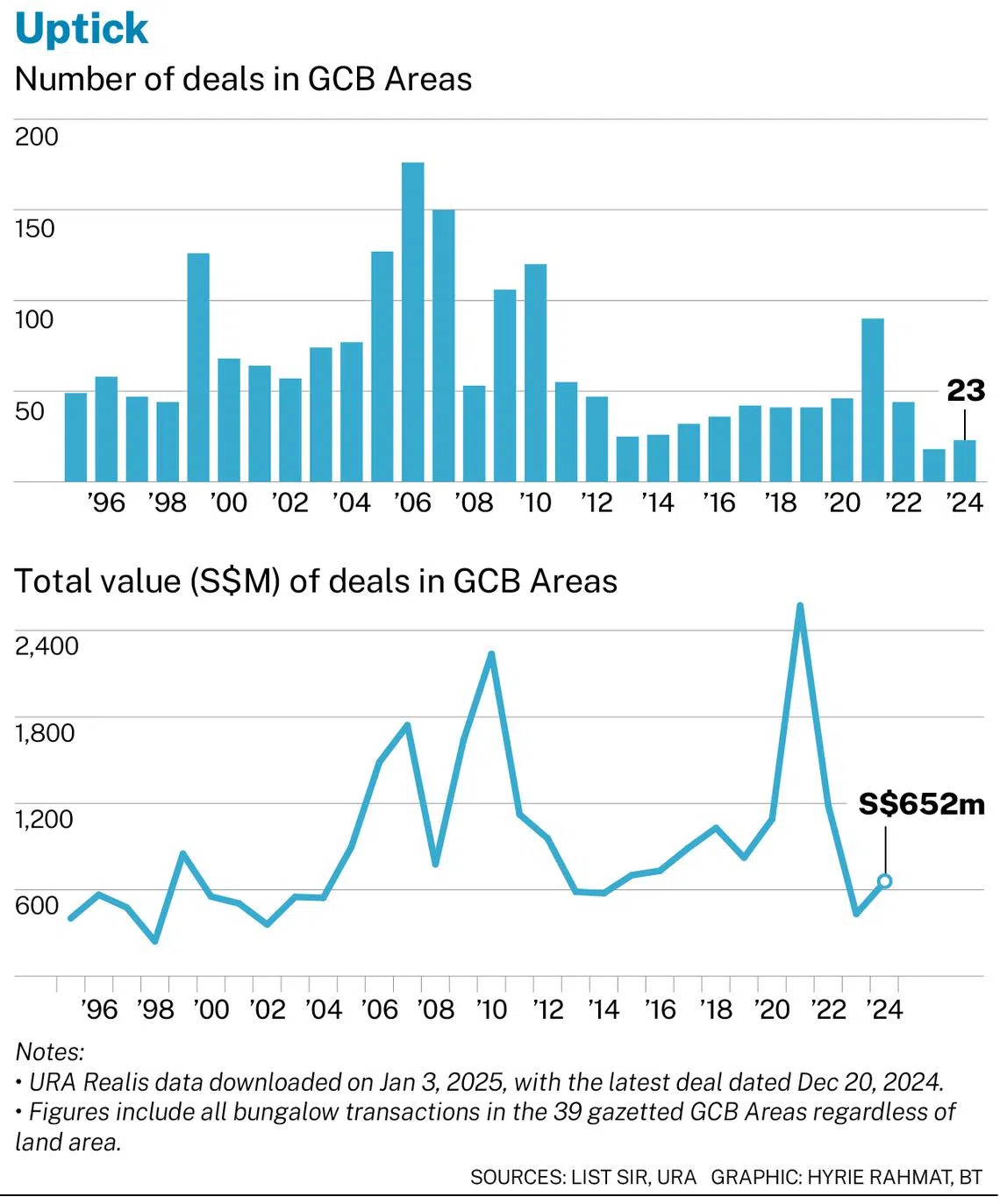
Based on List SIR’s analysis of the Urban Redevelopment Authority’s Realis caveats data, there were 23 deals in GCB Areas that amounted to S$652 million in 2024.
These include a bungalow in Cluny Hill that changed hands for S$52 million. Another example is the S$49 million purchase of a bungalow in Astrid Hill by the son and wife of Kuok Koon Seng, brother of Wilmar International chairman and chief executive officer Kuok Khoon Hong.
Market observers estimated that there were also deals worth more than S$900 million in 2024, for which buyers did not lodge caveats. Examples include the S$93.9 million sale of a bungalow under construction in Tanglin Hill.
The price for the house, which will be built to high specifications, translates to a record S$6,197 per square foot (psf) on land area of 15,150 sq ft. The property will have a built-up area of almost 30,000 sq ft.
Also not caveated were the purchases of two adjoining freehold bungalows on Belmont Road for a total of S$131.4 million, in separate transactions, by the family of Hillhouse Investment founder and chairman Zhang Lei.
The S$3,000 psf on land fetched for the property was above market expectations; market observers attributed this to the potential for redeveloping the combined 43,789 sq ft site into a large house at the highest point of Belmont Road, with a panoramic, unblocked view.
Sale in Gallop Park Road
Word in the market is that among the latest non-caveated deals is the sale of an old house in Gallop Park Road, with the price understood to be in the low-S$40 million range.
The property, which has a freehold land area of 18,427 sq ft, is being sold by Lily Yeo, the wife of the late Alan Yeo, who once helmed the Yeo Hiap Seng beverage and food products empire.
The 2024 tally of bungalow sales in GCB Areas is significantly higher than 2023’s, with 18 deals totalling S$432.5 million, based on caveats data. BT reported previously that in addition to this, the market had estimated at least S$700 million of non-caveated deals in 2023.
Just nine of the 23 caveated GCB deals in 2024 were in the first half of the year.
Tay of STRE noted the market had a slow start last year, given the global uncertainties, high interest-rate environment and sellers’ high price expectations carried over from 2023.
H2 2024 had an uptick in demand and transactions because of a clearer economic outlook amid lower interest rates, as well as the bridging of price expectations between sellers and buyers, he added.
More serious buyers
Realstar’s Yip observed that in H2 2024, buyers began accepting that prices of landed homes in highly sought-after districts would not ease.
Concurring, Tan of Newsman observed that “in the past six months, we’ve seen buyers who have been looking for a GCB for a while becoming more serious”.
“If they like a property, they are willing to make a reasonable offer and commit, because they are afraid of missing out on the opportunity to buy.”
Agents also report seeing seniors who own GCBs being more willing to sell, as they are empty nesters looking to downsize. Many of them are retirees and also feeling the pinch of paying higher property taxes since 2023.
“There’s also a tendency to dispose of estate sale properties (more quickly) if none of the family members are living in it,” said Tan.
According to Yip, the pace of price growth on average for landed properties – including bungalows in GCB Areas – in sought-after locations has slowed from about 13 per cent in 2021 to 9-10 per cent in 2022, around 7 per cent in 2023, and 4-5 per cent in 2024.
“Of course, there are the very exceptional properties, such as the Tanglin Hill bungalow and the pair of Belmont Road houses, that have transacted at a premium,” he added.
The great wealth transfer
Besides the drop in interest rates, improved economic growth and Singapore’s emergence as a stable Asian financial hub with a flourishing family office scene, there are other factors that boosted demand for the creme de la creme of the city-state’s landed housing sector in 2024, agents said.
Said Tay of STRE: “The cryptocurrency rally has generated new wealth among property investors and fintech players.”
“I’ve also seen an increase in younger local Singaporeans – be they self-made entrepreneurs or second or third generations of successful local business owners – looking to find a GCB to call their home,” he added.
Yip said that in 2025, the younger generations of local wealthy families benefiting from “the great wealth transfer” and newly minted citizens are likely to keep fuelling GCB purchases.
While bridging the buyer-seller price gap will continue to be the major challenge in sealing deals this year, “the bright spot is that asset-rich but cash-poor senior sellers are likely to be more willing to compromise”, said Yip.
He advises potential GCB buyers not to haggle over a small price gap, especially for properties in top-tier locations and with good attributes. “By quibbling over a small gap, you may lose the opportunity to buy your desired home.”
Agreeing, Tan said: “Good properties are hard to come by and when they do, the owner would want more than the fair market value. A serious buyer should just go for it.”
Yip suggests that owners with a strong reason to sell – for instance, the property is too big for them as their children have moved out, or they are struggling to upkeep the house and pay property taxes – accept a reasonable offer when it comes, and move on with their plans.
Video: What is a Good Class Bungalow?