

Growing difficulty in owning a private landed home does not imply a lower standard of living
Landed home prices are up sharply and their share of private housing stock is declining

IS LIFE getting harder for young professionals here? With costly car ownership, many people give up on owning a car.
On the housing front, upgrading from a Housing and Development Board (HDB) Build-To-Order flat to a condominium is challenging. And owning a landed home can be beyond the reach of even high-income earners.
Yet, in the early years after Singapore’s independence, numerous local accountants, civil servants, doctors, engineers, lawyers and teachers bought private landed homes, sometimes on single incomes.
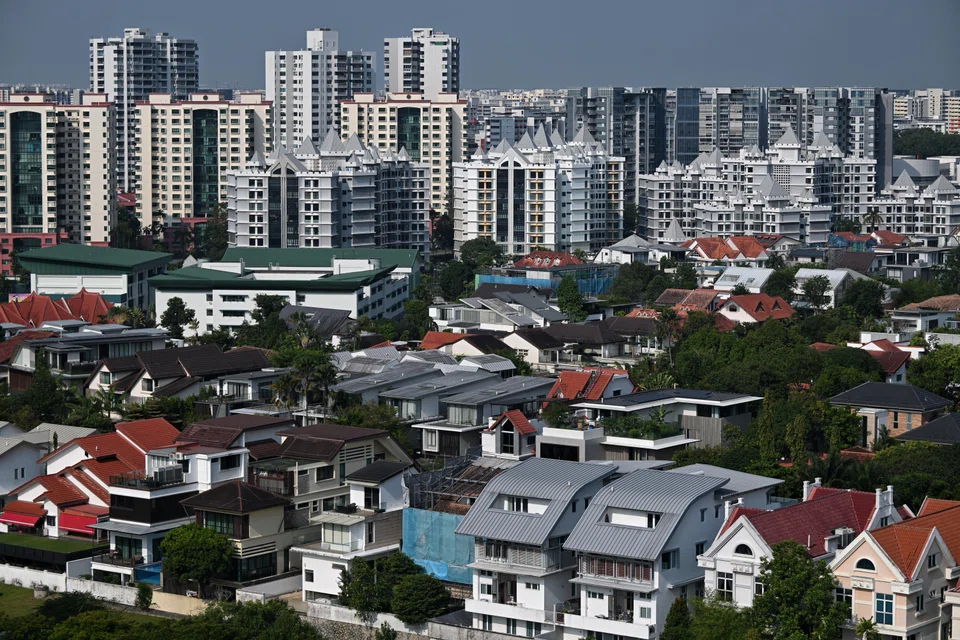
In land-scarce Singapore, urban planning helps ensure that there is a stock of private landed homes by having areas zoned for, say, two-storey or three-storey landed housing. As at the third quarter of 2024, there were 73,540 private landed homes here comprising 10,735 detached houses, 22,420 semi-detached units and 40,385 terrace homes.
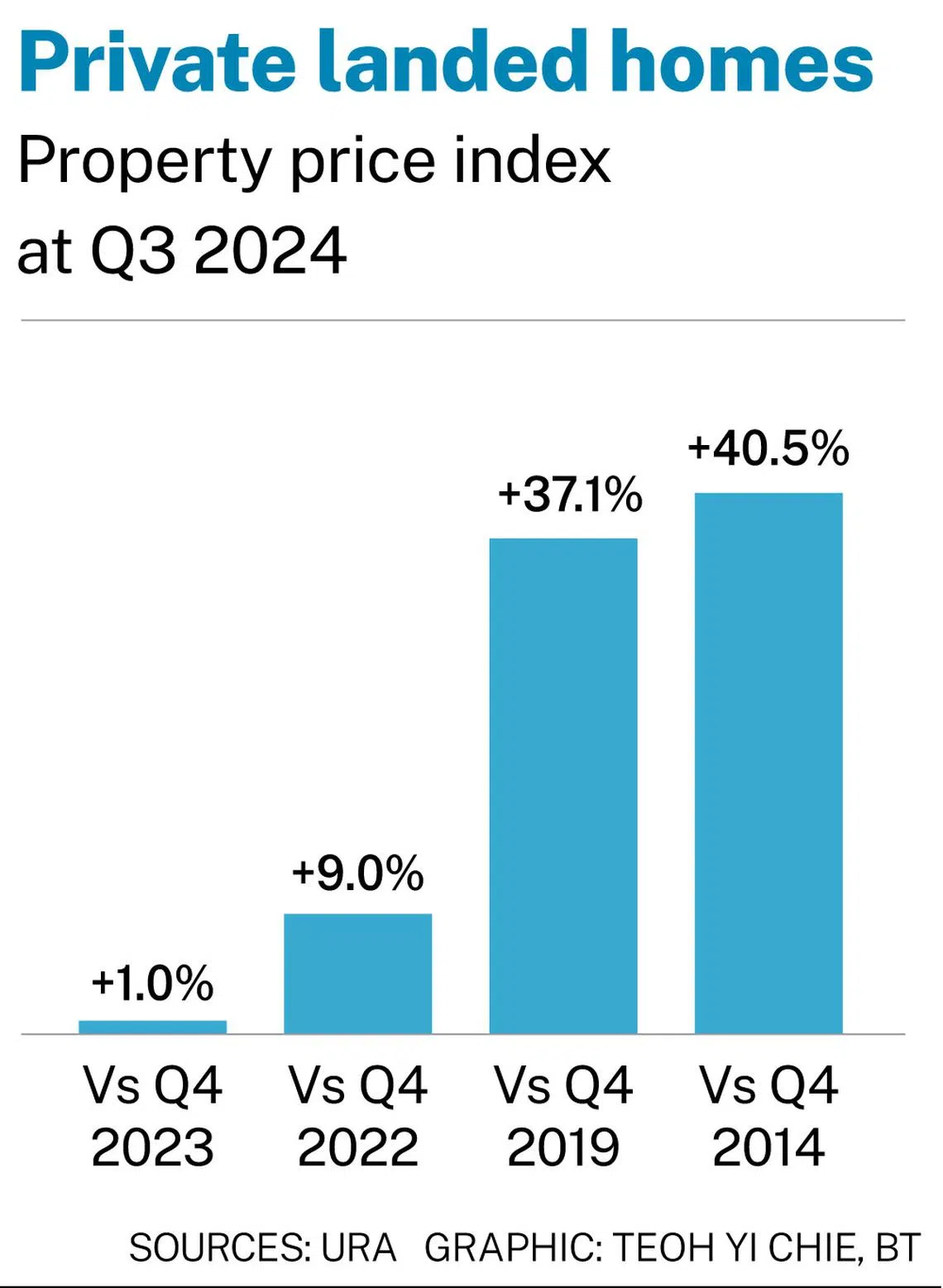
Owning a landed home, which is largely reserved for locals, is harder due to the sharp rise in prices. Between Q4 2019 and Q3 2024, private landed home prices jumped 37 per cent, outpacing the 32 per cent rise in private non-landed home prices, according to data from the Urban Redevelopment Authority.
Today, one might pay S$3.9 million for a new 99-year leasehold intermediate terrace house with land area of just over 1,600 square feet (sq ft) and floor area exceeding 4,000 sq ft at Bukit Sembawang Estates’ Pollen Collection in District 28, which works out to around 7.8 times for even a hypothetical annual household income of S$500,000.
An old freehold terrace house in the prime Holland-Bukit Timah area with land area of over 2,000 sq ft could cost more than S$5 million. This excludes redevelopment costs, which can exceed S$2 million.
Does the growing difficulty in owning a landed home here imply a decline in the standard of living of Singaporeans? Arguably not.
Old versus new terraces
One, the landed home that was way more affordable decades ago can be vastly different from many landed homes today.
Take a terrace house that was built several decades back. It may have a floor area of well under 2,000 sq ft. A terrace house at Pollen Collection has easily over twice the floor area. Such a house may have five bedrooms with attached bathrooms – far more than an old terrace house – plus a lift. Want a private pool? Possible, with a corner terrace at Pollen Collection.
In short, new or rebuilt landed homes may have much larger floor areas by maxing the development envelope as well as more luxurious materials and fittings versus old landed houses.
Moreover, amid Singapore’s rapid development, many landed housing estates today are no longer ill-served by public transport and other amenities. Various landed housing residents can now easily access MRT stations and buses as well as malls and a wide array of dining outlets located nearby.
Two, household sizes here are generally shrinking. In 2023, the average household size among resident households was 3.11 persons versus 3.5 persons in 2010, 3.7 persons in 2000, 4.25 persons in 1990 and 4.87 persons in 1980.
Arguably, many condo units adequately meet the spatial needs of small households, with each member having enough personal space.
Indeed, household members may see their quality of life improve when multiple-generations living under one roof split up to stay separately. Take two elderly parents who live with their son, daughter, daughter-in-law, and grandchild in a landed home.
Perhaps, having three households – namely the elderly parents, the son’s nuclear family and the daughter – stay in separate apartments close to one another will boost the well-being of the various household members.
High-quality condos
Three, developers have been upping their game in new condo projects to cater to discerning and selective homebuyers. Facilities such as 50-metre long swimming pools plus various play pools, fancy clubhouses, well-appointed function rooms and meeting rooms are not uncommon. And many projects incorporate thoughtful design that maximise the privacy and views of individual apartments plus the efficiency and flexibility of internal spaces within the units.
Many new condo projects meet the needs of modern-day families with three bedroom units at about 900 sq ft unit, four-bedders at around 1,200 sq ft unit and 5-bedders at over 1,500 sq ft. Also, these developments embrace sustainability features that enhance the living environment.
Building high-quality condo developments matters as more Singapore residents realise their private housing aspirations through non-landed homes. In 2023, 4.8 per cent of resident households lived in landed homes, while 17.2 per cent lived in condos and other apartments. In 2000, the share of resident households living in landed homes and condos plus other apartments were 5.1 per cent and 6.5 per cent, respectively.
Four, households today may not want to tie up too much of their funds in buying and maintaining their primary residence here. After all, many homeowners generate no recurring income from their owner-occupied homes and parking money in investments that produce passive income is crucial to help meet retirement needs as life expectancy rises.
Perhaps, living in a compact condo unit or an HDB flat here can be complemented by owning an overseas home. Some locals may want to live in owned homes in Singapore and overseas such as Australia, Japan, Malaysia, or the UK. Indeed, some Singaporeans might fulfil their landed housing dream much more affordably with a landed home in Johor, Malaysia.
As many Singaporeans travel extensively for leisure, they enjoy a high quality of life by soaking in an array of experiences overseas and not just the comforts of one’s abode.
Housing supply here is rising to meet demand from population increase and growth in household formation. However, supply of landed housing will hardly increase as state land tenders of private housing sites are predominantly for non-landed developments. Between Q4 2019 and Q3 2024, the number of private landed and non-landed homes excluding executive condominiums grew by 0.2 per cent and 14 per cent, respectively.
The landed homeownership dream here will likely become increasingly elusive for future generations of Singaporeans. Nonetheless, if the quality of non-landed developments and public infrastructure continues to improve, residents will enjoy a rising standard of living despite proportionately fewer locals owning private landed houses.
TRENDING NOW
Far East Organization’s The Serra Residences sells less than a quarter of units released at average S$3,460 psf

Singapore to use ‘every legal and regulatory lever’ against companies linked to haze: Shanmugam

Could stablecoins be the future of money?
The middle power moment arrives in South-east Asia – but not for Asean

