Prime residential properties account for majority of loss-making resale deals in Q2
Excluding executive condos, the most profitable trades by percentage were from homes in the suburbs, with sellers pocketing profits of up to 89 per cent

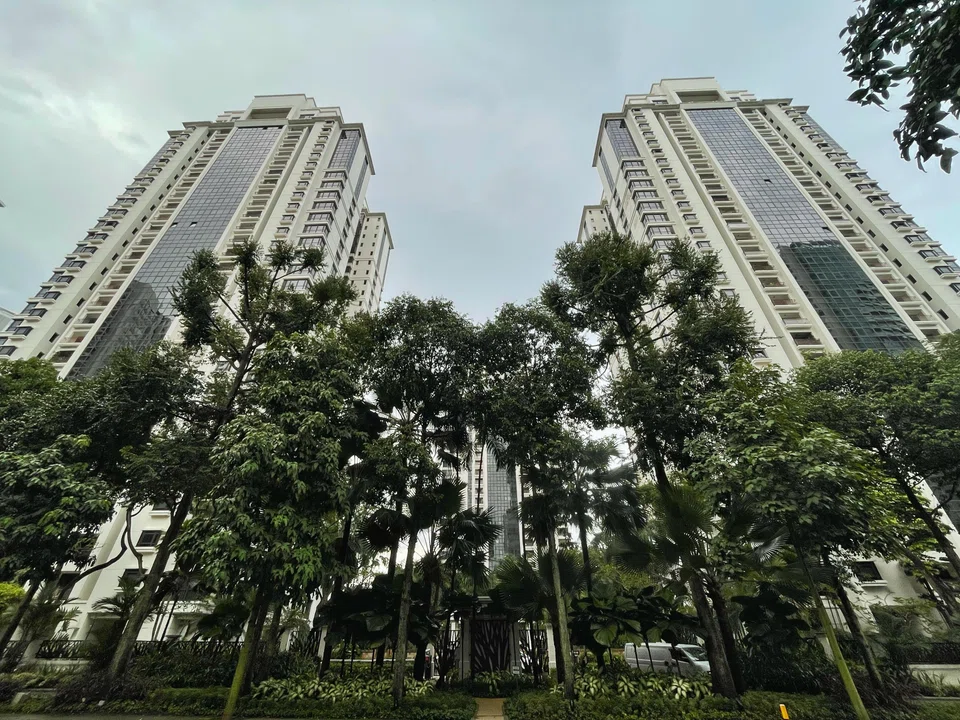
SINGAPORE’S prime residential properties chalked up the biggest losses – losing between S$780,000 and S$2.1 million in value – and accounted for the majority of loss-making deals in the second quarter of 2024.
Still, the majority of resale transactions in the Core Central Region (CCR) – at 80 per cent – remained profitable in Q2, data crunched for The Business Times by Cushman & Wakefield showed.
The biggest money-making deal by quantum in Q2 was for a 2,885 square foot (sq ft) unit in Ardmore Park in the prime District 10.
The 22nd-floor unit in the freehold luxury development was sold for S$11.9 million or S$4,108 per square foot (psf) in May. The seller netted S$2.7 million in profit, or 29 per cent over the initial purchase price of S$9.2 million (S$3,189 psf) in January 2020.
Based on a holding period of 4.4 years, the seller made an annualised profit of 5.9 per cent.
The data also showed that the five biggest profit-makers in terms of absolute gain in Q2 were all sales for freehold properties, which tend to command a premium, said Cushman & Wakefield head of research Wong Xian Yang.
In percentage terms, executive condominium (EC) transactions proved to be most profitable in Q2, continuing a trend that emerged in Q1 2023.
Most units were held for an average of around a decade before being sold for an “attractively high profit” of 101 to 103 per cent, said Wong.
Topping the list was a 495 sq ft unit in Sol Acres EC in Choa Chu Kang (District 23). It was sold for S$762,888 or S$1,541 psf in May, more than double the original price of S$376,000 (S$759 psf) in May 2017. Given the holding period of slightly over seven years, the annualised profit worked out to 10.5 per cent.
Excluding ECs, four of the five top percentage gainers were for units in the suburban Outside Central Region (OCR), and one in the Rest of Central Region (RCR) or city fringe.
The most profitable deal by percentage was for a 2,390 sq ft unit in Veranda condominium in Telok Kurau (District 15) in the OCR. It transacted at S$2.9 million or S$1,205 psf in June, grossing the seller S$1.4 million in profit or 89 per cent over the initial purchase price of S$1.5 million (S$638 psf) in April 2016. This translated to an annualised profit of 8.1 per cent, based on a holding period of 8.2 years.
“Given their lower price point, resale ECs and suburban homes continue to appeal to buyers with a limited budget and a desire for larger living space,” said Wong.
Meanwhile, the biggest losers in the quarter, by both percentage gain and quantum, were all prime properties bought during “varying periods of the market cycle”.
The deal that spilled the most red ink in Q2, in terms of quantum, was a 2,691 sq ft unit in Marina Bay Suites in District 1. It was sold for S$5.7 million or S$2,100 psf in May, down 27 per cent from the original price of S$7.7 million (S$2,861 psf) in June 2015. The seller made a S$2.1 million loss; the annualised loss was 3.4 per cent, based on a holding period of nearly nine years.
By percentage, the biggest loss-making transaction was a 657 sq ft unit in The Scotts Tower in District 9, which transacted at S$1.3 million or S$1,980 psf. The seller suffered a S$1.4 million loss – more than half the initial purchase price of S$2.7 million (S$4,092 psf) in January 2013. Given the holding period of 11.3 years, this worked out to an annualised loss of 6.2 per cent.
Wong noted that private homebuyers continue to gravitate towards “more affordable products” – for instance, homes in the OCR, where prices are relatively lower, or smaller homes, which cost less.
Government data also indicated that the median size of a resale non-landed home across the island fell to 1,023 sq ft in the first half of 2024, from 1,249 sq ft in 2014.
This is especially because private residential prices have risen amid “constrained affordability due to cooling measures and loan curbs”, said Wong.
For its study, Cushman & Wakefield examined caveats for non-landed private homes that were transacted in Q1 2024, and which had prior purchase history between January 2012 and June 2024. The analysis excludes transaction costs and taxes, such as Buyer’s Stamp Duty and Seller’s Stamp Duty.
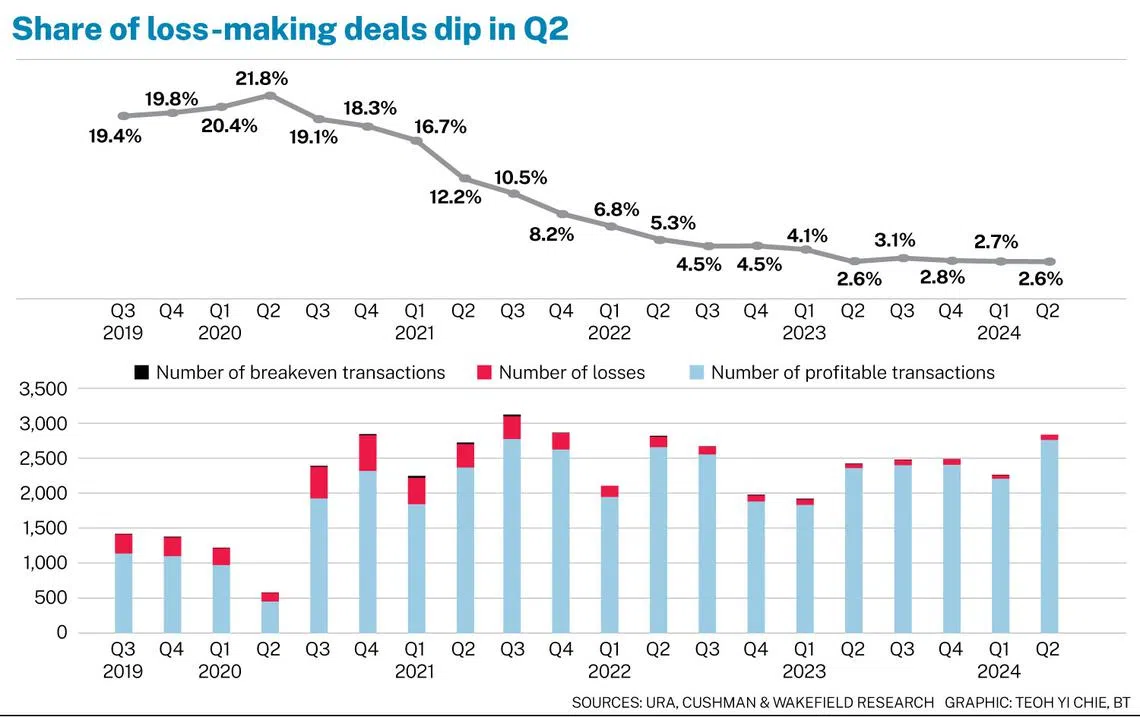
Caveat data of landed and non-landed private homes also showed that prime CCR properties accounted for 63 per cent of loss-making deals in Q2 of this year. The RCR accounted for 20 per cent of such deals, and the OCR, 17 per cent.
This came as the proportion of loss-making resale transactions of private homes in both sectors inched down to 2.6 per cent, from 2.7 per cent in the previous quarter.
Wong expects the overall levels of loss-making deals will likely remain low, as overall private residential prices continue trending higher, although at a more moderate pace.
“With still-low levels of unsold inventory and strong household balance sheets, prices remain supported by firm sellers’ holding power and higher replacement costs,” he said.