

Support parenthood: Push developers to offer more larger new condo homes
Small units sell well but may not meet needs of large families

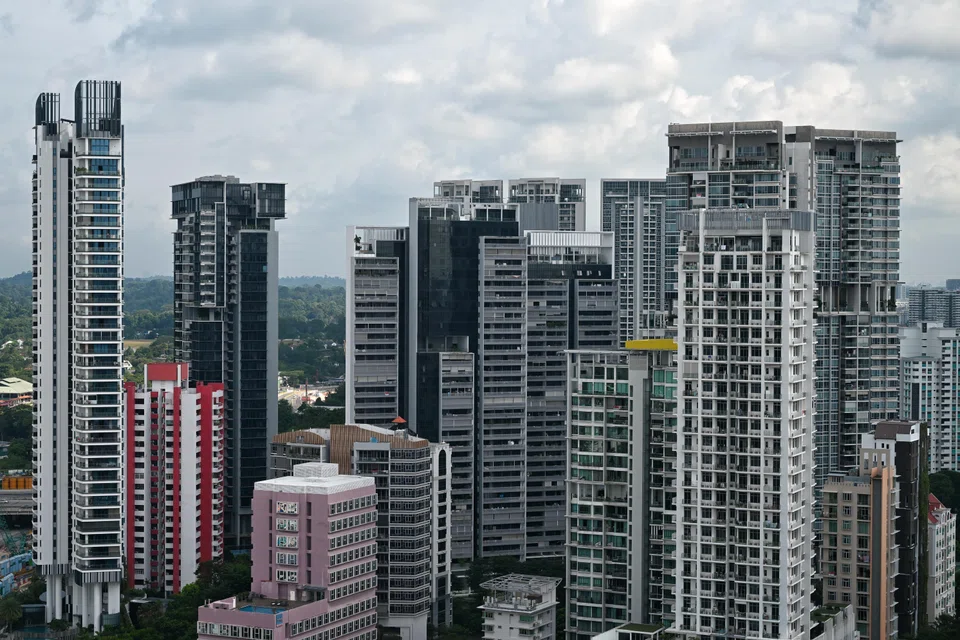
THE first condominium project launched after the Chinese Hungry Ghost Month, 8@BT in Upper Bukit Timah, sold 83 units, or 53 per cent of its 158 units over its launch weekend as at noon on Sep 22, at an average selling price of S$2,719 per square foot (psf).
At the launch of Bukit Sembawang Estates’ project, which has units with one, two, three and four bedrooms as well as penthouses, the sales rates of one-bedroom, two-bedroom and three-bedroom units were 91 per cent, 60 per cent and 49 per cent, respectively. The typical one-bedder is 517 square feet (sq ft), while two-bedders and three-bedders are generally between 642 sq ft and 732 sq ft, and 1,001 sq ft and 1,238 sq ft, respectively.
The popularity of smaller units with buyers is seen in other condo launches too. At the launch of Lentor Mansion, which has two, three, four and five bedroom units, earlier this year, two-bedders were the most popular – all 214 such units were sold.
At Kassia’s launch in July, one-bedroom and two-bedroom units sold better than the three-bedders and four-bedders. Sora sold 23 per cent of its total units as at 6 pm on Jul 7 during its launch weekend, with over 80 per cent of the one-bedroom units, which also include a study, snapped up.
Might developers be tempted to offer proportionately more smaller units in new condo projects? After all, smaller units can punch above their weight in contributing to returns of projects by selling faster and fetching a higher price psf.
However, developers face constraints in the mix of units in condo projects.
According to guidelines by the Urban Redevelopment Authority on non-landed residential developments, there is no cap on the maximum number of homes for developments within the Central Area, which covers the Orchard Road vicinity, areas around the Singapore River, and the Central Business District, among others.
Generally, the maximum number of dwelling units of a condominium development outside the Central Area will be the building’s proposed gross floor area (GFA) divided by 85 square metres (sq m) or about 915 sq ft. In certain locations, the denominator is 100 sq m.
Also, a condo outside the Central Area should have a minimum of 20 per cent of dwelling units with nett internal area (NIA) of at least 100 sq m and a maximum of 20 per cent of homes with NIA of 50 sqm or less. In the Central Area, a condo development should have a minimum of 20 per cent of dwelling units with NIA of at least 70 sq m. A unit’s NIA excludes voids, balconies, air-conditioner ledges and other external areas
Smaller households
Generally, households are getting smaller. The average household size among resident households was 3.11 persons in 2023 versus 3.5 persons in 2010 and 3.7 persons in 2000. The average household size among resident households living in condos and other apartments was 3.17 persons, 3.41 persons, and 3.67 persons in 2023, 2010 and 2000, respectively.
Meanwhile, between 2013 and 2023, the number of one-person and two-person households grew by 79 per cent and 47 per cent, respectively, outpacing the 21 per cent rise in the number of resident households.
Still, in 2023, around 60 per cent of resident households had three persons or more versus 40 per cent with one or two persons.
Should a project such as 8@BT allocate the majority of its homes as one-bedroom and two-bedroom units, which largely cater to one or two-person households?
Perhaps, buyers who opt for smaller new homes, to manage the overall purchase quantum, may face an excess of one-bedroom and two-bedroom condo units in future.
Supporting parenthood
Choosing to marry, have children and if so, how many, are deeply personal choices. Still, population growth is vital to ensure a vibrant economy, which is in turn non-negotiable in nation-building.
Numerous measures in the public housing market support parenthood. Also, various non-housing measures have been and are being rolled out to help raise the birth rate here. For example, mandatory paternity leave will double from two weeks to four weeks from Apr 1, 2025, and parents of newborn babies will soon get 10 weeks of additional shared government-funded leave.
Prime Minister Lawrence Wong, who is also the finance minister, might share some good news in next year’s Budget in February on providing more support for parents thinking about having a third child, as well as those with three or more young children.
Might building more new condo homes that can adequately house families with three or more young children encourage people to have larger families?
Sure, condo living is an aspiration. Also, many families may find private condos unaffordable. And some large families can make relatively compact-size homes work.
Nonetheless, a three-bedroom 1,238 sq ft unit or a four-bedroom 1,356 sq ft unit at 8@BT might not work for a large family. Excluding the balcony and the private lift lobby of said units, one may do better with the internal space offered by a four-room or five-room Housing and Development Board (HDB) flat.
Moving from an HDB flat to a home with the above configurations at 8@BT might hardly be an upgrade for a couple with three children. Such a family could need five bedrooms to comfortably house the couple, the three children individually, and a grandparent or helper.
Maybe guidelines can stipulate that a certain proportion of dwelling units in a condo development should have NIA of over, say, 125 sq m or about 1,346 sq ft. Or possibly give developers who provide a larger share of bigger units in their condo projects additional GFA.
Pushing developers to build more larger-sized units in new condo projects could depress the psf price of larger-sized condo homes. If so, this will be helpful to a large-sized young family hoping to buy a larger condo unit.






