

Retail rents expected to rise at slower rate in 2025 despite boost from new F&B brands
The strong Singapore dollar has led to less tourist spending per capita and could also dent local consumption

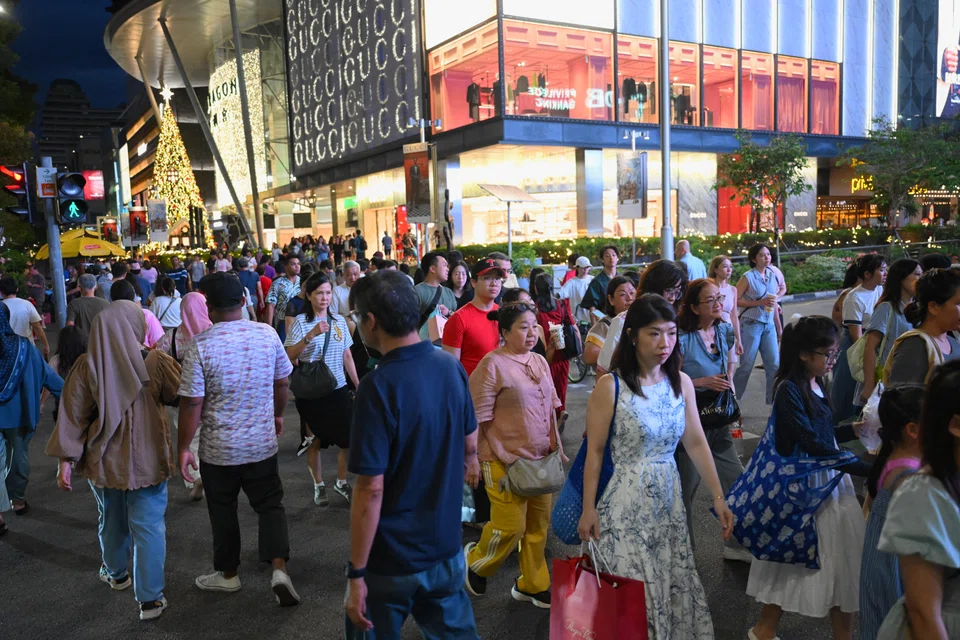
SINGAPORE’S prime retail rents islandwide are expected to have risen between 2 and 4 per cent for the whole of 2024, driven by tourism recovery and expansion of foreign food and beverage (F&B) brands.
But as the city’s retail trade normalises from its pandemic lows, the outlook for 2025 appears uncertain, hinging on tourist and domestic consumption spending.
Between January and October 2024, Singapore saw 13.9 million visitor arrivals, up from 11.3 million in the same period last year.
Visitor arrivals have reached 88 per cent of pre-pandemic levels, Cushman & Wakefield’s research head for Singapore and South-east Asia Wong Xian Yang said.
The recovery in tourism was driven by improved global flight connectivity, high-profile events, and the implementation of the Singapore-China visa-free arrangement which boosted Chinese tourist arrivals, he added.
The strong Singapore dollar, however, has led to less tourist spending per capita and could also dent local consumption.
Ethan Hsu, Knight Frank Singapore’s head of retail, said: “Per capita expenditure fell 11.2 per cent from 2022 to 2023 despite tourism receipts growing from S$14.18 billion in 2022 to S$27.16 billion in 2023, suggesting a similar prevailing trend in 2024.”
Post-pandemic “revenge travel” drove tourist spending following the lifting of border restrictions, and with an uncertain global economic outlook, “most travellers are still cost-conscious and unlikely to spend as much on their travels”, said Tricia Song, CBRE head of research for Singapore and South-east Asia.
Alan Cheong, Savills Singapore’s executive director of research and consultancy, said that at home, “the ability of retailers and F&B operators to tap domestic spending will continue to remain challenging in 2025 as the strong Singapore dollar continues to lure locals to spend overseas during their multiple vacation trips per year”.
Food and beverage scene
As Chinese tourists flocked to Singapore, so have popular F&B chains from the mainland which have made the Republic the first stop before expanding across South-east Asia.
Song noted how Chinese F&B brands Yong Fu and Chagee have opened at prime locations in malls such as Orchard Gateway and Suntec City this year.
She said: “The proliferation of Chinese F&B brands has helped to negate some of the closures in the F&B scene, with some drawing huge crowds during their opening period and adding to the vibrancy of their locations. Expansions of Chinese F&B brands have contributed to occupancies and rents, and even spurred other retailers to consider setting up here.”
While Orchard Road rents benefited from the return of tourists in 2024, suburban prime rents rose at a more moderate pace, though still supported by resilient local catchments, Song said.
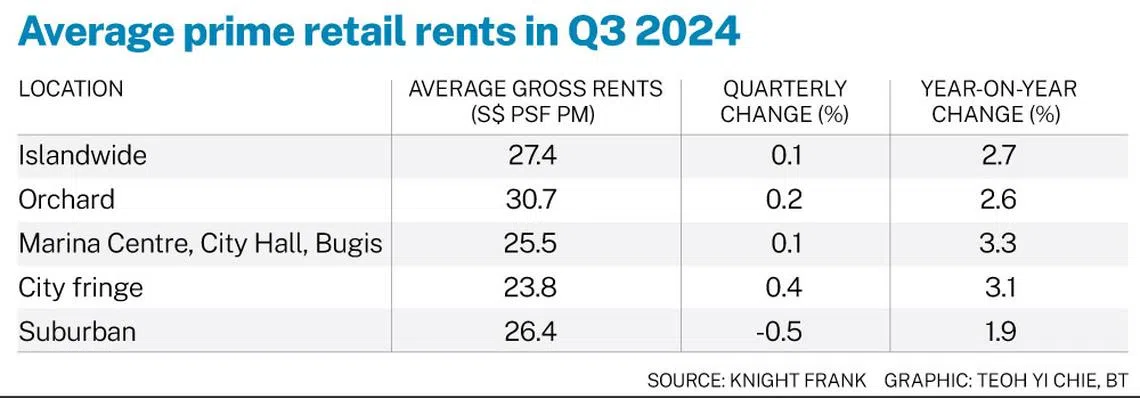
She expects prime rents in Orchard Road to show 4 per cent growth year on year for 2024, and suburban rents to rise at a moderate pace of 1.6 per cent.
For 2025, CBRE expects Orchard Road prime rent rises to ease to 2 per cent, with suburban prime rents rising 1 per cent.
Knight Frank’s Hsu said: “Prime retail rents in Marina Centre, City Hall and Bugis and the city fringe improved more than the other micro-markets mostly due to increased meetings, incentives, conferences and exhibitions activities and tourist inflows.
“These areas were also the most adversely affected by the pandemic with the recovery process only beginning after visitor arrivals and event activities gained momentum from 2023, continuing to normalise towards pre-pandemic levels in 2024.”
Suburban malls in the Outside Central Region (OCR) had the lowest vacancies this year compared with other sub-markets, and this was largely attributed to the completion of Pasir Ris Mall which had good take-up.
Song said: “Demand for spaces in OCR has remained robust due to well-controlled new supply and its resilient and growing residential catchment.”
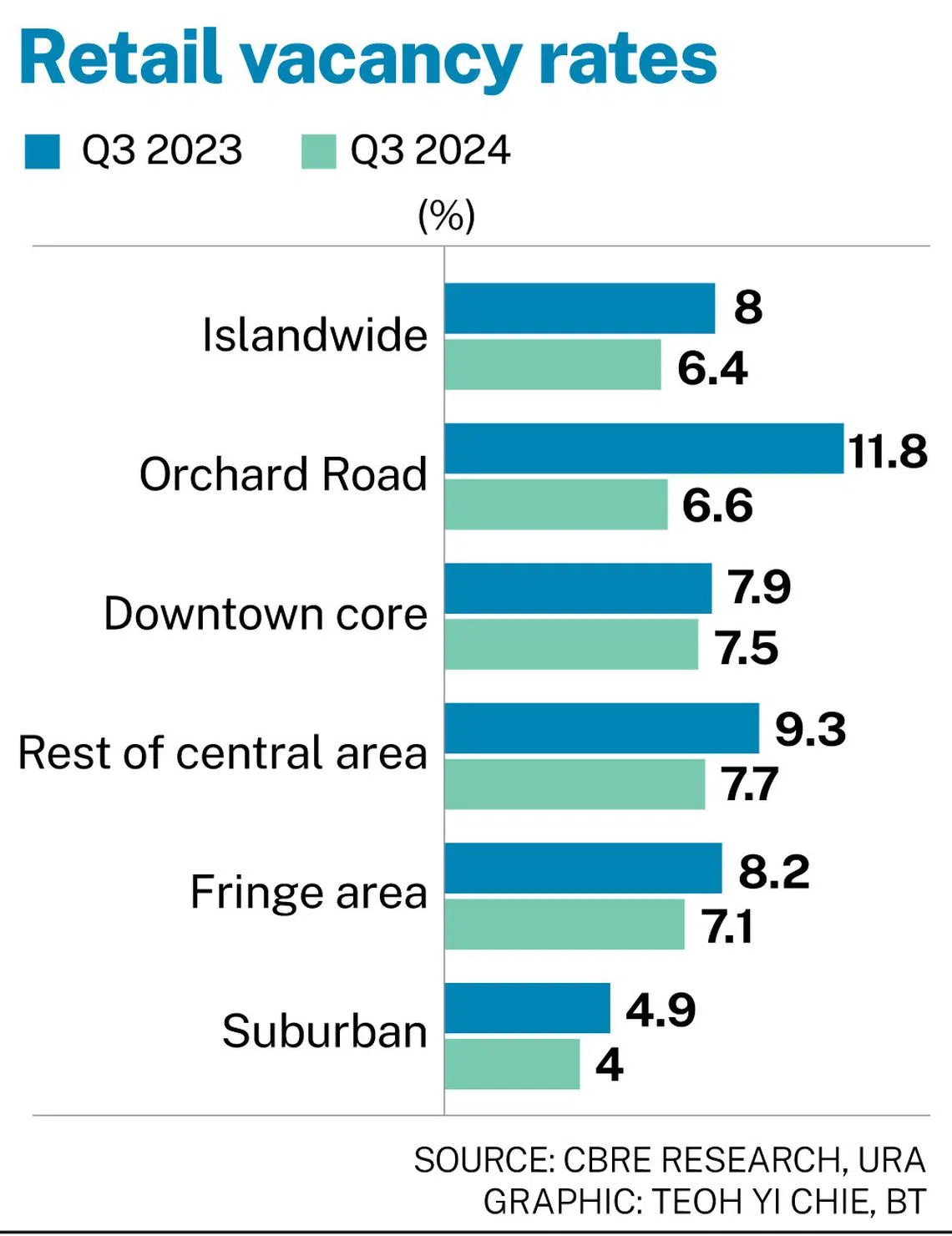
Islandwide, vacancies stood at 6.5 per cent in Q3 according to Savills Research, the lowest in 10 years.
Chua Yang Liang, JLL’s head of research and consultancy for Singapore and South-east Asia, said: “Sustained domestic consumption, supported by the tight labour market and the positive tourism outlook, should spur retail expansion in Singapore, and in turn keep vacancy rates low amid moderated supply conditions while supporting rent growth.”
He added: “For 2025, the outlook remains uncertain. It will largely depend on Federal Reserve rate movements, which could affect the Singapore dollar and consequently influence both tourism and domestic consumption spending.”
Savills’ Cheong said: “Foreign brands, especially those from Asia, are still keen to set up shop in Singapore. (As they have) much deeper pockets than local establishments, the possibility that rents may rise more than expected may not surprise us.
“However, although there is a possibility that rents may rise, vacancies on the whole may increase slightly because the much higher rents foreign brands are willing to pay may motivate landlords to hold on to their asking rents despite seeing more vacant space.”
Cost pressures
The labour crunch for retail and especially for F&B will likely continue to drive costs up, said Knight Frank’s Hsu. At the same time, supply disruption due to climate change and trade policies will also continue to add pressure on retailers.
He said: “As a result of the prevailing challenges in the retail sector, where labour and occupational costs can either be crippling for businesses, or limit expansion, prime retail rents in 2025 are expected to generally plateau or grow modestly as certain types of retail occupiers become increasingly resistant to rent increases.”
Apart from F&B, the main demand drivers for retail space in 2024 were beauty and health, and fashion brands, CBRE’s Song noted. “Conversely, supermarkets are optimising their networks, while books and stationery continue to consolidate or close. While the entertainment sector as a whole is expanding, cinemas are consolidating as consumer preferences have changed,” she added.
While tourism is likely to continue recovering in 2025 with a few new attractions such as Minion Land and Singapore Oceanarium in the pipeline, Song expects growth in tourist arrivals to moderate from this year’s, as the strong Singapore dollar and higher accommodation prices relative to neighbouring countries may deter some visitors.
TRENDING NOW

Two Singapore-listed palm oil firms named in Greenpeace report on Indonesian plantation fires
Singapore Airlines flight returns to San Francisco after ‘unruly’ passenger incident

Singapore looking into which companies responsible for haze-causing fires: PM Wong

Deluge IPO 3.86 times subscribed ahead of SGX debut

