Retrofitting not always best for older buildings to meet new energy standards
Bryan Kow
BY THE end of 2024, energy-intensive buildings will be subject to audits under a new Mandatory Energy Improvement (MEI) regime.
The Building and Construction Authority (BCA) estimates that, at present, 55 per cent of buildings are green by gross floor area (GFA).
However, some older buildings with poor energy performance do not meet the new minimum energy-performance standards, and their owners may face large bills in attempting to do so.
Is retrofitting the answer?
For such buildings, retrofitting may be a cost-effective solution.
Building owners can start with low-hanging fruit, such as installing energy-efficient fixtures. Jane Ong, general manager for contracts and procurement at GuocoLand Singapore, noted that choosing more efficient fixtures for air-conditioning and lighting – typically the biggest consumers of energy in most commercial buildings – can serve as a starting point.
Tridiana Ong, executive director for tenant representation of real estate consultancy Colliers, observed that more landlords have replaced fluorescent lights with light-emitting diode (LED) lights. She said that LED lights not only consume less energy, they also provide better lighting and do not emit heat.
But amid economic uncertainties, cost considerations matter when retrofitting buildings.
The cost of doing it depends on many factors, said Johnson Controls’ South-east Asia general manager Peter Ferguson. Some of these include the building’s age, size, space available and the condition of the facilities.
He added: “The process does not need to be expensive, and can be done in phases if companies want to spread out the costs or seek green financing, which is increasingly available.”
GuocoLand’s Ong noted, however, that extensive retrofitting can be quite costly, especially if asset-enhancement initiatives are conducted while tenants are still in the building.
She said that landlords need to be mindful of the longevity of the products chosen and their maintainability when implementing retrofits.
Ong added that landlords should consider the ease of upgrading or replacing the products being used: “If these things can be considered during the design stage, then it can save quite a lot of rework down the road.”
Managing director of Colliers Singapore Bastiaan van Beijsterveldt said that before landlords begin retrofitting their buildings, they need to understand the value of sustainability.
“They cannot see it only as an increase in capital expenditure; it is something that can lower their operational costs and raise their occupancy rates,” he said.
Wiping the slate clean
A much costlier alternative to retrofitting is for landlords to tear down older buildings and rebuild them in a greener way.
Retrofitting may not always be the more sustainable option, and a building’s carbon emissions need to be considered across its entire life cycle, said real estate company Lendlease.
Sam Okeby, Lendlease’s managing director for development in Asia, said that 25 per cent of a building’s typical carbon cost comes from its construction – known as embodied carbon – and 50 per cent is generated during daily operations. The remaining 25 per cent is usually from renovations and replacing fittings.
Colliers’ van Beijsterveldt noted that the decision to tear down a building should be on a case-by-case basis.
Although the environmental footprint of tearing down a building is larger than upgrading its infrastructure, he cited other considerations, such as the land’s plot ratio and the current life cycle of the building’s infrastructure.
“In the overall assessment of a building, it is important for us to look at the historic value, functionality and how people approach work,” Lendlease’s Okeby added.
Greening from the get-go
Companies are incorporating green building practices into new projects to achieve sustainable outcomes.
For example, Keppel Corporation in May announced the launch of Keppel South Central, a 33-storey commercial tower located near Tanjong Pagar MRT station.
The development is slated for completion by the fourth quarter of 2024. It will include features such as a smart chilled-water pumping system for high-efficiency air-conditioning. Photovoltaic panels that convert thermal energy into electricity will also be installed.
Louis Lim, chief executive of Keppel’s real estate division, said he expects the completed Keppel South Central to have an annual energy use intensity (EUI) of 110 kilowatt-hour (kWh) per square metre.
This translates to annual energy savings of 6.2 million kWh over a code-compliant building – an amount that could power about 1,300 homes in Singapore for a year. Lim also projected annual cost savings of approximately S$1.8 million.
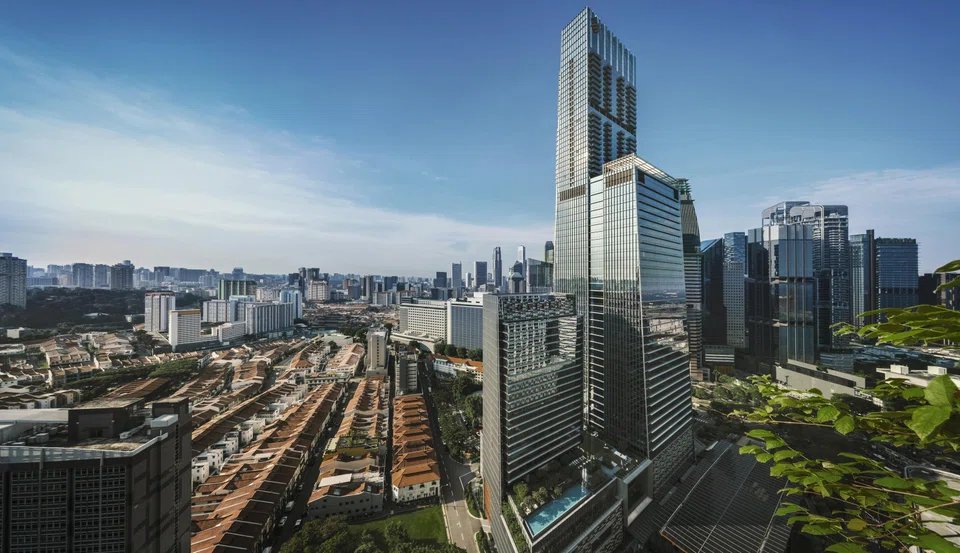
Another example of a building that embraces sustainability is GuocoLand’s mixed-use development Guoco Tower. The development harvests condensate and rain water to lower water consumption. Condensate refers to water vapour that has become liquid, and can be collected from areas such as air-handling units.
Investing in Guoco Tower’s high-performance envelope – the building’s outer shell, which includes glass and shading devices – has reduced its cooling load by 20 per cent, said GuocoLand’s Ong. For instance, it uses high-performance glass which reduces heat gain, while letting in a large amount of natural light.
Going ground-up and top-down
Apart from making physical enhancements, companies can also adopt a collaborative approach to lower the environmental impact of building operations.
Lendlease has worked with industry partners such as Signify and Stora Enso to help drive net-zero carbon in the construction sector.
“For the industry to attain higher sustainability standards, we need to recognise the value of establishing ongoing dialogues, and having the collective will to drive better sustainability outcomes as a whole,” said Okeby.
Signify, a lighting company, is carbon-neutral – referring to a state of net-zero carbon dioxide emissions – in all its operations; Stora Enso provides renewable packaging and wooden construction products.
While more building owners are rolling out green initiatives, Johnson Controls’ Ferguson said the introduction of mandatory audits and measures around energy use would speed up the transition.
Under the MEI, buildings with an EUI above a certain threshold will be audited. After the audit, building owners can be mandated to implement measures to reduce energy consumption and attain an improved level of energy performance over a stipulated period.
Measures can include replacing faulty parts or getting tenants to use energy-saving lighting, said the Ministry of National Development at this year’s Committee of Supply debate.
The new requirements will apply to commercial buildings, healthcare facilities, sports and recreation centres and institutional buildings with a GFA of 5,000 square metres or more.
“Through the MEI regime, building owners can expect to generate cost savings from the reduction in energy use. This will also reduce the overall environmental impact of building operations,” said BCA.