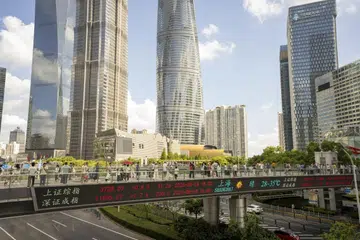
Richard Rogers, shaper of city skylines, dies aged 88
 Add BT as a preferred source
London
BRITISH architect Richard Rogers designed a series of landmark buildings around the world, including London's "Cheesegrater" and the famous multi-coloured, pipe-covered Pompidou arts centre in Paris.
Rogers died Saturday (Dec 18) night aged 88, according to Britain's Press Association, which cited his spokesperson. One of his sons also confirmed his death to the New York Times, but did not give the cause.
An Italian immigrant and winner of the prestigious Pritzker prize in 2007, Rogers was a leading member of the "High Tech" school of architecture that also included Norman Foster and Renzo Piano.
Together they pioneered a hyper-modern style that showcased machines and technology, overturning aesthetic principles to expose the functional elements of buildings. Among his other notable buildings are the 3-towered Lloyd's of London headquarters - which also reflected his inside-out style - and the Millennium Dome, also in London.
In a 2014 BBC television series The Brits Who Built the Modern World, Foster and Rogers were presented as the leaders in a generation of 1930s-born architects who helped shape the modern landscapes of London, Paris, Hong Kong, New York and elsewhere.
Born in Florence in 1933, his father was a doctor, his mother a former pupil of the famed Irish writer James Joyce. The family fled the dictatorship of Mussolini, settling in England in 1938.
London was miserable. The family had been comfortably middle-class in Italy but the relocation had reduced them to a single-room flat that ran on a coin meter for heating. School was no easier either.
Rogers was dyslexic at a time when there was no diagnosis for the condition that "was called stupidity", he told the Guardian newspaper in 2017. He was miserable, he said in his 2017 autobiography A Place for all People, "crying myself to sleep every night - years of unhappiness".
He left school in 1951 with no qualifications and, after his army national service, managed to gain entry into London's Architectural Association School, known for its modernism.
He completed his architecture studies at Yale in the United States in 1962, where he met fellow Brit Norman Foster.
They returned to England in 1964 and with their wives founded the architecture firm "Team 4", which became known for its technology-inspired designs. In 1968, Rogers met the Italian architect Renzo Piano with whom he shared an interest in developing a flexible and anti-monumental architecture.
The same year they met, they won a competition to design a new art gallery in Paris, which became the Pompidou Centre.
Today a landmark of the city, its facade is covered by thick pipes painted in bold colours, with stairways and escalators on the outside of the building. It quickly attracted a range of nicknames, not all of them complimentary: "The Gasworks", "The "Pompidolium", "Notre-Dame of the Pipes".
Rogers completed some 400 commissions in a career punctuated by big-statement, skyline-defining buildings characterised by light structures, prefabricated materials and use of cutting-edge technology. He designed the European Court of Human Rights in Strasbourg, Potsdamer Platz offices in Berlin, an airport terminal in Madrid and Three World Trade Center in New York.
He was also behind London's vast white marquee with yellow crane supports known as the Millennium Dome and then the 02 Centre, a popular venue for events from pop concerts to tennis competitions.
Although buildings were Rogers' world, he insisted it was the space around them that was the key in defining those that worked.
"The two can't be judged apart," he told The Guardian in 2017. "The Twin Towers in New York, for instance. They weren't great buildings, but the space between them was." AFP
Decoding Asia newsletter: your guide to navigating Asia in a new global order. Sign up here to get Decoding Asia newsletter. Delivered to your inbox. Free.
Share with us your feedback on BT's products and services