

Roxy Square’s S$1.25 billion collective sale closes with no bids
Appetite for en bloc sites may not pick up any time soon despite the Federal Reserve’s oversized interest-rate cut, according to market watchers

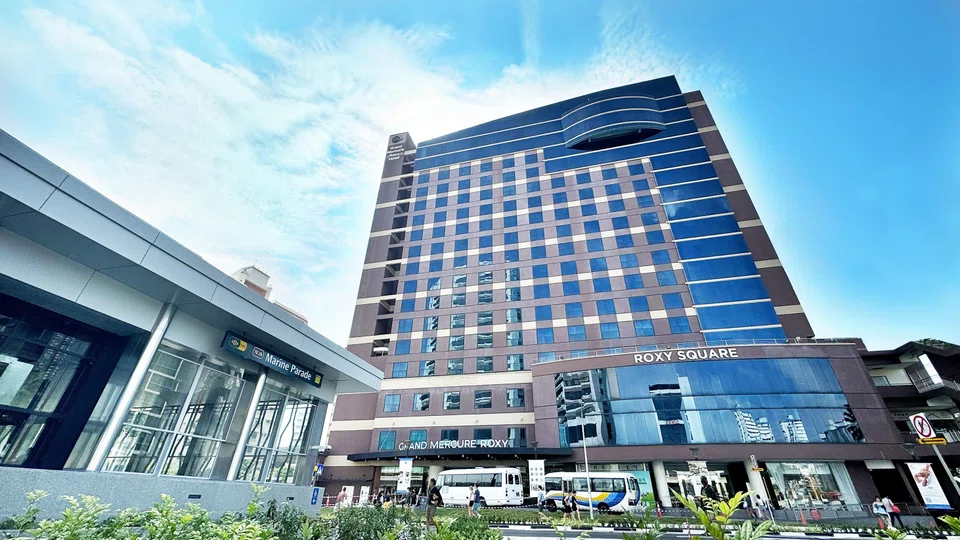
ROXY Square’s collective sale tender closed on Thursday (Sep 26) with no bids, after the freehold mixed-use development in Katong was launched for sale in July at a guide price of S$1.25 billion.
JLL executive director of capital markets Tan Hong Boon told The Business Times: “At the close of tender today, no bids were received. The collective sale is now moving into a 10-week private treaty process, in which negotiations will be taking place during this period with a few interested parties.”
Roxy Square’s guide price reflects a land rate of about S$2,094 per square foot per plot ratio (psf ppr) and is inclusive of land betterment charge at the base gross plot ratio of 3.86.
Factoring in an additional 10 per cent for the bonus gross floor area (GFA) for the residential component if the land betterment charge is paid, the land rate would be around S$2,034 psf ppr, marketing agent JLL said.
Built in three phases from the early 1980s to 2000, Roxy Square comprises Roxy Square Shopping Centre and the 576-room Grand Mercure Singapore Roxy hotel. According to its website, property developer Roxy-Pacific Holdings owns 56 out of 296 shops in Roxy Square Shopping Centre, as well as the hotel.
Currently, Roxy Square has a gross floor area of 668,000 square feet (sq ft). Subject to the Urban Redevelopment Authority’s approval, a developer could potentially configure the allowable GFA into a mixed-use development with over 350 residential units and close to 80,000 sq ft of retail and food and beverage space. The remaining GFA of about 172,000 sq ft could be used for office, hotel or other compatible commercial uses.
In recent months, there have been two other major en bloc attempts in Katong.
The 41-year-old Katong Plaza was put up on the market for collective sale in May at an asking price of S$188 million. This translates to a land rate of S$1,901 psf ppr, including a land betterment charge of about S$6 million. The tender closed on Jul 25, but BT understands owners are in private treaty negotiations.
Last July, the freehold Katong Shopping Centre made a fourth en-bloc attempt at a reserve price of S$638 million, or S$2,277 psf ppr. There were no takers when the mixed use development’s tender closed last August.
The last successful en bloc was the sale of Delfi Orchard to City Developments Ltd (CDL) for S$439 million in May 2024. This was just a shade above the guide price of S$438 million which the site was launched for sale.
CDL, which already owned over 80 per cent of the units in the building, said the acquisition would allow the group to unlock the full potential of the prime, freehold asset amid the rejuvenation of Orchard Road.
Appetite for en bloc sites may not pick up any time soon despite the US Federal Reserve’s oversized interest-rate cut, according to market watchers that BT spoke to.
Wong Xian Yang, head of research for Singapore and South-east Asia at Cushman & Wakefield, said: “With interest rates on a downward trajectory, sentiments are expected to improve, and developers could become more confident to deploy capital...
“That said, interest rates in Singapore have already started to fall since the start of 2024, and current financing costs would have largely considered the fall in US Fed interest rates. The cost of capital remains significantly higher compared to pre-pandemic levels, and developers that are refinancing debt would face higher financing costs.”
Edmund Tie’s CEO, Desmond Sim, said that while a fall in interest rates is favourable for the collective sale market, developers will still have to consider other factors, such as the cost of acquisition and whether their redevelopment plans are feasible.
“The gap between owners’ expectations and the price developers are willing to pay remains challenging,” he said.
Tricia Song, CBRE research head for South-east Asia, said: “We expect investment sentiment should continue to improve as more meaningful (rate) cuts materialise. Meanwhile, we note investors are still cautious and selective, preferring high-performing sectors in proven locations, and are generally more active in smaller commercial assets.”






