
S$3.9 billion Paragon acquisition seals CICT’s dominance in downtown retail, adds medical exposure

Deal, to be partly funded by S$2.5 billion divestment of Asia Square Tower 2 to IOI, seen as ‘tactical swop’; may yield redevelopment potential on freehold Orchard Road parcel

Summarise
Ry-Anne Lim
Published Mon, Apr 20, 2026 · 02:49 PM
    • The Reit is exiting Asia Square Tower 2 at an estimated 3% yield and redeploying proceeds into Paragon at a higher 3.9% net yield, notes Darren Chan of Phillip Securities Research.
    • The Reit is exiting Asia Square Tower 2 at an estimated 3% yield and redeploying proceeds into Paragon at a higher 3.9% net yield, notes Darren Chan of Phillip Securities Research. PHOTO: BT FILE

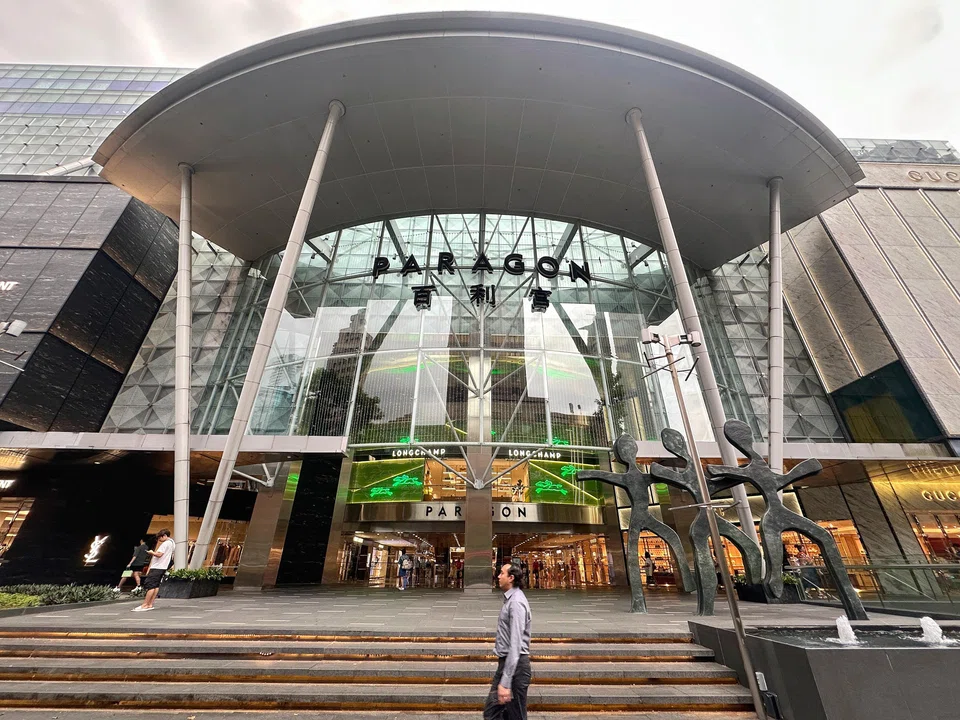
    [SINGAPORE] The S$3.9 billion proposed acquisition of Paragon mall is set to cement CapitaLand Integrated Commercial Trust’s (CICT) dominance along the Orchard Road shopping belt and downtown stretch, and also gives it a foothold in Singapore’s high-end medical sector. 

    Aside from the ownership of a prime retail asset housing luxury brands and premium medical suites, the freehold acquisition also gives CICT a line to tap into potential for future redevelopment, in an area where several redevelopment projects are planned.  

    On Monday (Apr 20), the manager of CICT announced the acquisition of the mall from a consortium of Temasek Holdings subsidiaries, including Cuscaden Peak. 

    The acquisition will be funded by debt, a private placement to raise at least S$600 million and funds from its divestment of Marina Bay area office property Asia Square Tower 2 for S$2.48 billion – at a 9.9 per cent premium over its market valuation of around S$2.25 billion as at end-2025. 

    CICT is selling Asia Square Tower 2 to Malaysia’s IOI Properties Group, in what Tan Choon Siang, CEO of the real estate investment trust (Reit) manager, called a “timely divestment”.

    The sale, “at an exit yield of 3 per cent enabled us to unlock value from a leasehold office asset and redeploy capital into a freehold integrated development”, he said.

    Overall, the transaction is expected to be 2.1 per cent accretive to distribution per unit (DPU), with gearing holding steady at 39.2 per cent. Paragon is being acquired at a net yield of about 3.9 per cent, based on the adjusted net property income for FY2025. 

    Darren Chan, research manager at Phillip Securities Research, viewed the move as “opportunistic capital recycling” rather than a structural pivot from office to retail. The Reit is exiting Asia Square Tower 2 at a 3 per cent yield and redeploying proceeds into Paragon at a higher net yield.

    The move improves income stability by reducing exposure to more cyclical office cash flows, said Chan. “After factoring in the private placement and funding costs, the 2 per cent DPU accretion represents a modest DPU uplift for unitholders.”

    Vijay Natarajan, RHB Singapore vice-president of equity research for real estate and Reits, called it a “tactical swopping” of a leasehold prime office building with a prime Singapore retail asset with freehold interest.

    Buying Paragon reinforces CICT’s stronghold as the largest owner of private retail stock in the city-state, the Reit manager said in a bourse filing. 

    CICT holds several other prime Central Business District (CBD) area retail assets in its portfolio – Ion Orchard, Plaza Singapura, The Atrium@Orchard, Raffles City Singapore and Funan. 

    Explaining the rationale for the Paragon buy, the manager flagged the “potential upside to rerate rents closer to prevailing market levels, supporting positive rental reversions”. Some 30 per cent of leases (by gross income) at Paragon are due to expire next year, 11 per cent in 2028, and another 20 per cent in 2029.

    It also pointed to value-creation opportunities beyond rental reversion, “through proactive tenant remixing to further sharpen the trade mix, optimise space allocation and enhance rental quality”.

    With limited new retail supply of 0.3 million square feet (sq ft) per annum between 2026 and 2028 and no fresh supply along Orchard Road, CICT’s manager cited average prime Orchard Road retail rents rising quarter on quarter, widening the gap against suburban rents. 

    Improving tourism fundamentals would support momentum, it added. 

    Paragon mall’s retail positioning – with more than 190 retail and lifestyle brands – is also complemented by a “well-established” medical cluster of over 80 multidisciplinary tenants. 

    “Medical space in Singapore is structurally scarce,” it noted. According to a report by Savills, there are fewer than 2,000 medical suites in the Republic, of which around half are located within hospitals. “The remaining 50 per cent are available in the market, which highlights the value of such medical spaces.” 

    This scarcity, together with long-term demand drivers such as an ageing population and rising medical tourism, is expected to support sustained demand for quality medical facilities, the manager said.

    The building’s immediate proximity to the Mount Elizabeth medical cluster further positions it to capture medical tourist flows, it added. “These attributes have enabled Paragon to maintain consistently high committed occupancy, at or near 100 per cent, across market cycles.” 

    Potential costs

    CICT is acquiring Paragon at an agreed value of about S$3.9 billion. Two independent valuations done as at Mar 31, 2026, priced the asset at S$3.895 billion (Knight Frank) and S$3.905 billion (Cushman and Wakefield). 

    The most recent valuation prices the property as a freehold asset, markedly higher than an earlier valuation done at end-2024 when Paragon was held as a 99-year-leasehold property by Paragon Reit at S$2.9 billion.

    At the time, Paragon’s owner, Cuscaden Peak, had proposed a privatisation of the Reit, saying the mall needed an overhaul.

    “Paragon’s premier upscale status is being challenged by malls undergoing major upgrades and upcoming redevelopments in the surrounding catchment (for example, Ming Arcade, Tanglin Shopping Centre, Forum The Shopping Mall, voco Orchard Singapore, and HPL House), which are expected to significantly ramp up competition once completed,” Cuscaden Peak said in its Feb 11 statement last year.

    “In addition to these competitive pressures, a persistent slowdown in luxury spending post-pandemic, with international luxury spending at 74 per cent of its 2019 peak, has also weighed on Paragon’s performance,” it added. 

    A major asset enhancement initiative (AEI) was needed for Paragon to “maintain its long-term competitiveness”, but had execution risks that were “more suitably carried out in a private setting”. 

    The AEI for Paragon, which opened in 1986, could cost S$300 million or more, Cuscaden Peak said then. 

    The proposed AEI was expected to take up to four years to complete, with capital expenditure projected to range from S$300 million to S$600 million, or between 10 and 21 per cent of Paragon’s FY2024 appraised value of S$2.9 billion. 

    On Monday, CICT’s manager said it would undertake its own evaluation, including detailed feasibility studies and cost analysis. “Any capital expenditures going forward… may differ from Cuscaden Peak’s preliminary analysis.” 

    The mall’s last major revamp, which cost S$82 million, was in 2009. At the time, 42,000 sq ft of space was added to the mall. The integrated development currently comprises a six-storey retail podium with two basement levels, spanning 45,691 square metres (sq m), and two medical and office towers with 20,726 sq m of net lettable area.

    With several redevelopments on the horizon for Orchard Road properties, the acquisition of the freehold Paragon parcel also opens up the possibility of potential redevelopment in the future.

    Upside and positioning

    With the completion of the Paragon and Asia Square transactions, about 95 per cent of CICT’s portfolio will be anchored in Singapore. Portfolio property value will increase from S$27 billion to S$28.7 billion. 

    The manager added that the portfolio will remain “well-balanced and diversified”, comprising 32 per cent retail, 31 per cent office and 37 per cent integrated developments of retail and office assets. 

    The share of integrated developments will rise significantly from 25 per cent, reflecting a shift towards assets combining “scale, diversification and defensive income characteristics”. 

    The acquisition will cement CICT’s positioning as the largest Asia-Pacific Reit, with assets under management of S$29 billion, said RHB’s Natarajan. “We recommend that investors participate in the placement considering the reasonably attractive entry level of around 1.05 times of book and 5 per cent yields, with upside potential from valuation uplift and Singapore dollar fund flows in the current uncertain environment,” he added. 

    String of divestments

    The impending sale of Paragon is the latest in a series of divestments by Cuscaden Peak, selling assets that it acquired from its takeover of Singapore Press Holdings in 2022. 

    These include three freehold Nassim Road bungalows for S$206.7 million; a student housing portfolio of properties in the UK and Germany worth £1 billion (S$1.7 billion); The Seletar Mall for S$550 million; and The Rail Mall in Upper Bukit Timah Road for S$78.5 million. 

    A third retail property, The Woodleigh Mall, has been on the market for S$800 million since July 2024. The shopping centre is jointly owned by Cuscaden Peak and Japanese developer Kajima Development. 

    In December 2025, the group sold The Clementi Mall for S$809 million to an entity linked to Zhao Zhichao of property firm, The Elegant Group.

    With Paragon to be sold, Cuscaden Peak now holds just two retail assets in its portfolio: a 50 per cent stake in the integrated development comprising The Woodleigh Residences and The Woodleigh Mall, and a 50 per cent stake in Westfield Marion in South Australia.

    Trading in CICT was halted on Monday morning. The counter closed flat at S$2.39 on Friday.



