Simon says: Here’s why I bought a 99-year terrace house

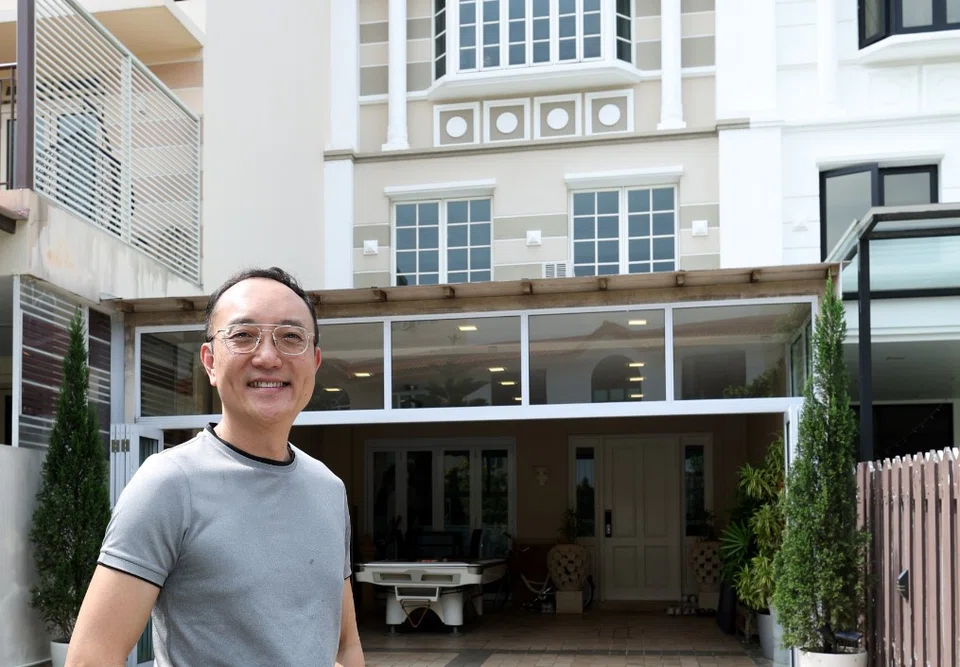
HOME for Simon Ang’s family of seven, spanning three generations, is a three-storey terrace house along Jalan Rindu near Bartley MRT station. He and his wife, Josephine, paid S$1.82 million for the property in August 2017, with close to 75 years left on the property’s 99-year lease.
Rather than spring a fortune for a freehold property, the couple decided they could overcome the “stigma” relating to lease decay for 99-year landed properties.
“We would have loved to have a freehold home, but my immediate concerns were more about affordability and size. We needed a lot of bedrooms,” Ang said. “For the same budget, we could have bought a freehold house with a much smaller land size – maybe 1,600 square feet (sq ft) – but that would not have catered to our space requirements.”
The couple took advantage of the relatively large site area of 2,174 sq ft of the intermediate terrace house to boost the property’s count of five bedrooms by creating a granny room as well as a maid’s room for the family’s two helpers on the ground floor. The couple spent nearly S$100,000 renovating the property, including replacing all the toilets.
Ang estimates that a comparable property across the road with a similar site area, but freehold tenure, would have cost about S$2.6 million at the time.
“My most important consideration was that I did not want to overstretch myself by taking a very big mortgage and subsequently having difficulty paying it off – and we are now seeing the dangers of this amid rising interest rates.”
Today, the Jalan Rindu house, which is held under the wife’s name, is left with a balance lease of 69.5 years.
The couple is open to selling the property if they can get a good price, but Ang is cognisant of the challenges facing potential buyers: “The loan quantum that a bank would grant for this purchase may not be that big due to the shorter balance lease; so a buyer would have to fork out more cash.”
If unable to sell the house, Ang said the couple are “happy” to keep it. “Our three children are in their 20s. In less than 10 years, hopefully, they would be out on their own, getting their own flats. And I won’t really need such a big house after that. My wife and I could move into an apartment, and then we would probably rent out this entire three-storey house as a co-living offering.
“What is beautiful about co-living, as a landlord, is that you enjoy a higher rate of return than renting out the whole house to one family. I more or less know what the market is for co-living. This location has its plus points.” The Jalan Rindu house is about 250 metres from Bartley station, which in turn is one stop from Serangoon station, where Nex mall is.
Ang owns a one-bedroom freehold apartment in Toa Payoh that is currently tenanted out. “This could be our retirement home.”
“Even though a 99-year landed residential property may not be so saleable as the lease runs down, one can spruce it up and rent it out to generate passive income. In a way, this helps to recoup what you have paid for the house,” said Ang, 56, who is a forex trader. The couple also own a wedding events business.
Ang also points to the potential for a collective sale for the stretch of 99-year leasehold terrace houses in Jalan Rindu. The site is zoned residential with a 1.4 plot ratio (ratio of gross floor area to land area) under the Urban Redevelopment Authority’s current Master Plan.
“Paya Lebar Airbase is nearby. When it is moved out in the 2030s, I believe the plot ratio in the surrounding areas including Jalan Rindu may be adjusted upwards accordingly.”
Of course, consent of all owners would be required for an en bloc sale involving a row of landed properties. And there is no certainty the state would agree to top up the combined site’s land lease to 99 years for a developer keen on redeveloping the site.
“It’s not a guarantee that an en bloc sale can be done here, but this is a possibility which all the owners can come together to explore.”
TRENDING NOW
Why US$100 oil, 5% US yields affect Singdollar, ringgit differently vs other Asean currencies
Singapore fintechs struggle to find finance and tech talent
Despite the de-dollarisation debate, demand for dollar liquidity in Asia is growing
Why Tan Aik Keong of digital solutions specialist Agmo wants to make himself less indispensable