Singapore industrial rents up 0.4% in Q1 amid uncertainty arising from Middle East conflict: JTC
The occupancy rate for all industrial spaces is up 0.2 percentage point from Q4 2025

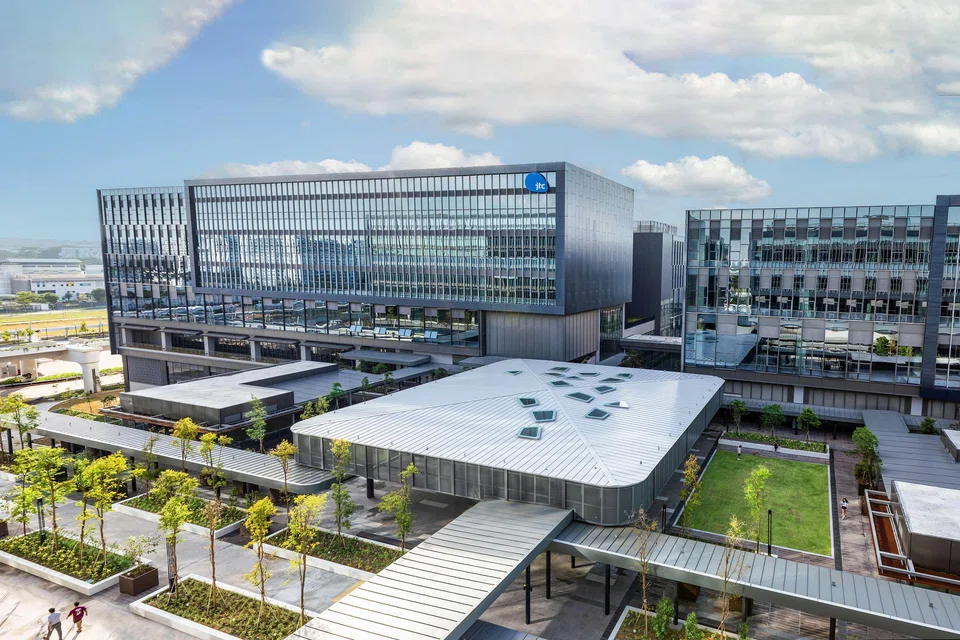
[SINGAPORE] Rental rates and prices of industrial spaces in Singapore rose in the first quarter of 2026, with higher rents of 2.3 per cent year on year, and a moderate 0.4 per cent quarter on quarter.
Data released by JTC on Thursday (Apr 23) also showed that prices for industrial spaces in the city-state increased 4.6 per cent year on year, and 1.2 per cent quarter on quarter.
This is marginally less than the 1.4 per cent quarter-on-quarter expansion in the price index in Q4 2025.
Such performance comes amid an uncertain outlook for the industrial property market due to geopolitical instability from the war in Iran, especially as Singapore is a regional logistics hub, said Nicholas Mak, chief research officer at Mogul.sg.
“The overall industrial property rental index’s 0.4 per cent (quarter-on-quarter rise in Q1) is marginally slower than the 0.5 per cent rise in the preceding Q4 2025,” he said.
In particular, Mak flagged that warehouse rentals rose 0.2 per cent quarter on quarter in Q1, slower than the 1.1 per cent expansion in the preceding Q4 2025.
He added that disruptions to global supply chains due to the Iran war have invariably contributed to “slower growth” in warehouse rentals in Q1 – often considered a barometer for the logistics and industrial space.
Occupancy rates
For Q1, the occupancy rate for all industrial spaces rose 0.2 percentage point to 88.9 per cent from a quarter earlier.
“The increase was led by the multiple-user factory and single-user factory segments, whose occupancy rose by 0.3 percentage point and 0.4 percentage point, respectively, as companies moved into developments that were completed last year,” said JTC.

Business parks and warehouse segments, however, saw occupancy levels ease by 0.4 percentage point each quarter on quarter, to 76.7 per cent and 89.4 per cent, respectively.
This suggests some “pockets of softness” in an otherwise stable market, said Wong Shanting, director and head of research at Newmark Singapore.
Additionally, the occupancy rate for all industrial spaces fell 0.1 percentage point year on year in Q1.
Transaction sale volumes
The transaction volume of industrial properties – estimated based on caveats lodged for industrial properties – fell 3 per cent from the year before.
Rental transaction volume also declined 1.5 per cent from a year earlier.
In the quarter, JTC allocated a total of 101,000 square metres (sq m) of ready-built facilities space to industrialists. This included 57,900 sq m of high-rise space, and 39,000 sq m of land-based factory space.
The total ready-built facilities returns in the quarter was 62,500 sq m. Of these returns, 29,700 sq m was high-rise space and 13,200 sq m was land-based factory space.
Around 63 per cent of the total returns were due to natural expiries or companies consolidating their operations.
About 61 per cent of the high-rise space that was allocated was in JTC’s newer developments, noted the agency. This includes JTC Defu Industrial City, TimMac @ Kranji and Kranji Green.
Outlook on upcoming supply
Based on planning approvals as at end-March, around 700,000 sq m of new industrial space is expected to be completed in the next three quarters of 2026.
About 61 per cent of the supply is single-user factory space, typically developed by industrialists for their own use.
Data from JTC showed that warehouses entail another 30 per cent of the supply. Multiple-user factory space and business park space make up 6 per cent and 3 per cent, respectively.
This comes on the back of average annual supply and demand of industrial space being about 700,000 sq m and 600,000 sq m, respectively, over the past three years.
Impact of Middle East conflict
June Chua, senior managing director and head of Singapore leasing at Newmark, said the electronics sector was a “bright spot”, driving and holding up demand for industrial space in Q1. “While growth has moderated from the highs of 2025, electronics activity remains underpinned by sustained AI-related capital expenditure.”
Tridiana Ong, head of occupier strategy and solutions at Knight Frank Singapore, said this comes amid continued tensions in the Middle East and volatile energy prices, with occupiers at this stage likely to focus on business continuity in the leasing market.
Newmark’s Chua said that electronics demand “continues to support the broader Singapore economy and, by extension, leasing demand for higher-specification industrial facilities and logistics spaces that can better support automation and improve operational efficiency”.
Despite the Republic’s generally positive performance in the industrial space in Q1, analysts believe that the Middle East war is expected to weigh on demand in the coming months amid mounting cost pressures.
Chua said the war “has pushed oil prices higher, and may lead to rising interest rates in the coming months”.
“Some companies (may) have hedged their energy contracts, which could help defray costs to a certain extent, (but) industrialists are expected to face higher operating costs (soon) and may turn cautious in their relocation and expansion plans.”
JTC said that it is monitoring market developments in the light of the conflict.
Decoding Asia newsletter: your guide to navigating Asia in a new global order. Sign up here to get Decoding Asia newsletter. Delivered to your inbox. Free.
Copyright SPH Media. All rights reserved.