

Singapore office landlords poised to turn more aggressive in rent expectations
Most property consultants project acceleration in CBD Grade A office rent growth in 2026, on the back of tighter supply

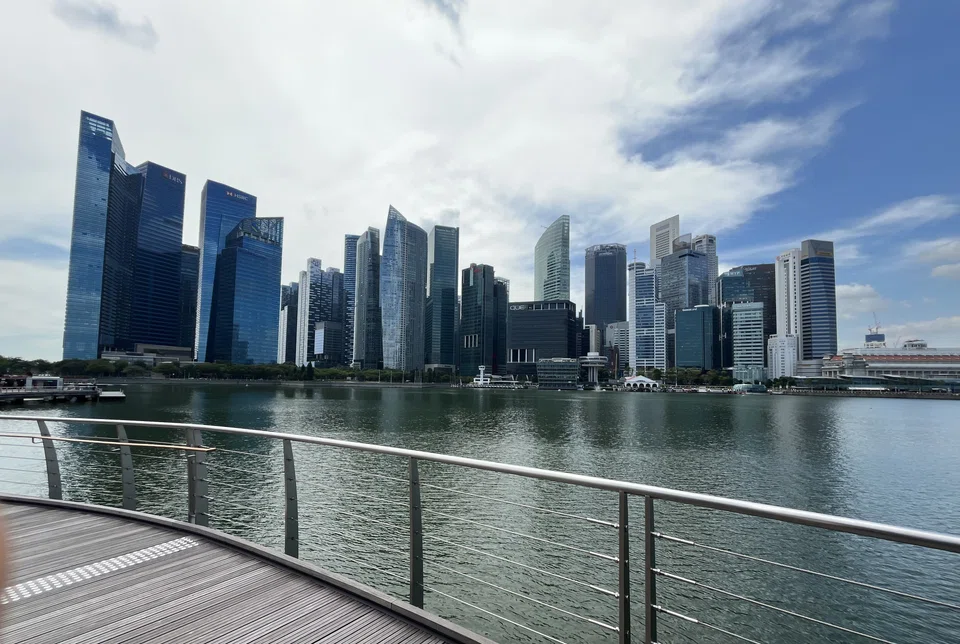
[SINGAPORE] The balance of power is shifting towards landlords in Singapore’s prime office market, with most property consultants forecasting an acceleration in Central Business District (CBD) Grade A office rent growth in 2026 due to tighter supply conditions.
Demand is expected to remain stable.
CBRE expects the gross effective average office rental value for its Core CBD (Grade A) basket to increase by 4.9 per cent to S$12.90 per square foot (psf) per month in the fourth quarter of 2026, from S$12.30 psf in Q4 2025.
This will outpace full-year rental gains of 2.9 per cent in 2025 and 0.4 per cent in 2024.
JLL is predicting a 4 to 5 per cent rental gain for its Grade A CBD office basket in 2026, higher than the increases of about 3.8 per cent in 2025 and 2.5 per cent in 2024.
Cushman & Wakefield (C&W) predicts rental growth of 4 to 7 per cent for 2026, following increases of 2.2 per cent in 2025 and 1.7 per cent in 2024.
Andrew Tangye, head of office leasing and advisory for JLL Singapore, said: “Singapore’s office market will pivot towards landlord advantage throughout 2026 as declining vacancy rates create conditions for continued rental growth.”
Supply limitations will set the scene for “a competitive landscape where property owners can pursue more aggressive pricing strategies across premium office assets”, he added.
“If rents are held up almost purely due to supply constraints, there will be a price to pay in the longer term.”
Alan Cheong, executive director of research and consultancy, Savills Singapore
David McKellar, CBRE’s head of office services for Singapore, who also expects a “landlord-favourable environment”, said: “Large contiguous floors in existing buildings remain extremely scarce, and new supply is limited, with Shaw Tower in Beach Road being the only major completion in 2026.
“This tight availability is expected to keep vacancy rates low and sustain upward pressure on rents.”
CBRE predicts the vacancy rate for its Core CBD (Grade A) basket to slip from about 4.5 per cent at the end of 2025 to closer to 4 per cent at end-2026.
The downside of rising rents and limited supply is that they “may challenge occupiers’ budgets, especially for Grade A space”, said McKellar.
Already, occupiers have faced mounting cost pressures in 2025 as rents continued to rise.
“Some tenants renewed leases in 2025 at rents that were 15 to 25 per cent above rates in their preceding leases secured during the pandemic years in 2020 and 2021,” said McKellar.
“Bridging the landlord-tenant gap is particularly challenging for tenants whose leases were signed three to five years ago, during the Covid period, as they now encounter significant rent increases,” he added.
When tenants do their cost-benefit analysis
Weighing in on the discussion, Alan Cheong, Savills Singapore’s executive director of research and consultancy, said that while a tight supply market “helps maintain revenue stability and growth for office landlords, it ignores the forces that either glue or rip apart the business models of occupiers”.
“High operating costs are acceptable if business prospects are good. However, if rents are held up almost purely due to supply constraints, there will be a price to pay in the longer term,” he added.
“If there is great uncertainty on the downside, it raises the likelihood that companies will take action to reduce uncertainty by lowering overheads in Singapore. There are many ways they can do this; one of them would be to reduce their workforce and office space here.”
The lack of CBD Grade A office supply, Cheong said, is expected to “further speed up tenants’ action plans as they seek to minimise their cost-to-benefit ratio in Singapore”.
Savills has one of the less bullish forecasts for CBD Grade A rent growth in 2026, at 2 per cent, matching the increase for 2025. In 2024, rents rose 1.1 per cent.
Colliers forecasts a 2 to 4 per cent rise in 2026 for the average rental value of its CBD Grade A and Premium Singapore office basket, following increases of 1.2 per cent in 2025 and 1.7 per cent in 2024.

Knight Frank Singapore predicts a 3 to 5 per cent increase in the average rental value for its Prime Office Rent basket in 2026, following rises of 1.1 per cent in 2025 and 2.1 per cent in 2024.
The CBD Grade A supply shortage may be felt more acutely in 2026 if the re-centralisation trend intensifies.
CBRE’s McKellar noted that despite the focus on decentralisation, many corporations and sectors such as private wealth management still demand high-specification offices in central locations.
“We also envisage AI (artificial intelligence) companies needing office space, driven by heavy venture capital investment and corporate adoption,” he said.
“AI development thrives on teamwork and cross-functional collaboration, which is harder to replicate remotely. Many AI firms prefer central locations with premium amenities to position themselves as attractive employers and innovation leaders.”
For 2026, JLL forecasts new office completion of about 800,000 sq ft islandwide, including about 700,000 sq ft of CBD Grade A space.
This is lower than the 2025 islandwide office completion of 1.1 million sq ft, including about 600,000 sq ft of CBD Grade A offices. The 2025 numbers in turn are lower than the supply completed in 2024, with 2 million sq ft islandwide, including 1.3 million sq ft in the CBD Grade A category.
JLL data shows that besides Shaw Tower, other completions in 2026 are expected to come from the Solitaire on Cecil project and refurbishments of 39 Robinson Road and 137 Cecil Street.
For 2025, major completions included Keppel South Central and Paya Lebar Green. In 2024, IOI Central Boulevard Towers and Labrador Tower were completed.
JLL forecasts net demand – defined as change in occupied space – for its basket of CBD Grade A offices for 2026 at about 500,000 sq ft, similar to the figure for 2025. The number for 2024 was about 700,000 sq ft.

Major leasing deals in 2025
Shaw Tower has steadily gained leasing momentum. Tenants secured include payments technology firm Adyen, which is said to have inked a lease for two floors totalling 38,000 sq ft. This will be an expansion from its footprint in Funan, where the group is expected to exit.
Flexible workspace operator The Great Room has also leased two levels amounting to 36,000 sq ft in Shaw Tower. JLL is understood to have brokered the Adyen and The Great Room deals, though it declined to comment.
Pharmaceutical company Sanofi-Aventis Singapore is expected to head to Shaw Tower from the neighbouring South Beach Tower.
Shadow office stock shrinks
CBRE figures show that the volume of total shadow office space islandwide has eased from about 700,000 sq ft at the end of Q1 2023 to an estimated 200,000 sq ft at end-Q4 2025.
Shadow space refers to excess space on an existing lease obligation that a tenant would like to give up by finding a replacement tenant for the landlord.
C&W figures show CBD Grade A office shadow space contracted from a peak of about 300,000 sq ft in Q2 2023 to about 100,000 sq ft in Q3 2025.
“The drop reflects more disciplined space planning by occupiers, who are consolidating footprints for efficiency and cost control, and quicker backfilling by landlords amid steady demand for quality space and a limited supply pipeline,” said Deyang Leong, co-head of commercial leasing for Singapore at C&W.
“CBD Grade A office shadow space is now slightly below pre-pandemic norms and, barring any unforeseen economic deterioration, we anticipate shadow space levels to remain low in 2026.”
Occupier, landlord strategies to persist
Tridiana Ong, head of occupier strategy and solutions at Knight Frank Singapore, noted that most occupiers remain conservative amid ongoing global economic uncertainty.
“Many tenants continue to prioritise lease renewal, over relocation, to maintain the status quo and avoid incurring new capital expenditure. Even among larger occupiers that had previously explored relocation, some are now opting to stay put given the limited range of viable alternatives,” she said.
“Proactive landlords offering fitted-out spaces are seeing healthy interest, as tenants look to reduce upfront investments in the face of elevated construction and fit-out costs.”
Ashley Swan, executive director of commercial and industrial at Savills Singapore, said: “Office demand is not coming from a particular sector or industry; it is from a more widespread base across tech, finance, pharma and government agencies.
“As with the last few years, we expect this trend of distributed demand to continue for the foreseeable future.”
Swan also pointed to another enduring trend. “We expect that flight to quality will also continue to drive the market, with possible redevelopment of older buildings pushing tenants out into the market looking for alternative premises.”
Return to the CBD
Chris Archibold, managing director of office services for South-east Asia at Colliers, expects some occupiers to move from fringe areas back towards the CBD, to provide employees with convenience and amenities to maintain high office attendance.
He also highlighted that some tenants are realising that they had cut their office footprint too much after the Covid-19 pandemic. “Given return-to-office mandates, their current offices are getting crowded and these occupiers are now reviewing their space needs.”
Overall, Archibold envisages that “tenants will start reviewing their portfolio early to secure space amid increasingly limited options, and to avoid getting caught in the rental upcycle”.
TRENDING NOW

Britain’s mansion tax shows the difficulty of targeting wealth

Once staunchly pro-China, Malaysian Chinese businesses are now distancing themselves from Beijing

The only common thing in S-E Asia is that we all eat rice: Cisco’s Asean president
Singapore data centre operator DayOne opts for US IPO at likely US$20 billion valuation

